Colin Sheridan: Ryder Cup prices, and Adare Manor, feel surreal
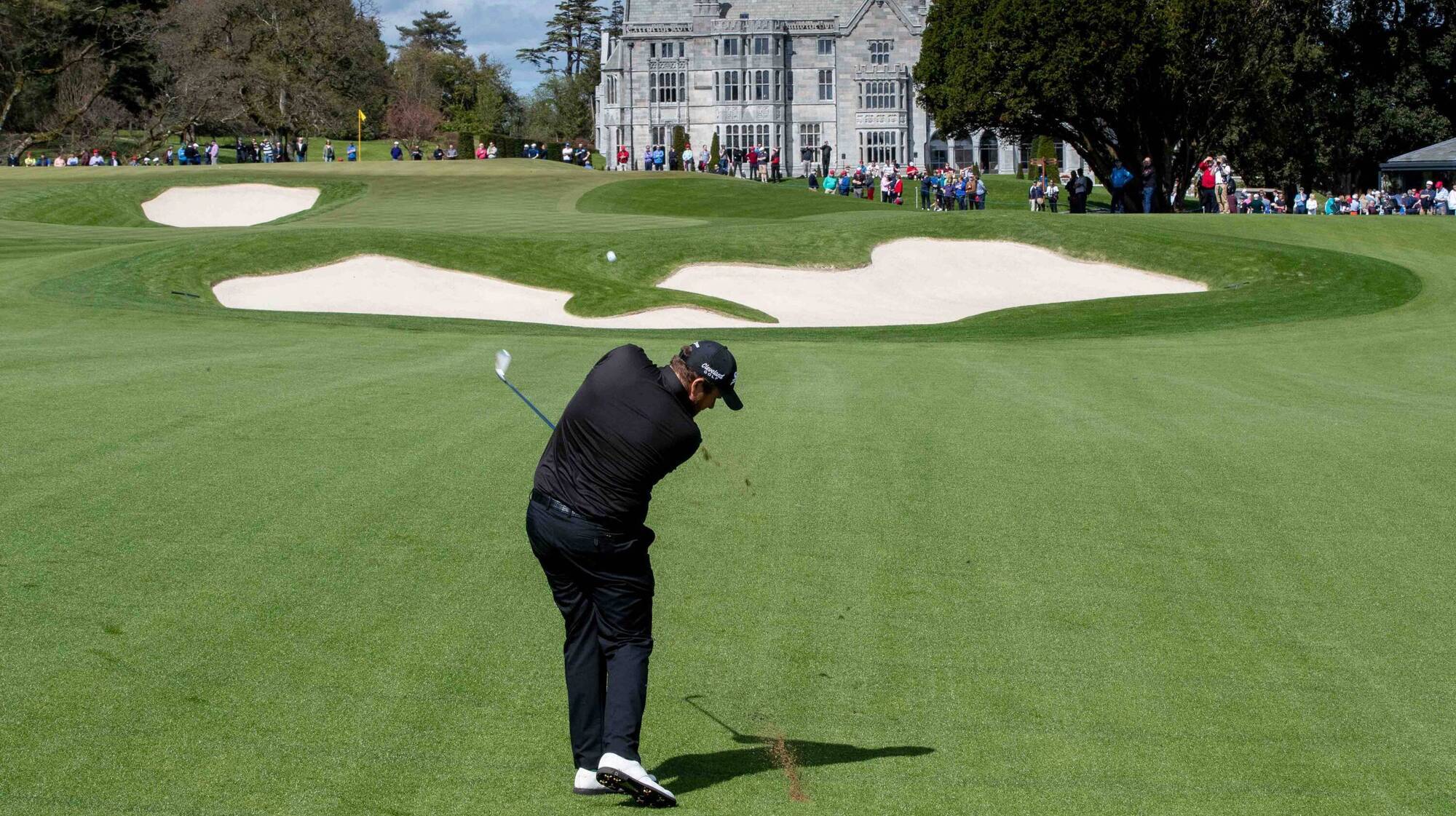
Adare Manor is a spectacular golf course. Immaculate in a way that almost doesn’t seem real. And yet, walking it, I couldn’t shake the feeling that it wasn’t I that didn't quite belong, but the course itself. Pic: ©INPHO/Morgan Treacy
I thought my kids would be a little bit older before I had to explain late-stage capitalism to them, but last Friday’s sale of Ryder Cup tickets brought things to an unexpected head. They are too young to understand about extreme wealth inequality, and the encroachment of market logic into all aspects of their lives, but when they’re sitting at home next September while Brooks Koepka’s wife is taking selfies with Jon Rahm’s wife just an hour down the road, I guess I want them to understand why they’re not photobombing the occasion.
Friday was the day tickets for the 2027 Ryder Cup at Adare Manor went on sale - initially to Irish residents, a gesture that felt both generous and faintly condescending. First refusal, if you like, provided you had €499 to spare for a single day’s attendance. The website crashed under the demand. Which tells you everything and nothing at once.
I grew up in the west of Ireland, where golf didn’t carry the same baggage it seems to elsewhere. It wasn’t a marker of class. It wasn’t aspirational in that glossy, exclusionary way. It was a thing you did, the same way you kicked a football or whacked a tennis ball against a wall. The courses weren’t manicured, but were shaped by wind and weather and time. My father brought us everywhere. The West of Ireland at Rosses Point every Easter. The Irish PGA. The Irish Open at Portmarnock. There, you got close enough to the players to smell their cologne. You were part of it. Close enough to stand next to Seve and feel his magic.
Read More
Nothing felt curated, nor enhanced.
And yes, of course, even that had a cost, a cost my father wore. We weren’t unaware of that, but we were never made to feel it as a burden. There was privilege in it, certainly, but it felt accessible. Attainable. Normal, even.
That’s the part that feels furthest away now. Because €499 for a day at golf - before you’ve eaten, travelled, or even considered bringing a child - belongs to a different universe. And yet, I find it difficult to sit here and simply dismiss it. I could say it’s absurd. I could say it’s emblematic of everything that has gone wrong with elite sport. I could roll out the line about fools and their money.
But it wouldn’t quite ring true.
The truth is, I’d go. I know I would. Not only would I cross the road for it, I’d drive across the country. Probably happily. That’s the uncomfortable part. I can recognise the excess, the spectacle, the creeping sense that this is less a sporting event and more a kind of travelling circus for the wealthy - and still want to be there when the first tee shot is struck.
Because the Ryder Cup, for all its contradictions, still taps into something fleetingly genuine. It’s one of the few events in golf where the atmosphere breaks free from its usual constraints and that matters to someone like me, who loves the game not just as a participant but as a witness.
So I’m left in this awkward middle ground. Not outraged enough to disengage. Not comfortable enough to fully buy in. It becomes more complicated when you add family into the equation. I have children now. I think about bringing them the way my father brought us. About passing something on. But the arithmetic is unforgiving. Two tickets? Three? Which child goes if it’s only one? What message does that send, and how many years of therapy does it cost to undo?
And beyond the personal, there’s the broader question that sits uneasily in the background. The scale of public investment. Tens of millions in direct support, more again in infrastructure and promotion. All to facilitate an event that, for most people, remains financially out of reach. It’s difficult to square that with the realities of modern Ireland, where the idea of ownership - of a home, of stability - feels increasingly distant for many.
How do you explain that to a child? That this is what we prioritise. That this is where the money goes.
Maybe you don’t. Maybe you just go, and enjoy it for what it is, and leave the contradictions at the gate. But that feels like a cop-out too.
I played Adare Manor not so long ago. It is, undeniably, a spectacular golf course. Immaculate in a way that almost doesn’t seem real. And yet, walking it, I couldn’t shake the feeling that it wasn’t I that didn't quite belong, but the course itself. Not in the way the courses I grew up with belonged. It felt imported. Designed for a different audience, a different expectation.
There’s an American polish to it that reeks. It caters to a kind of golfer who can arrive by helicopter, play, and leave without ever really touching the place around it. That’s not a criticism so much as an observation. But it does make you wonder what exactly is being showcased when the world arrives in 2027. Is it Irish golf? Or something else wearing its clothes?
I don’t have a neat conclusion. That’s probably the point. I’m conflicted, and I suspect I’m not alone in that. Drawn to the spectacle, uneasy about what it represents. Wanting to be there, while questioning the cost - financial, cultural, and otherwise - of doing so.
Maybe the answer lies somewhere simpler. Somewhere closer to where it all started. This year’s Walker Cup in Lahinch might offer a clue. A different scale. A different feel. Still elite, still meaningful, but perhaps a little more grounded. A little closer to the version of golf many of us recognise.
Or maybe I’ll end up in Adare in 2027 after all, €499 lighter, telling myself it’s worth it. I just doubt it will be.
Imagine hopping on your treadmill, turning it up to about 2:53 per kilometre pace-that’s roughly 20.8 km/h-and then running 42.2 kilometres on it. That’s what Sabastian Sawe effectively did en route to his stunning victory at the London Marathon. To put that into perspective, most recreational runners ticking off a steady morning 5K might average somewhere between 4:30 and 6:00 per kilometre.
Sawe was running nearly two minutes per kilometre faster than that - and not for 5K, but for the full marathon distance. It’s the kind of sustained speed that doesn’t just win races; it redefines what seems physically possible. Even among elite runners, those numbers are startling. A 2:53/km pace means covering 10 kilometres in just under 29 minutes, then doing it again. And again. By the time most club runners are beginning to fade past the halfway mark, Sawe is still cruising at a tempo that would feel like an all-out sprint to others.
There was Irish interest too, with Peter Lynch delivering a breakthrough performance. His ninth-place finish in 2:06:08 not only marked a personal milestone but also a new Irish record. Even that time-extraordinary in its own right - translates to around 2:59 per kilometre, underlining just how fine the margins are at the very top.
Of course, in any discussion of remarkable Kenyan performances, questions inevitably arise. The country’s recent doping history casts a long shadow. But in Sawe’s case, there are reassurances. Before the Berlin Marathon, his sponsor Adidas paid the Athletics Integrity Unit £50,000 to test him extensively. He underwent 25 tests in a matter of weeks, with advanced analysis - including isotope ratio mass spectrometry - designed to detect even trace levels of banned substances. A similar, if slightly scaled-back, protocol was followed ahead of London. Ultimately, though, what remains most striking is the run itself. Not the politics, not the suspicion - but the sheer, relentless speed.
Even if Arsenal somehow still claw their way to a title, their choice of leading man call looks increasingly indefensible. The decision to lean on Viktor Gyökeres over a proven, Premier League-ready No.9 has left them blunt when it matters most. Against Newcastle, he made them worse after coming on, failing to replicate the technical impact of those he replaced. This is the issue: potential versus proof. Gyökeres arrived prolific, yes - but not proven at this level. Titles are decided in fine margins, in moments a real striker lives for. Arsenal, for all their structure and style, still lack that certainty. And that feels less like bad luck - and more like a choice.
Ireland’s women’s rugby team have clearly turned a corner - but now comes the harder part: turning promise into results. Under Scott Bemand, performances have improved markedly, with a dominant win over Italy and long spells of control against France showing a side growing in confidence and cohesion. Yet the 26–7 defeat to les Bleus on Saturday shows the gap that still exists. Ireland created chances but failed to convert, managing just one try despite sustained pressure. Bemand insists belief “hasn’t been dented,” but belief alone won’t shift standings. Progress is evident - but until performances consistently deliver results, Ireland remain a team on the brink rather than one that has truly arrived.