Maurice Brosnan: The contradictions and the conviction of Rory McIlroy
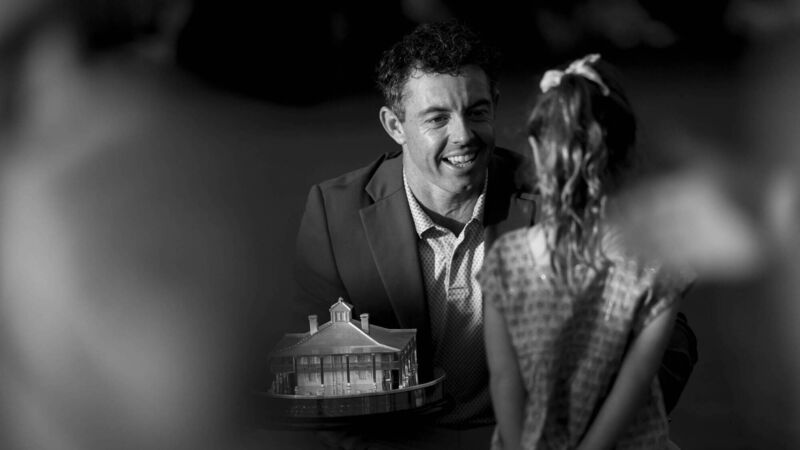
POPPY PLAY: Rory McIlroy with his daughter Poppy after the Green Jacket Ceremony at the Masters at Augusta National. Pic: Jared C. Tilton/Getty Images)
One of the paradoxes at the heart of Rory McIlroy’s story is how a kid who dropped out of school before 16, whose parents worked multiple jobs and 90-hour weeks to support him, is now talking about how he brings his daughter to class before taking a private plane to Augusta and returning home for dinner.
The McIlroy origin story is well-told by now, but the scale of his ascent is no less remarkable. There was a time when his father, Gerry, was so short of change that he couldn’t afford a full bucket of balls at the range. Eleven years later, his son bought them a five-bedroom home, complete with a gym, driving range and putting green.
Such contrasts are central to his story. He can start the day in Rome during a dramatic Ryder Cup discussing his study of Stoicism and reading Marcus Aurelius’ Meditations, while ending it by almost duking it out with a caddie in the car park. He can dismiss that entire competition as unimportant and an “exhibition” before later heralding it as the greatest tournament in the world. There are multitudes to the man, basically.
Read More
Which makes picking a side absurdly easy. On the one hand, there is much to admire. Genius, charisma, a healthy sprinkling of controversy and flashes of fallibility all contribute to that appeal.
The extent to which McIlroy held Augusta National in his grip earlier this month was extraordinary to witness. To walk the course was to overhear a cacophony of conversation about gnomes and scoreboard analysis and ex-wives but one subject rose above them all: Rory. Where is he, what is he doing, how is he playing? The sport needed a frontman in the post-Tiger era; the Masters demonstrated once more who the leading candidate is for that role.
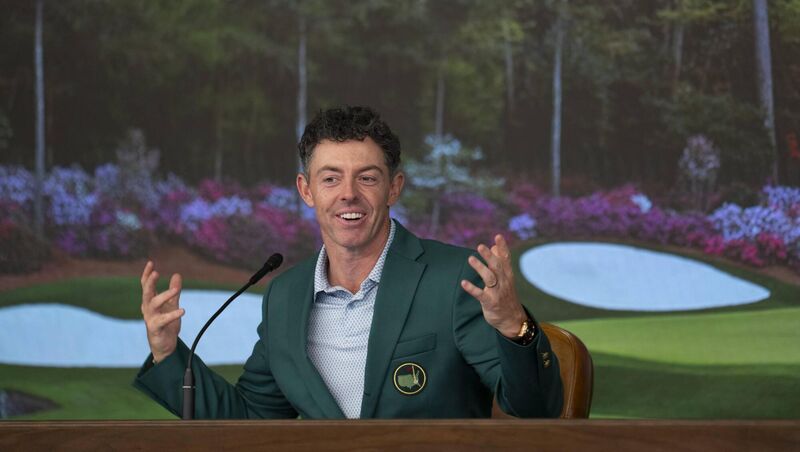
On the other, such overexposure and constant talk is liable to give people a reason to tire of him. Beside the clubhouse that pinches the 1st tee and 18th green is a media stand where golfers move for quick interviews. Instead, McIlroy made his way across the course to the press conference room in the lavish media building on four different occasions, including three of four tournament days. It was there he was asked about his Champions Dinner, the pressure of the speech and his chosen menu.
"I was trying to achieve something that I would enjoy but – and it ties back to experiences that I’ve had – also wanted it to be something that all the other people in that room would enjoy as well.
"People keep asking me, 'Why didn’t you go more Irish?’ And I said, ‘Because I want to enjoy the dinner as well.'”
A light joke that prompted mild irritation in places. It was during another press room appearance that he clarified details about his prep and why he skipped three PGA Tour tournaments to focus on the first major. It stemmed from a basic dislike of those courses, so he utilised that time to jet up from Florida while getting back home for some family time.
That prompted a torturous talking head debate about a possible “unfair advantage,” an unfortunate consequence of a sports-news void. The Masters fell in a window without any NFL and a week before the start of the NBA playoffs. Fellow pros like Michael Kim, who missed the cut at the Masters, felt moved to clarify on social media that, if they wanted to match the number of rounds at Augusta that McIlroy had, they could easily have done so.
To be in east-central Georgia as the 36-year-old clinched his second successive green jacket, joining the illustrious company of Jack Nicklaus, Nick Faldo and Tiger Woods, was to be confronted with stark contrasts. Cruise down the I-77 with striking road signs urging you to repent, love the lord, save souls and purchase a war chest of firearms. Read the American Heart Association’s dietary guidance in the local paper while sitting down to the cuisine of the South, grits with a generous helping of butter and cheese. We didn't know Aromat was still a thing until we made this trip.
One media event took place in a gated community with houses so big they seemed to boast more than one front door. Our Uber driver to that function was an Atlanta native who had come down for the week in search of extra work. Her previous trip had taken almost two hours in gridlocked traffic for a fare total of ten dollars. She admitted, with a trace of weary amusement, that a return next year did not greatly appeal.
There are two types of contradictions in adult life. The first is the sort of jarring dissonance that strains our capacity to deal with the world. To be in the idealistic surroundings of the cathedral of pines with all of its tranquility, while that very country is at war.
Then there are contradictions that are connected. To be a failure and to be a success. These are not mutually exclusive destinations, but states made possible through a process of evolution, introspection and growth. McIlroy is the living embodiment of that.
It is a complexity that his critics consistently fail to grasp. There is an elegance and there is an edge. When former US Ryder Cup captain Paul Azinger accused McIlroy of being a hypocrite for advocating for more decorum while cursing back at an unruly gallery, it fundamentally missed this point. That defiant 'eff you' was a response to appalling abuse towards himself, his family and his friends.
He revealed that fervour himself. This is who he is. The fact that McIlroy embodies so many different elements is only a reflection to what it is to be human. On his way to the career grand slam 12 months ago, he managed to hit the shot of a lifetime and the worst shot of his career in the same round. How about that drive into the trees on the 18th? The Rorycoaster tends to veer between extremes in a manner that is both exhilarating and exhausting. To try, fail and try again. When asked what the most recent win had taught him about life, he offered this:
“Good things come to those who wait, maybe. Just keep going.”
He has, of course, changed. Evolved. He is the same madman, too. Looking across to the green on the par-5 15th is a searing experience, a fitting tribute to its name: Firethorn. That downhill lie feeding towards a green perched between two ponds is perilous, as the defending champion knows.
As soon as his approach came off the club face last Sunday, McIlroy was waving both hands, urging it forward. The grandstand in the corner almost recoiled in horror. It looked, for all the world, that he had left it too short and it was destined for the drink. That collective gasp became a sigh of relief as it held on to the green.
He followed that up with an iron that drifted long and left on the par-3 16th. Now the teeth were really starting to grind. “Tiger chip,” was the immediate assessment among the patrons, a nod to that famous 2005 shot.
"rIt was there he produced a terrific putt that rode the slope to funnel towards the hole. He was in the zone now too. Once again, we know this because he wears it all so visibly.
“My goal for the week was to keep my eye line above the crowd,” McIlroy said in the recent documentary on his 2025 triumph. “Shoulders back, eyes up. If you can put it out to the world that you’re ready for this, your physiology affects your psychology.”
That recognisable bounce harks back to a boy instilled with confidence from a father who would once casually adjust the scorecard to allow him to shoot under par. When he slumps down the fairway, it is clear how he is feeling as well. The mental work of Bob Rotella has paid off here. We know this because he talks openly about it.
The defining point of his entire career is the reality that seemingly needs to be repeated. His former caddy, JP Fitzgerald, issued it nine years ago: “You’re Rory McIlroy. What the fuck are you doing?” Before the Hollywood man defeated Xander Schauffele at the 2021 Ryder Cup, Shane Lowry opted for the same approach.
“I said to Rory McIlroy before we went out this morning. ‘You’re Rory fucking McIlroy. You’re already one of the best players of all time, and you’re 32. Go and show it today.’”
This is a necessary antidote for a man toiling with self-doubt. That one of the most talented players of his generation exhibits that so obviously should be welcome.
Of course, he is far from perfect too. We are aware of this because he tells on himself. A few years ago, a story emerged of McIlroy playing as an amateur for Ireland in the home internationals. Before he teed off, he flashed a golf ball at his opponent with an insult written across it: loser. McIlroy is the one who revealed it as a caution against youthful arrogance.
An inability to reconcile shades is another reason why his standing as the greatest Irish sportsperson can become the subject of debate. Nationality is not always a binary proposition; it can be complex and historically confusing.
Now, it is often said, rightly, that any demand for these stars to be paragons of virtue is a hollow pursuit. As much as we know about the athlete, we are largely unaware of them as people. That is the problem with treating sportspeople as role models.
To be successful in any game often demands a singular self-absorption and focus that isn’t always conducive to social graces.
Accept it for what it is. Seek the humanity in the athlete, not the other way around. What a wonder it is to see self-doubt, the obvious rewards for hard work, camaraderie, class and the occasional flash of fire, in sport.
CONNECT WITH US TODAY



Be the first to know the latest news and updates