Donal Lenihan: It's 26 years since such major surgery to an Irish team. We were backed into a corner then
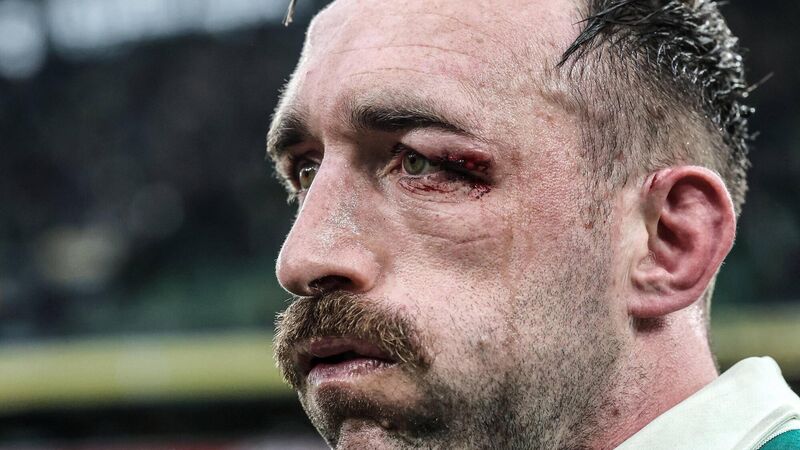
CONAN THE BARBARIAN: Ireland's Jack Conan after the match. Pic: ©INPHO.

It's 26 years since such radical surgery was undertaken by an Irish management team on a side looking to bounce back from a shattering defeat in the opening game of a Six Nations campaign.
The difference back then was Warren Gatland and I were backed into a corner when taking radical measures in promoting five young men for their first caps after a comprehensive pasting at the hands of England at Twickenham.
John Hayes, Simon Easterby, Peter Stringer, Ronan O'Gara and Shane Horgan all went on to have pretty decent international careers despite being dropped in at the deep end against Scotland all those years ago.
Reluctant to promote them, away from home, against a very good England side that eventually went on the win a World Cup, we decided it was all or nothing against the Scots.
The gamble paid off with a morale boosting 44-22 win that transformed the mood over night and inspired a first win over France in Paris in over two decades on the day Brian O'Driscoll announced himself to the rugby world with that famous hat trick at the Stade de France.
Read More
There’s a fair chance the French team that put Ireland to the sword in the opening match of this season's championship may well go on to emulate the England class of 2003 by winning a World Cup. They certainly have the ingredients, more so if they can unearth a couple of grizzled scrummaging props.
The fact Andy Farrell felt compelled to conduct major surgery on his starting side, with six changes for Saturday's game against Italy, may well prove a turning point in the evolution of his new Ireland team which, on the evidence of the 20-13 win over the Azzurri, still has a way to travel yet. Remember, in the corresponding fixture two years ago, Ireland won 36-0.
Ireland were far from perfect in a jittery seven-point win over Gonzalo Quesada’s improving side but the promotion of Ulster duo Rob Baloucoune and Cormac Izuchukwu looks like a step in the right direction. With four caps each under their belts, they weren’t quite in the same place as the famous five that faced Scotland in 2000.
At 28 and 26 years old respectively, they were hardly in the rookie category either. To be fair to Farrell, he’s been endeavouring to give them their chance for some time but an unfortunate sequence of injuries to both players hasn’t helped.
The only potential debutant on the day was 23-year-old Cobh Pirates powerhouse Edwin Edogbo who is fast becoming a cult hero down these parts. I can’t remember a new cap receiving such an ovation from an Irish audience for his arrival onto the international stage. Let’s hope it’s the start of a brilliant career for Edogbo in the coveted green shirt.
Despite the win, Ireland were far from perfect. Trailing 20-13 entering the closing stages of this fascinating, if at times error strewn game, a draw wouldn’t have flattered the visitors. Far from it.
In fact, Ireland’s one score victory at the death owed a much to a fortunate bounce under the Irish posts that evaded the excellent Tommaso Menoncello in collecting a superb chip from Paolo Garbisi. It was that tight.
In trying circumstances, this Irish side lacked the composure and confidence to back one good moment with another due to a series of unforced errors, poor handling or execution but, to their credit, they still found a way to win.
It wasn’t perfect but it was a step in the right direction without some key personnel on board. When you take stock of those currently in sick bay, key players such as Andrew Porter, Paddy McCarthy, Jack Boyle, Adam Baird, Mack Hansen, Robbie Henshaw and Hugo Keenan, having a cohort of less experienced players having to find a way to get over the line could yet pay dividends down the line.
That said, this game could have gone either way. At times, a rapidly improving Italian side played like France in disguise, no surprise given Quesada spent so much time playing and coaching in the Top 14. The quality of their attacking game, their ability to get the ball to width, allied to their counter attack asked big questions of Ireland defensively.
In addition to that cruel bounce for Menoncello, you can add his sublime midfield break that led to a superb try for Louis Lynagh on 63 minutes only to be correctly called back for a forward pass by the excellent Hollie Davidson on a landmark day for female referees when she became the first to preside over a men’s Six Nations game.
In highlighting Ireland’s many injuries, it’s only fair to mention the fact that Italy pushed us all the way despite being short first choice backs in scrum half Martin Page-Relo and Ignacio Brex in midfield along with a trio of quality forwards in Sebastian Negri, Ross Vintcent and Marco Riccioni. Despite their limited pool of players, that gives you a feel for how far their squad has progressed since Quesada came on board.
In the circumstances the visitors would have been thrilled to add a draw to their opening victory over Scotland in Rome, a result that remained very much on the cards entering the final quarter.
That outcome would have been a disaster for Ireland, finishing any title aspirations retained by Farrell’s men. As it happens, given Scotland’s shock win over England in Edinburgh - if there is such a thing in that Calcutta Cup fixture of late - Saturday’s win keeps the door ajar even if the French are very much in the driving seat at this stage.
It summed up the topsy turvy nature of Ireland’s day that an opportunity to pilfer a four-try bonus point off an attacking line out at the death never presented itself when an over exuberant Jack Crowley kicked the ball dead from a penalty inside the Italian twenty two. It was that kind of day.
Crowley will be disappointed with that mistake given the excellent contribution he made, in tandem with a influential bench, that helped rescue a game that could so easily have slipped away from Ireland in the third quarter.
It also felt significant that, on this occasion, Crowley was a direct replacement for Sam Prendergast, who experienced a difficult day from placed balls, having been slotted in at full back in all his recent appearances off the bench.
I’m wondering if it’s a sign of the heightened pressure on the side that, in both championships games to date, it was the impact of the replacements like Jamison Gibson-Park and Tadhg Beirne, both of whom started in Paris, in tandem with Crowley, Ronan Kelleher and Nick Timoney that sparked Ireland’s best moments in both outings.
Only time will tell whether England’s catastrophic set back in Murrayfield will prove a help or a hindrance in the long term. From an Irish perspective, we’ll find that out pretty soon.