John Fallon: In identifying a way forward, Irish football should look to Denmark
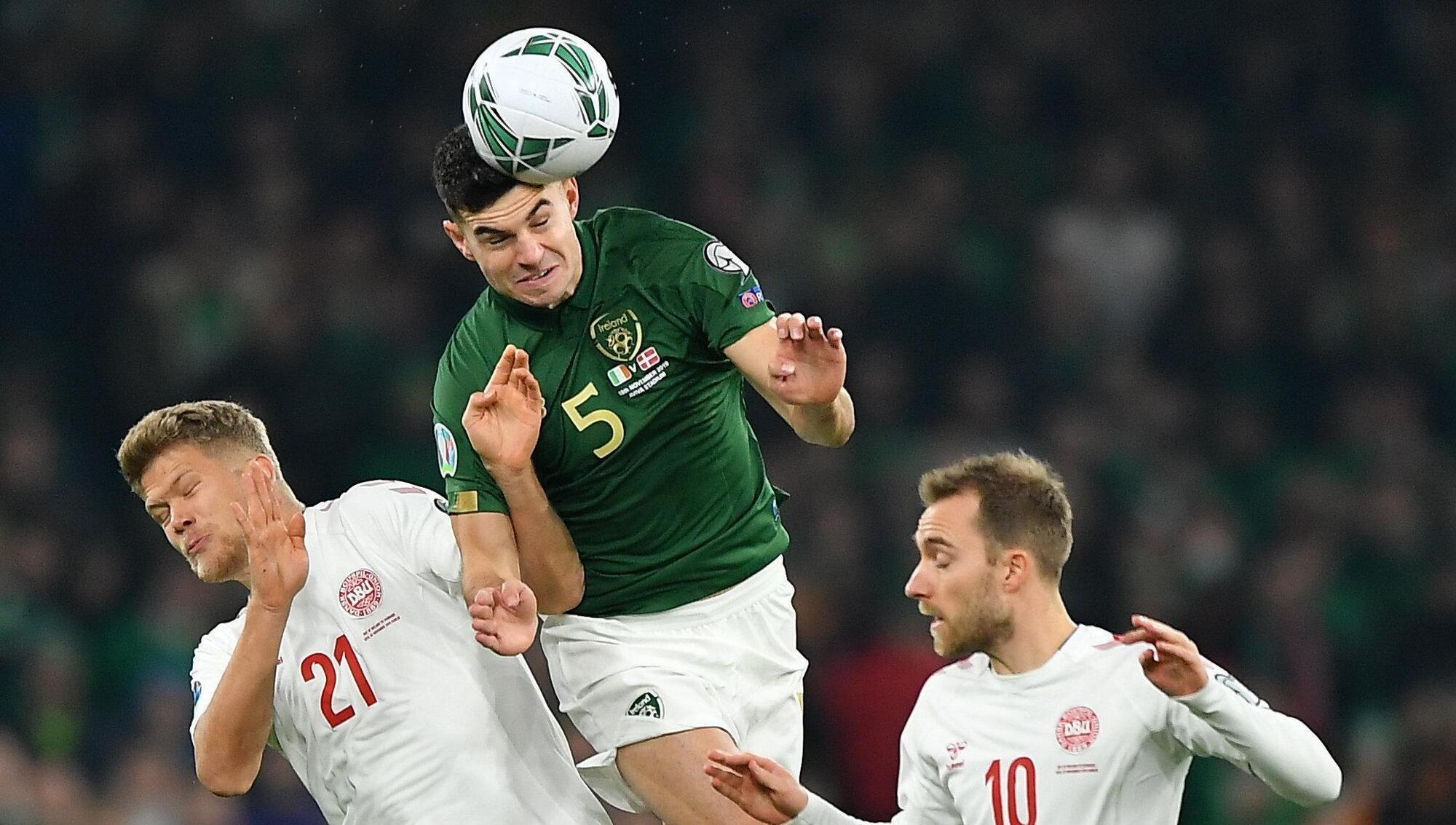
John Egan of the Republic of Ireland in action against Andreas Cornelius, left, and Christian Eriksen of Denmark during the UEFA EURO 2020 Qualifier. Pic: Seb Daly/Sportsfile

It’s almost 18 months since an audience at the Aviva Stadium had to endure Ireland being compared to England in gauging international success.
Granted, the background of the speaker, Marc Canham, was ingrained in the FA and Premier League structure but the entire pretence was flawed by mixing apples with oranges.
Primarily, judging one’s record against a nation with 10 times the population made no sense whatsoever.
Then throw in the fact that England’s sporting culture is by far and away dominated by the single code of football.
A more appropriate comparator to measure best-practice, for various reasons, is Denmark.
Population-wise they are similar, the Danes slightly ahead of Ireland on 5.9m inhabitants.
Yet, according to those closest to the action when it comes to tracking Ireland’s decline of top-flight players, Denmark is the exemplar Ireland should be aspiring to.
Their volume of academy staff, for instance, sits at 140 across 14 centres – a multiple of 20 to the Irish equivalent.
It has also been highlighted how they are one of only four of the last 52 European countries to qualify for a men’s World Cup that were ranked lower than 25. Christian Eriksen’s team that slayed Ireland in the playoff to reach the 2018 finals sat 36 in the standings.
Their senior women’s squad has long been a staple at major tournaments too; four World Cups franked by appearances at the last European finals on the spin.
In summation, be it male or female, their footballers are consistently punching above their weight.
Ireland can watch in envy, and maybe by the end of this year both their teams will have experienced or clinched World Cup spots, but to ensure regular qualification is the norm rather than exception, perhaps the best trick we can rob from the Scandinavians is how they’ve overcome climate as an obstacle.
January’s deluge of rainfall once again revives the debate around the football calendar.
Tommy Martin, in these pages, has vented his frustration at the cancellation of fixtures, mirroring many a parent stuck inside their houses at weekends with pent-up children devoid of sporting activities.
His views on the matter were influenced as well by the wave of feedback he gleaned about resorting to what many perceive as a simple solution of flipping the format to the summer months.
This aspect framed the FAI’s Football Pathways Plans (FPP), a manuscript mapping out the next 12 years of Irish football. Canham authored the blueprint, arguing the grassroots game should synchronise with the League of Ireland into an aligned calendar. He’s no longer at the FAI and neither is Ger McDermott, the head of grassroots front and centre of its implementation.
No matter how often eyes are rolled at the reality of Ireland being in the unique position of competing against a machine in the GAA, it won’t alter its truth. Whereas that’s particularly acute beyond in the provinces, other inhibitors apply around the capital.
That’s not going to change anytime soon and as our columnist advocates through his lived experience, better to ponder solutions than wallow in a standoff.
Denmark has led the way in this regard, the outlier among their neighbours in sticking with the traditional school curriculum calendar which 80% of European countries adopt.
Statistically, they don’t suffer the rainfall average of Ireland but must confront steeper cold snaps.
That’s why January, at all levels, is considered a closed month. Football is available for recreational purposes but only indoors.
Altogether, around 1000 halls were constructed around Denmark between the 1960s and the mid-1980.
Legendary goalkeeper Peter Schmeichel recently extolled the skills gained from diversifying into handball during the snowy period.
Their senior Superliga resumed following their break last weekend and all around the country football proceeds for every child, man or woman.
Investment accounts for the key difference, unsurprisingly. And still throwing money at the challenge in itself didn’t garner a resolution. Rather, the Government opted for a targeted approach, giving priority to facilities shared by various codes. We can only dream of such collaboration in Ireland.
It was the financial guru Roy Barrett who decried Ireland’s meagre spending on sport as his term as FAI chairman was finishing in 2023. He cited the 0.4 percent of public expenditure as in the relegation places of the European table, further lamenting football languishing as the bridesmaid to the GAA grants.
Recent academy funding helped redress that balance but it’s at the ground level where infrastructural deficits are robbing children of weekly fixtures.
About 80 percent of all public spending on sports in Denmark is funnelled through 98 Danish municipalities. Rarely is there a grass pitch without an adjoining artificial one.
Moreover, the DBU is investing 220 million kroner (€29m) constructing new football centres in nine Danish cities, making them available for enjoyment, regardless of skill levels. This is a scale of investment from a federation that the cash-strapped FAI are lightyears away from.
Instead, the exchequer is being relied on. Central to their €863m facilities and investment plan was 48 new artificial pitches (including small-sided games) costing €24m and upgrading another 128 to the tune of €51.2m.
Ever so gradually, football clubs are benefiting from the sports capital scheme, nowadays called community sports facility funds, but catching up to the nation Ireland might be hosting for a World Cup spot on March 31 is such that winters of discontent won’t magically disappear.
Entertainment on and off the pitch is never far away from Athlone Town but linear stability is the objective for the League of Ireland’s oldest club under a new board.
Last year saw their teams experience contrasting fortunes. Whereas the women’s team scooped their first-ever double, the men propped up the bunch as the First Division’s bottom side.
That was all the more disappointing given the Midlanders finished fourth and fifth in the previous two seasons.
A 22-game winless sequence from mid-May to mid-October might be attributed to the slowness in their takeover being finalised. Veteran goalkeeper Brendan Clarke will spearhead their bid for an upturn.
US-based Nick Giannotti was beaming at the side of the Tallaght pitch when the women beat Bohemians to complete the double and he’s all the happier for assembling his board following months of a handover.
Fellow investor Andrew Beal is another member at the top table, along with existing chief executive Steven Gray and finance manager Emerson Farrelly but the eye-catching name is Andrea Clarke.
She’s a qualified solicitor whose previous football experience was in the legal department at the FAI and as the country’s only female-licensed FIFA agent.
Her external expertise should be vital for a club that’s been entangled in quite a few disputes over the years.