Every abuse story has the same dynamic — power vs vulnerability
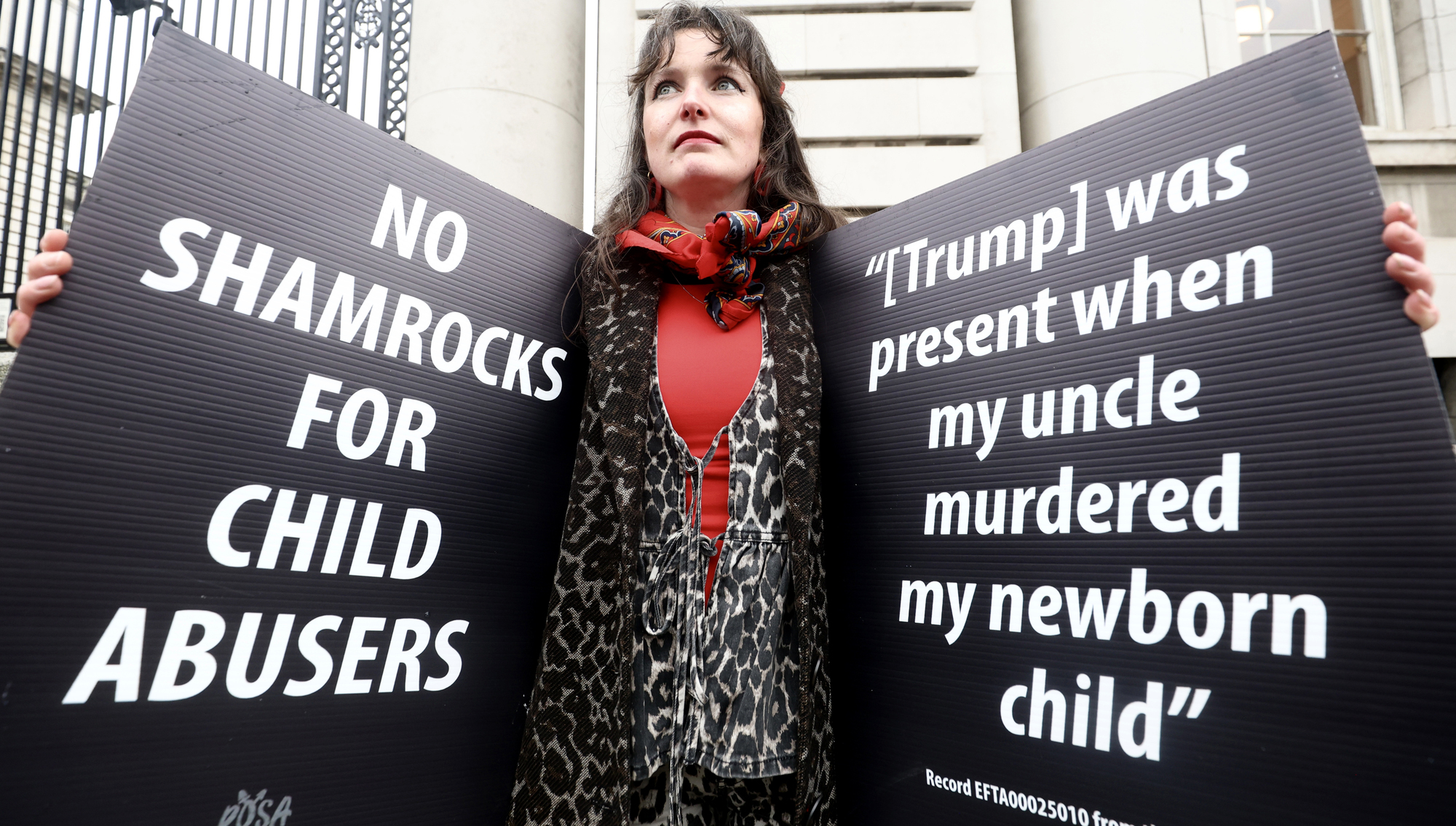
Laura Fitzgerald, spokesperson for the ROSA Socialist Feminist Movement, after activists handed in a letter on Tuesday at the Department of An Taoiseach detailing allegations against Trump in the Epstein files. Photo: Leah Farrell/© RollingNews.ie
The Epstein saga feels like it has been going on for a long time, but the focus remains on the names of the men in Epstein's circle and not on the women and girls he abused or on those who allowed it to go on for so long.
All acts of abuse and violence, regardless of status, have one thing in common — the exploitation of vulnerability. Whether that vulnerability is momentary or situational; someone who is unconscious and cannot consent or perhaps is vulnerable in circumstance; they do not have somewhere to stay as evidenced in the sex-for-rent exploitation.
Others may be vulnerable by ability or demographic — someone with physical or intellectual disabilities, as evidenced in the harrowing ‘Grace' case, or the high number of young people at risk of sexual exploitation whilst in State care.
For many, simply being female or identifying as female puts them at high risk of acts of abuse or violence. For those who carry out acts of violence or abuse, the modus operandi is always the same: to dominate, control, and denigrate.
The Epstein files are shocking in both volume — six million pages — an unfathomable number of documents, and in nature — the innumerable girls and women trafficked and used like objects, discarded when no longer needed. The details are both horrifying and unimaginable, yet the core of what is described is not new to any of us.
Here in Ireland, we are no strangers to the abuse of power and the hiding of same. On a large, industrial scale there are the abuses carried out at the hands of the Catholic Church.
The trading of women and babies did not just happen without the knowledge or suspicion of others. Indeed, it was impossible without the complicity of others, from the top (the Catholic Church and its clergymen and women, the Government) all the way down (local gardai, teachers, doctors, family members, neighbours etc.)
Abuse and violence may be described in court or in news articles as an incident or set of incidents that occur between an alleged abuser and a victim/survivor, but we are only looking at a still of a much broader vista if we think that it starts and ends in such a description.
The lived reality for many is that the horror may start with the actions perpetrated against them but is further compounded in how others treat them — the lack of belief, the disgust, the isolation, the shame. The cover-up.
When is evidence seen as evidence?
The release of the Epstein files also echoes many public discourses on the collection and use of evidence in cases of abuse and violence — because saying something happened brings more ire than sympathy, let alone belief.
Despite three-and-a-half million files being released, there is no indication of criminal investigation. To be clear, these files focus on some of the most serious crimes that the law says can be committed: the rape, sexual assault and trafficking of women and girls.
It has been stated that there will be investigations into the leaking of sensitive financial information to Epstein in the United Kingdom with Peter Mandelson and Jack Lang in France, but nothing about the systematic abuse of women and girls.
There are allegations that Epstein’s depravity included the trafficking of girls and women here in Ireland for powerful individuals. Surely, under Children First legislation, this must be investigated. And if not, who is making the decision not to investigate?
How can a piece of legislation such as Children First be bypassed when it is by design so clear regarding reporting any allegations of child abuse, particularly if the accused individual/s have any possible access to minors.
The treatment of the identities of the victims and survivors in comparison to that of the alleged perpetrators is noteworthy. That some of the identities of the now women were released, possibly by accident, shows how little care really is at times taken by those tasked with investigating evidence.

Yet it is likely that many details and names of individuals that caused harm were redacted or remain undisclosed in the other half of unreleased files. What we don’t know in the case of the Epstein files is perhaps more worrying than what we do, given the selective release of the files.
This wouldn’t happen in Ireland, some might say. But what about the newly identified 22 bodies of babies in Tuam and the ongoing lack of accountability? The countless men and women who were abused by the Catholic Church being subjected to further attacks by defence barristers in seeking compensation.
What about Margaret Loftus putting together her own witness statement as evidence in a bid to prosecute her ex-husband for domestic abuse? And what about the reporting restriction that prevented journalists from naming Trevor Bolger, Margaret Loftus’ ex-husband for three years?
What about the Farrelly Commission, where the physical document came under scrutiny for being laid out in an atypical manner that made accessing its contents in a coherent manner difficult.
Moreover, that evidence was only found for what could be physically determined — financial mismanagement and physical neglect due to a lack of appropriate dental care, but the testimony regarding alleged sexual assault and neglect was not considered.
It was later claimed that the Farrelly Commission report did not include the full body of evidence available to the investigation. In a situation where whistleblowers spoke out for a vulnerable individual who has no voice herself, it seems there is still no accountability.
Conversely, with the highly contentious use of therapy notes in sexual assault cases as evidence if it fits the narrative of the defence team, yet they are not gathered as part of the book of evidence in seeking to prosecute the alleged perpetrator/s, nor are they seen as evidence of harm done, or disclosures made by a complainant.
There seems to be an incongruence with what is evidence with regards to sexual crimes.
It seems that when seeking justice or accountability, the imbalance of power is truly crystalised, leaving victims and survivors feeling even more disempowered. What does it take for victims and survivors to be believed when there are documents, statements, and eyewitness accounts all corroborating the same narrative?
Epstein did not act alone, and there had to have been countless others, who even by not being directly involved, knew what was happening. The same is true in our day-to-day lives.
Abusers hold power, whether they are an elected official, a corporate executive, a local pillar of their community, or captain of the local football club. That power is given to them, bestowed and maintained by those around them, and what can be given can be taken away.
I believe it is our duty to report what we see and hear that we know is wrong. What if those who suspected or knew what Epstein did had reported it? What if the men invited to those ‘parties’ said no, told the authorities, and refused to continue engaging with Epstein — personally or professionally?
Sexual abuse happens when we let it as a society, when we say nothing. Silence is violence, as Rebecca Solnit puts it. We cannot keep asking victims to disclose their pain if we cannot bear to hear it, and most importantly, act on it and ensure that there is accountability — no matter who the perpetrator is.
- Niamh Ní Dhomhnaill is a sexual violence campaigner and chartered senior clinical psychologist working with young people. Her fee for this article will be donated to CARI.
CONNECT WITH US TODAY



Be the first to know the latest news and updates