Mick Clifford: As Fianna Fáil marks 100 years, Bertie Ahern emerges as a ghost from its past
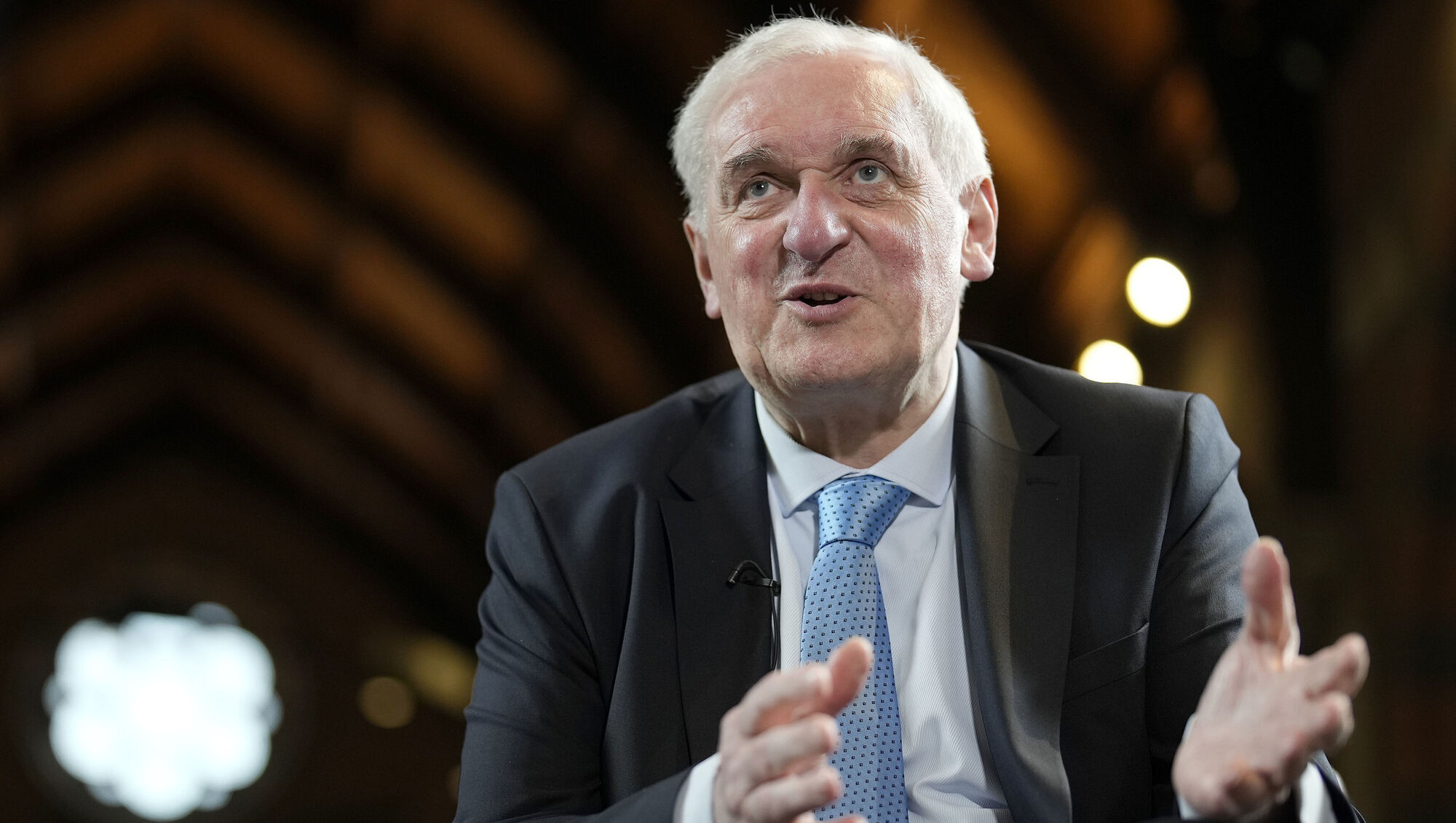
Bertie Ahern was a brilliant canvasser in his day but his time predated social media and the use of a phone as a weapon.
The doorstep strikes back. Through the long and storied history of Irish elections, the doorstep has been used and abused. Candidates and parties have attributed all sorts of opinion and emotion to the poor befuddled entrypoint to homes up and down the country.
“The word I’m getting on the doorstep is that the people think we’re great”.
“That’s not what I’m hearing on the doorstep.”
“The kind of reaction I’m getting on the doorstep is not in agreement with that opinion poll.”
“There’s a lot of anger at the government on the doorstep.”
And on it goes. The beauty of invoking the doorstep in elections is that its opinions and musings have always been exclusive to the ears only of those who subsequently relay what they claim to have heard. You can’t dispute what a candidate or canvasser claims to have been privy to on the doorstep because you weren’t there. And practically always in the throes of a campaign the candidate will relay that what was heard on the doorstep was precisely what suited his or her campaign.
Then along came Bertie. This week it emerged that Mr Ahern, in the course of campaigning for Fianna Fáil’s John Stephens in the Dublin Central by-election, was ambushed on the doorstep in the most nefarious manner.
A recording on social media has a woman coming to her doorstep and asking a canvasser can she talk to Bertie, who is nearby. The former taoiseach obliges totally unaware that the woman is secretly recording the encounter. She berates Bertie — who left high office 18 years ago — over immigration and “Sharia law”.
He suggests initially the thing that bothers him is the length of time it takes to reach a decision on whether applicants are entitled to international protection. She persists.
His old electioneering antenna kicks in and he succumbs to the cavasser’s instinct to agree in order to ensure this vote is not completely sacrificed.
He is heard responding that “the ones I worry about are the Africans”, and “we can’t be taking people in from the Congo and all these places. I think there are too many from these places.”
Bertie, who is 74, was a brilliant canvasser in his day but his time predated social media and the use of a phone as a weapon.
As political scientist Gary Murphy pointed out to me on this week’s podcast, one of the remarkable features of the encounter was that Ahern was out canvassing door-to-door nearly 20 years after he left high office. Could you imagine any other ex-leader anywhere committed to politics to that extent?
His comments no doubt provided some succour to the element in society that wants to cast immigrants as “the other”. We have, in recent years, seen politicians on the fringes hitting out at immigration in an attempt to root around in the gutter for votes. To be fair to Ahern, that is not him, his style or his disposition. As Murphy told me on the podcast of Ahern, “he hasn’t a racist bone in his body”.
The timing of the emergence of the Ahern recording was embarrassing for his party, not least because this weekend it celebrates a centenary in existence. In this respect, Bertie may be a ghost from glories past whose career summed up much about Fianna Fáil in the second half of that century.
He was first elected to the Dáil in 1977 in what was the last occasion that the party secured a comfortable overall majority. Fianna Fáil had evolved from its initial guise as a kind of populist anti-state entity into a party whose primary focus was the acquisition of power by any means that suited around half the electorate.
Ahern in many ways personified the party during his time in politics. He was a popular figure, like the party’s founder Éamon de Valera. Just as Dev’s austere, remote persona was a reassuring figure for so many at the time, so Bertie’s relatability ensured he was an electoral asset during his career.
He was left of centre on economic issues and willing to be led by broad public sentiment on social matters.
He was central to the social partnership process that ensured old industrial relations enmities would not hinder the progress of the state towards a fully developed status by the turn of the century.
On the North he demonstrated that his party above others had some form of connection to northern nationalists which allowed him to steer the Good Friday Agreement into being.
Then there was his personal connection to money matters as uncovered by the Mahon Tribunal. Was it not ever thus with leaders of a party that presented itself as the spirit of the nation, back to Charlie Haughey’s era, as far as Dev appropriating the group as a family asset?
Equally, the Fianna Fáil instinct to embrace a form of populism, being all things to all people, chimed with Bertie’s own public persona. So it was that when the Celtic Tiger got into its stride, his stewardship ensured that taxes were cut and spending increased as if Dev’s old magic was resurrected to smite economic orthodoxy.
Time caught up with the party’s traditional brand of politics with the economic crash in 2008.
Today, all the old certainties are gone for Fianna Fáil. On this big birthday the party can claim to offer a managerial centrist hand in government but not a hell of a lot more. Like Bertie on the doorstep, perhaps they are finding it hard to keep up with the changing times.
The party can claim some credit for what has been positive about Ireland’s story over the last century, but must also accept responsibility for a lot that has not.
It might well be argued that the country was waiting for something like Fianna Fáil when it came into being in 1926. Today, the question is whether the party can remain relevant as a distinct entity in a political firmament that has changed utterly.
CONNECT WITH US TODAY



Be the first to know the latest news and updates