Clodagh Finn is a journalist, writer and collector of stories. Her recent book, The Irish in the Resistance, co-authored with John Morgan, shines a light on the forgotten contributions of the Irish who resisted Hitler during WW2.
Mary Delany was in her 70s when she invented a new art form simply by noticing the similarity between a piece of red paper and a petal that had fallen from a geranium plant.
She picked up a pair of sharp scissors to render the fallen petal in paper and saw that one was an exact mirror of the other. She kept going until her paper geranium was so like the real thing that it looked like a watercolour.
“I have invented a new way of imitating flowers,” she wrote in a letter to her niece, describing the ‘mosaicks’, as she called them, that would act as the precursor to the artistic technique known as collage.
Over the next decade, this 18th-century woman who honed her artistic craft in Ireland made almost 1,000 paper flowers — exquisitely rendered and botanically accurate creations set off magnificently against a black ink background.
HISTORY HUB
If you are interested in this article then no doubt you will enjoy exploring the various history collections and content in our history hub. Check it out HERE and happy reading
All 985 of them, to be precise, are now in the British Museum. You can make an appointment to view them in person or, as I’ve just done, spend a happy hour looking at the collection online.
I love everything about them but, most of all, I love the fact that they were brought into glorious being by a “late bloomer”, as the museum describes Delany.
Any reminder that women don’t shrivel up and atrophy once they hit… I don’t know, 55, 60, 65? — it gets younger by the day — is to be crowed from the rooftops.
Only last week, the supremely talented Eileen Walsh, who is a mere 49, compared women actors to avocados. “You’re nearly ready, nearly ready — then you’re ripe, then you’ve gone off,” she said in a powerful interview exposing the hypocrisy of a film industry that allows men to age like fine wines while women bruise and pucker like fruit.
It’s heartening, then, to see the same industry produce a film like The Blue Trail (O Último Azul), the Brazilian hit which describes a dystopian near-future where the elderly are banished to a colony out of society’s way. If they try to abscond, they are picked up by a “wrinkle wagon” and returned.
There’s a rebel, though: the 77-year-old protagonist Tereza (Denise Weinberg) is not going to be boxed in, and she takes off on her lifetime dream of a journey through the Amazon.
Director and screenwriter Gabriel Mascaro has said the film was inspired by his grandmother, who took up painting in her 80s after her husband died. More power to both of those women, one real, one imagined.
Meanwhile, Mary Delany was on her own creative journey of imagining throughout her 70s and early 80s, two decades that are almost excised from view.
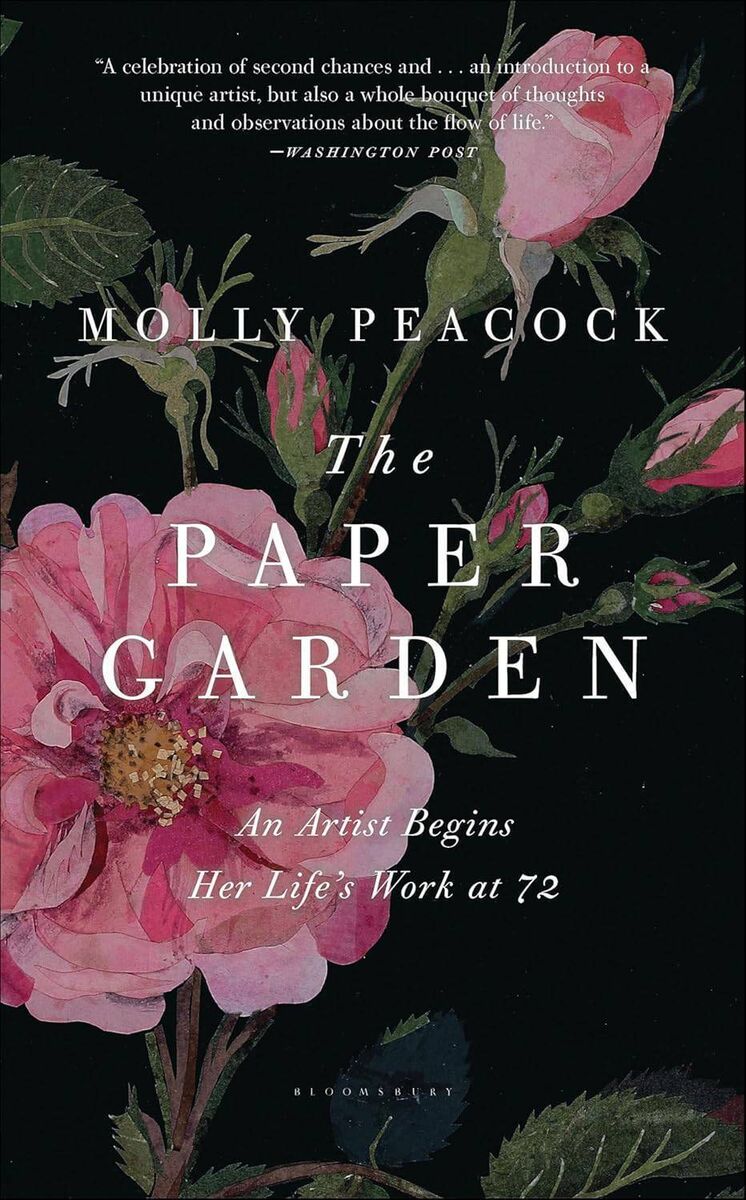
In The Paper Garden, an utterly enchanting biography of Delany, author Molly Peacock offers a particularly evocative image of the artist at work with tweezers, bodkin (an embroidery tool for poking holes), brushes, mortar and pestle, and bowls full of ox gall, a viscous mixture made from the bile of cows to help paint flow more smoothly.
The sight of Delany’s papers, pigments and pins was, writes Peacock, “a feast for the tactile sense; it was dirty, smelly, prodigious”.
It needed dexterity, imagination, determination, eagle eyesight, too, not to mention good light. Imagine doing that kind of work in the dusky gloaming of a winter afternoon with only a guttering candle for company.
But then, as Mary Delany said herself: “An ingenious mind is never too old to learn.”
'Tarnished by time'
Though she was not immune to the effects of physical ageing. She wrote this, in 1730, when she was just 30 years old: “As for my countenance, I cannot say much in its commendation; it is somewhat thinner and paler than usual, and my complexion is altered… thirty years is enough to wear off bloom, and I must submit to be tarnished by time.”
Though, she had already been through the mill by then. At 17, Mary Granville, as she was born on May 14, 1700, in Wiltshire, England, was married off to Alexander Pendarves, a 60-year-old Tory MP with a taste for alcohol.
When he died, seven years later, the hoped-for inheritance failed to materialise and Mary Delany was left to survive on a small widow’s pension.
There were offers of marriage, and the breakdown of one potential match. After that, she took some time out in Ireland. She travelled with her friend Anne Donnellan (c1700-1762), an Irish literary critic with deep connections in the world of music, art and literature (Jonathan Swift and Handel were in her circle).
During that trip, Mary met Patrick Delany, an Irish clergyman and friend of Swift. Spoiler alert: they would go on to marry a decade later and set up a happy house at Delville, Glasnevin, Dublin, and later in Co Down, where Mary’s creative impulse was allowed to flourish.
In the interim, though, it’s fascinating to see how Mary Delany’s craft developed through her contact with other Irish artists.
She was not quite the late bloomer so publicly acknowledged now. Her artistry was developed over many years and, in particular, while in Ireland.
'A new madness'
In 1732, she and Anne Donnellan built a grotto at Killala in Co Mayo, using shells from the collection of Bishop Clayton, Donnellan’s brother-in-law. That piece of work no longer exists, alas, but at least the memory of it does.
The project ignited a new passion in Mary Delany: “I have got a new madness, I am running wild after shells,” she wrote in 1734 when she returned to London. “This morning I have set my little collection of shells in nice order in my cabinet, and they look so beautiful, that I must by some means enlarge my stock”.
Mary Delany forged another important friendship around that time, with Irish artist Letitia Bushe.
“She paints delightfully,” she wrote of the Kilkenny watercolourist and miniature painter in a letter to her sister Anne. “She is hard at work for me, she paints both in oil and watercolours. I have enclosed you a little scrap of her drawing, which she scratched out by candlelight in a minute.”
We would know very little about this artist’s work and her circumstances had it not been for Delany.
In 1731, she told her sister that Letitia Bushe had lost her renowned good looks after contracting smallpox and criticised the men, once admirers of her friend, who had now faded into the distance.
Letitia, however, was able to make a living independently as an artist and also as a teacher and companion.
“Known for her witty, intelligent conversation and constant good humour, she was in great demand as a ‘ladies companion’ in genteel society. She taught many, often lonely, women and their children to paint and encouraged their artistic endeavours,” Ruth Devine tells us in the Dictionary of Irish Biography.
She also stayed with her good friend Mary Delany for long periods, both of them painting and, we might imagine, having long, witty conversations about their art and their lives.
This embroidered quilt, one of the only known pieces of needlework by Mary Delany, is preserved at the Ulster Museum. It measures 8.1ft by 8ft. A forklift was needed to photograph it from a height. Picture: Courtesy of National Museums NI, Ulster Museum Collection
Some of their respective landscapes survive in the National Gallery of Ireland and a breathtaking quilt, the Delany quilt, measuring 8.1ft by 8ft, is held at the Ulster Museum in Belfast.
Recently, the museum posted a photograph of it along with this question: “Did you know that a forklift is needed to photograph large flat pieces like this from a height?”
I did not.
We might also ask this question: Did you know that Mary Delany was an important artist and one of many women sharing friendship and creativity in 18th-century Ireland.