Fergus Finlay: On both sides of the Irish Sea, political leaders are in trouble
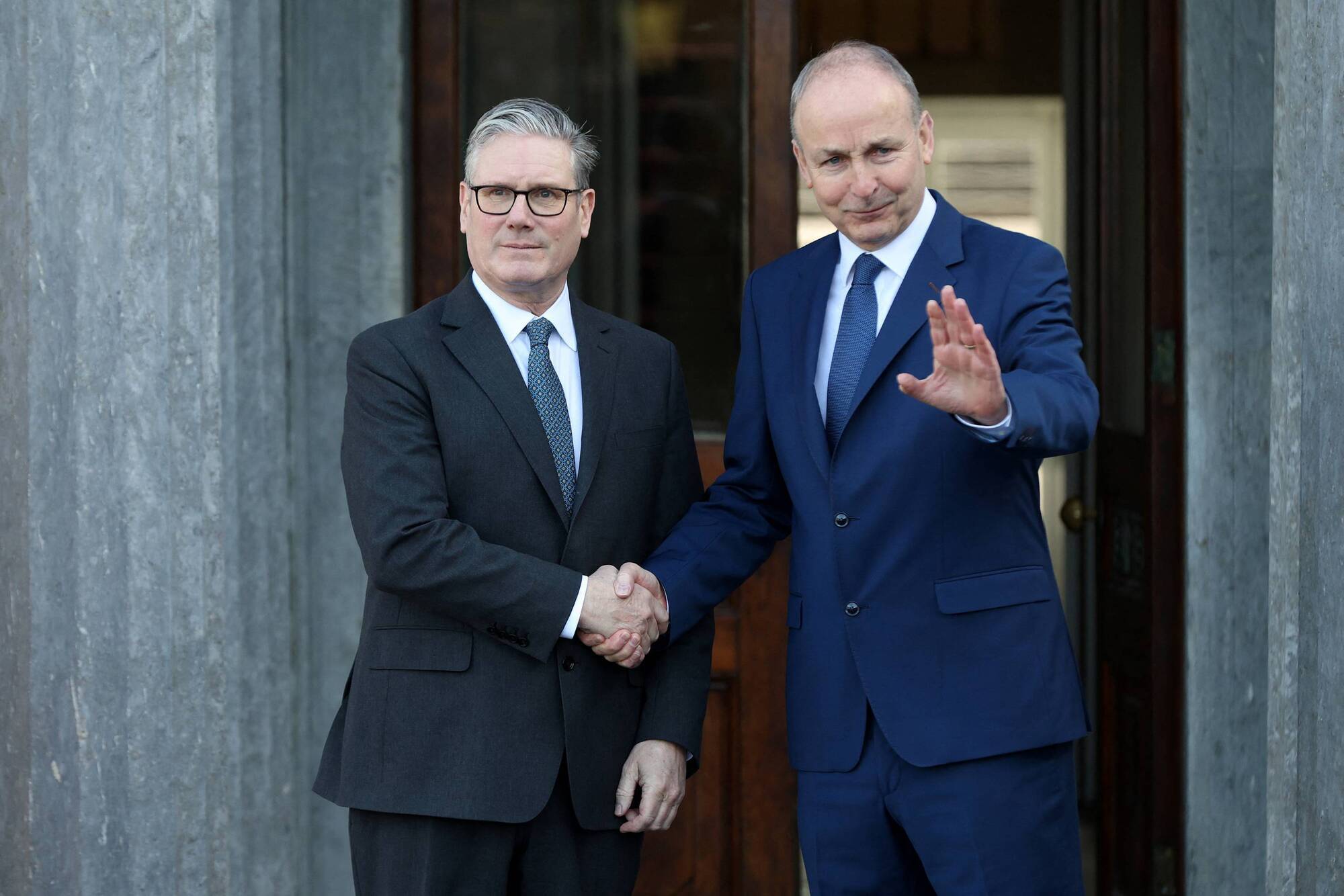
Taoiseach Micheál Martin and UK prime minister Keir Starmer at Fota House, Co Cork, last month, for the second UK-Ireland Summit, aimed at reviewing progress and driving implementation of the UK-Ireland 2030 programme. File picture: Paul Faith/AFP via Getty Images

'To lose one elected leader may be regarded as a misfortune; to lose both looks like carelessness.’ Oscar Wilde’s Lady Bracknell didn’t quite say that, of course.
But if we all, the poor benighted electorate of these two neighbouring islands, were standing in front of her, timorously trying to explain the mess in which both of our leaders find themselves, she might well have.
On our side of the Irish Sea, and on the other one, there are now two political leaders in the deepest possible trouble.
By the time you read this, there is the possibility that one of them will be gone ( the one over there) and although he’ll probably survive the day, his situation seems politically terminal.
It seems impossible to see how he can survive much longer than the UK elections in a few weeks’ time.
Read More
Back in the day when he was UK Labour Leader (and a very good friend to Ireland) Neil Kinnock used often refer to “Tory Free Wales”.
He was (and is) a proud Welsh man, and I’m guessing he’s completely distraught at opinion polling suggesting British Labour could be wiped out in his home place, the place where Labour has always had the deepest roots.
If it happens, and if there’s no place for Labour in the governance of Wales, it will be historic. And devastating. If not now, they will come for Keir Starmer then.
Regular readers of this column will know I have been a supporter (maybe a forgiver would be a better word) of Keir Starmer since the beginning of his leadership.
I’ve always regarded him as a man of integrity and decency, who was making hard decisions that were necessary in the recovery of the British economy from a decade-and-a-half of Tory misrule.
He made mistakes and misjudgements along the way, most notably in the general election, when he was prepared to make promises about tax that were both undeliverable and unwise.
The day Winston Churchill became prime minister, he told the House of Commons “I would say to the House as I said to those who have joined this government: ‘I have nothing to offer but blood, toil, tears and sweat’.
“We have before us an ordeal of the most grievous kind. We have before us many, many long months of struggle and of suffering.”
If Keir Starmer had chosen, in all his public utterances before the election, to use language of that sort, he almost certainly wouldn’t have won the massive number of seats he has now.
But he’d still have won a significant majority, because every voter in the UK back then shared a common purpose — to finally rid themselves of the rotting carcass the Conservative Party had become.
And he would have been free to strike a much better balance between tax and spending.
Yes, there would have been short-term unpopularity, but there’d have been a much better chance of visible economic growth and recovery.
Instead he allowed himself to be hog-tied to an economic and fiscal policy that seems doomed, as much by government inaction as by the sort of external shocks that the crazy and cruel attacks on Iran and Lebanon have caused.
But then came Peter Mandelson. Trouble follows him because it appears he has never been able to say no to money, and also because he clearly has no scruples whatsoever.
I heard Harriet Harmon, a really senior and much respected member of the Labour Party, say that Mandelson was, quite simply, a thoroughly bad man.
I wonder how anyone with a titter of wit thought it was a good idea to appoint him without the most detailed scrutiny.
It transpires of course the scrutiny was done, Mandelson failed it and was appointed anyway.
Every commentator in the UK, whether friendly or hostile to the government, reads the result exactly the same way.
Either Starmer is lying about the whole thing, or else he is so incompetent that if you wanted someone to organise a piss-up in a brewery he’d be the last person you’d send for.
The only thing that can save him as a result, it seems, is a calculation that he’ll be handy to have around as a scapegoat when the upcoming election is a disaster.
Keir Starmer’s rapid fall from political grace may be self-inflicted, but it’s really sad. Public life everywhere needs people with good and honourable instincts.
Sadly, that’s not enough. You have to have skill as well as decency.
Micheál Martin has both. I’ve never been a Fianna Fáil member or voter, but I’m at a bit of a loss to understand the antipathy to him that seems to be ever-present in his own party.
Sure, he led Fianna Fáil to its worst ever defeat in the disastrous election of 2011 — his first election as leader. But it’s entirely arguable he saved his party from a worse fate by spirited and vigorous campaigning.
Most of us, I reckon, were ready to write the party’s obituary at that stage. But, although he’s never recaptured ancient glories, he slowly but surely built his party back to being the largest party in the Dáil, and once again a party of government.
He’s a man who has been on a journey throughout his political life — a strongly republican politician who scorns Sinn Féin; a pro-lifer who had a profound effect on the Repeal the Eighth campaign by openly supporting it; the leader of Ireland’s most conservative political party who was an early advocate for equal marriage.
And he’s made some weird mistakes. His decision to promote Jim Gavin as Fianna Fáil’s presidential candidate, which clearly stemmed from his opposition to Bertie Ahern for the same job, was a pure, unadulterated disaster he was lucky to survive.
(If Starmer had done it, it would be seen as another example of his haplessness.)
Micheál now stands accused by his own as being massively out of touch over the fuel protests — which was after all the kind of campaign whose vanguard would once have been led by FF personages.
He’ll fight on, I’ve no doubt. The strongest thing he has going for him is there’s no obvious replacement — at least none willing to unsheathe a dagger, in the way he himself did with Brian Cowen.
And certainly none that could tell us what they’d have done differently during the protests. Different times, different strokes, I guess.
Now, both he and his colleague across the water (whom he stoutly defended, don’t forget, in front of the bully Trump), are staring into the abyss.
Starmer is only a wet day in the job, but has stumbled every single day, it seems. Micheál Martin is the longest serving leader of Fianna Fáil, with the single exception of Dev.
Long or short, they are both likely, I think, to prove that every political career sooner or later runs out of road.
The only question remaining to be settled, I’m guessing, is on whose terms they are going to leave. Keir Starmer is kicking against that question.
I’m beginning to wonder if instead, Micheál Martin is quietly beginning to think about it.
CONNECT WITH US TODAY



Be the first to know the latest news and updates