Terry Prone: GPO Museum communicates how memory of Easter Rising evolved
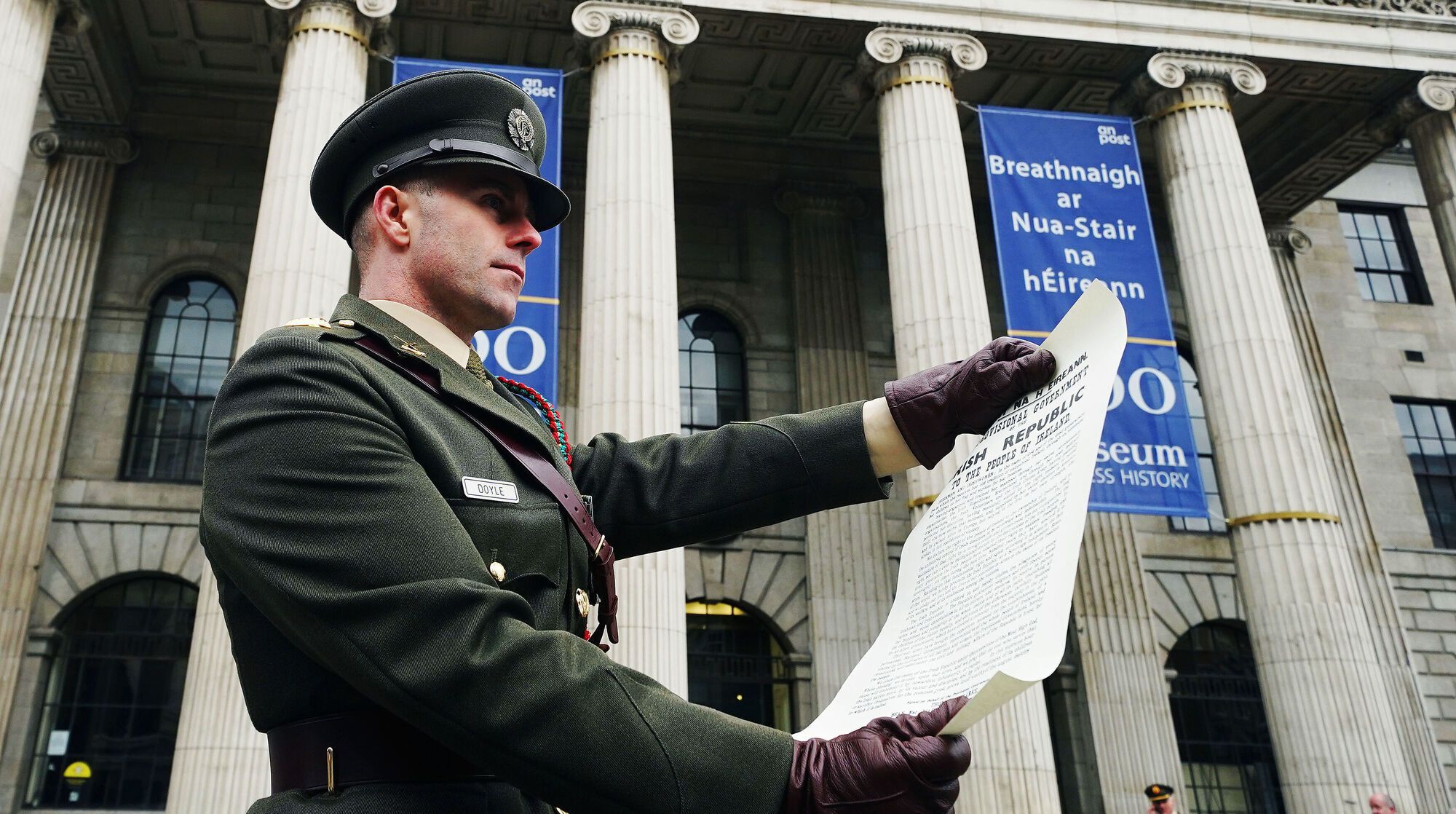
Captain Austin Doyle with the Proclamation of Independence following a ceremony at the GPO on O’Connell St in Dublin to mark the anniversary of the 1916 Easter Rising in 2023.

No other building in any of our cities gets quite the annual boost that Easter Week gives to the General Post Office (GPO).
We notice it all over again as stills from its destruction in 1916 run in media, as will happen again this year because this is the 110th anniversary of the Easter Rising.
O’Connell St, these days, is not what it once was in terms of either pedestrian or car traffic.
I remember as a child watching as my grandmother handed money over to Sinn Féin guys selling between the great dirty grey pillars of the edifice.
Despite my mother’s tight-lipped disapproval, Nana continued to call them “our lads” and believed them to represent a continuum with what had happened during the 1916 Rising.
When I was 16, I went to work in the GPO. Not in the post office section downstairs, but upstairs, where Radio Éireann lived from the 1920s, when radio started in Ireland, until 1976, when all broadcasting shifted to Donnybrook.
If you walked along the front of the building and turned left into Henry St, you encountered a small entrance.
Down from the door was an old-fashioned lift which took you to the long, long corridor leading to the studios.
Not that they would ever have wanted to look at those grey eminences in charge of standards and production and punishment.
The punishment came after a broadcaster or a programme breached inchoate rules of balance, fairness, and good taste understood only by the grey eminences.
The rules had little to do with politics and even less to do with the views of the listening public. Listeners, in particular, were regarded as something of an irritating necessity, like plumbing, rather than customers.
On one occasion, I got into the lift with Siobhan McKenna, a legendary actor of the time who I thought was a ridiculous ham.
As I closed the gates of the lift, I gave her that nod which is received as respect but is in fact dismissal, me being a teenager who was expert in the arts, broadcasting, and fame as only teenagers, then and now, can be.
Which was grand until the lift reached the point of no return, where its passengers could see nothing but a scraped wall outside the gate, and the vehicle lurched to a halt.
This was something it frequently did, the machinery having got rheumatic with age.
If you were used to it, you knew that it would either re-start within 30 seconds, or stay stuck until mechanical assistance arrived.
Thirty seconds passed. I used the red telephone on the wall of the lift to alert those responsible for mechanical assistance.
It could have become boring, if it hadn’t been for the full-on hysterics Siobhan McKenna delivered. She screamed. She cried.
She clutched the latticed gates as if in a performance of Dante’s . She demanded that I telephone again.
I shook my head. Even at 16, I knew that if you poke a mechanic too frequently, he goes on strike.
This seemed like a good option for me, so I sat down, put my head on my knees and tried to shut out the abuse coming from the famous person who had decided my refusal to mechanic-poke was a form of treason.
By the time the mechanics arrived, she had exhausted herself but was still standing. Fame doesn’t share a lift floor with an unknown, so she was never going to sit down.
The technical guy shouted a question to me. Did I have Siobhan McKenna with me?
I told him I did and she yelled something at him which established only that she had made herself so hoarse that nothing broadcastable was going to come out of her, that day.
We were rescued and she left the lift like she was Molly Brown, the heroine of the Titanic.
John had noticed that Liam Nolan was sitting in a studio that backed onto the roof of the GPO, which was filled with enormous self-evidently hungry gulls.
He got some biscuits (RTÉ never rose higher than a bourbon cream, so they were always expendable) and crushed them in a Y-shaped configuration with the tail of the Y at the window and each wing moving to both sides of the broadcaster.
Then he opened the window, which meant that Liam Nolan did the last 10 minutes of his programme surrounded by marauding sea-birds.
When I arrived, a consensus had been reached that this was a truly awful thing to do but all the same, you had to hand it to John Keogh.
Liam Nolan never said what he’d like to have handed to John Keogh, but we figured amputation of a Keogh limb might play a part.
More seriously, during the 50-year anniversary of the Easter Rising, another broadcaster, Louis Lentin, produced a week-long reconstructive drama about that event, a fair amount of which, inevitably, was set in the GPO.
Someone in authority explained to Louis that since the final scene required the place to go up in flames, permission could not be extended to him for filming within the actual building. A massive and convincing RTÉ set was built and burned instead.
Now, of course, we’ve reached the 110th anniversary of the 1916 Rising, and those currently in charge of our GPO are pulling out all the stops to make the links come alive for today’s Irish citizens and visitors to our capital city.
“At the end of this month, we will have on display a temporary exhibition on loan from the Department of Foreign Affairs and Trade, called ‘Peace Heroines’, which will run throughout the summer months,” says a press release from the GPO.
“This exhibition shares the same goal as GPO Museum: remembering those that often get lost from the narrative of history.
“Women from all walks of life played a pivotal role in the Northern Ireland peace process and continue to foster cross-community dialogue and reconciliation projects today.
“This exhibition sheds a light on these women, and complements discussions explored in the museum.”
The museum mentioned is 10 years old this month, with a cafe operated by Walk, an organisation that provides employment opportunities for people with intellectual disabilities and autism.
In addition, the GPO will host a commemorative panel event on Saturday, April 25, bringing together academics and those involved in the GPO Museum’s development for a reflection on how the memory of the Easter Rising has evolved and how the GPO Museum communicates this to the public.
Any one of these is worth considering, coming up to Easter Week.
CONNECT WITH US TODAY



Be the first to know the latest news and updates