Mick Clifford: Survey on school patronage should be conducted beyond the current crop of parents

Nearly 90% of the state’s 3,300 primary schools are under a Catholic patronage. This does not reflect the make-up of the population in a secular state. File photo: iStock

This country’s past as a form of a theocracy is still hanging around in a few different guises. One is the daily observance of the Angelus on the national broadcaster. This is an anomaly in a largely secular state, but personally I don’t have a problem with it.
Whenever I happen to be in front of the TV at 6pm, the depiction of various people pausing to observe the call to prayer brings me back to my childhood. My grandmother lived across the road from the cavernous Daniel O’Connell Memorial Church in Cahirciveen.
When I was in there, the loud gonging as the town closed up for the day had a sense of reassurance about it. Shops would be closing, the odd car labouring back through Main Street, the light fading, and from the church came the ritual closing of the day.
Call it vacuous nostalgia, but I don’t care. From a selfish point of view I would contend the retention of the Angelus is relatively harmless.
There are other anomalies still hanging around that are not so incidental. One is the fact that nearly 90% of the state’s 3,300 primary schools are under a Catholic patronage. This does not reflect the make-up of the population in a secular state. It also acts to exclude for religious instruction classes that cohort of children who are not being raised as Catholics.
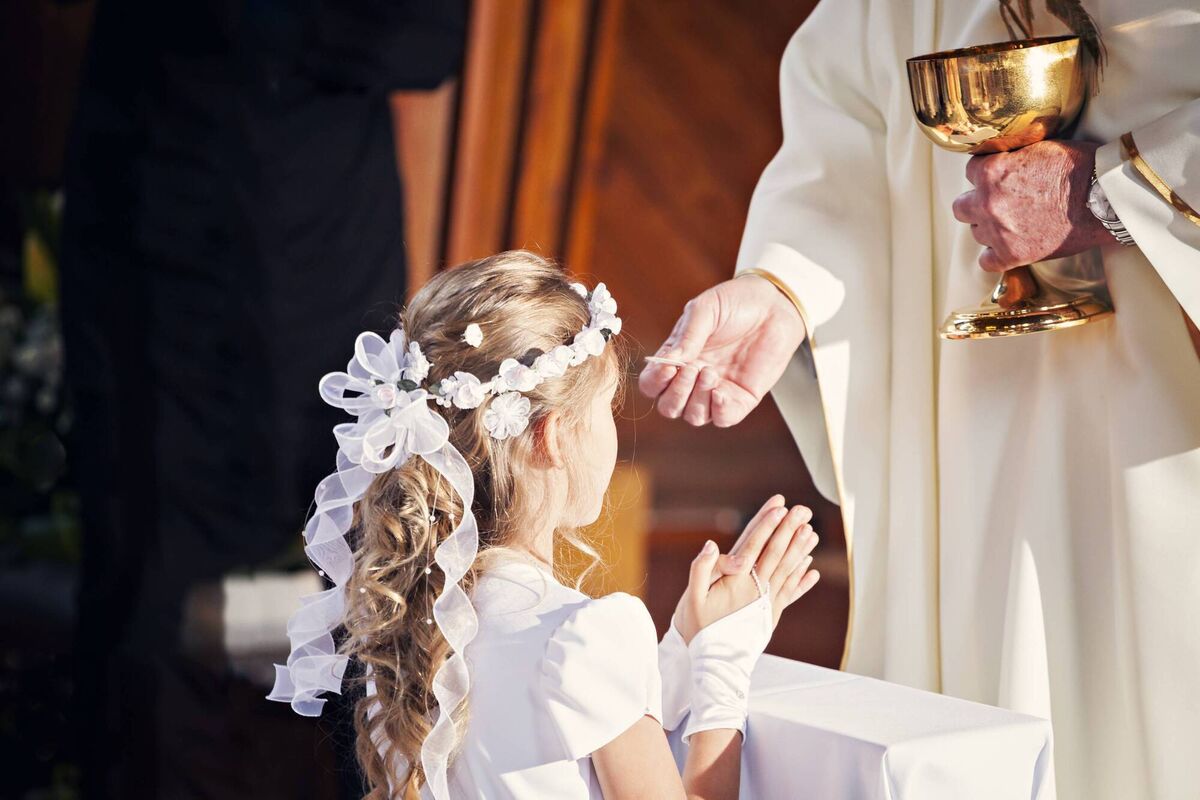
Then there is preparation for the sacraments, such as first communion. This is conducted during the school day and can be a time of great excitement, but again excludes those who are not taking the sacraments.
The UN committee on the Rights of The Child has repeatedly stated that Ireland is in breach of the UN convention of human rights for its failure to provide an alternative education for non-Catholics. Instead of doing its duty, successive governments have filed this offensive anomaly away in that corner of public life where resides an Irish solution for an Irish problem.
Everybody accepts that the status quo needs to change. The government throws shapes which it casts as its “action”. Vested interests work to circumvent this change and stasis follows. This has happened time and again over the last half century in various aspects of public life.
Attempts to realign patronage in a manner appropriate for this state began 13 years ago when then education minister Ruairi Quinn set up the Forum for Patronage and Pluralism for that purpose. The aim at the time, he said, was to reduce the number of Catholic patronage schools from 92%, as it was, to 50%. Quinn had a genuine commitment to the policy.
Despite the forum’s best efforts, and other separate initiatives since, the current level of Catholic primary schools stands at around 88%. Following one fresh initiative in 2016 just four schools changed patronage. Currently, just one in every 20 schools in the state are multi-denominational.
In the 2002 census, around one quarter of parents with children under the age of four replied that they had no religion. Something simply does not add up.
This week, we heard of the latest call to action. Parents of all children up to the age of 12 are being asked to take part in an online survey to determine what kind of patronage they want for their local school. They are also being asked whether they want a single-sex or co-ed school.
Outlining the proposal recently, the secretary general of the Department of Education, Bernie McNally, said parents would complete the questionnaires “in the privacy of their own homes”. She warned that this was a sensitive matter where “sometimes misinformation can thrive”.
By any standards, it is deeply worrying that the top official in the department felt compelled to emphasise that parents can engage with this in the privacy of their own homes. Why should expressing a view of this be considered as sensitive as might have been the case half a century ago?
Yet Ms McNally was entirely justified in expressing the matter in those terms because misinformation, often disseminated at public meetings over the last 13 years, has proliferated. Such disinformation has been designed to attempt to retain, for the greatest part, the status quo.
Parents have sometimes been presented with predictions that the change being attempted could lead to terrible outcomes, such as Christmas being abolished in state-run or even multi-denominational schools.
The whole process of change has frightened off some parents. Better the school you know than the one that is new.
For instance, some parents might want their children to take the first communion, but baulk at the idea that they may have to actually engage with the process, or that preparation takes place outside the school day, as is the case in multi-denominational schools.
Beyond all that, it is difficult to escape the conclusion that elements within the Church have ensured that change will not occur in a manner that might in a way be perceived as contrary to the institution’s interests.
Sure, they will say that this is all about parental choice. But as outlined above, parents can and often have been subjected to the kind of pressures that push them in a particular direction.
Apart from that, surely there is a case for throwing this issue out to the public beyond those who are, or will be in the next four years, parents of primary school children. Why should that transient cohort, at this point in time, be the constituency for this poll?
Parents, for instance, of children in fifth and sixth class are highly unlikely to be concerned interests by the time any change is effected as a result of this survey. If such a survey was undertaken when the whole process kicked off 13 years ago, I, and thousands of others like me, would have been included. That’s no longer the case.
The principle of parental choice can be a weapon as well as a right. Any decisions emerging from this latest process will impact, in the coming years, on parents of children as yet unconceived, not to mind born. Surely there is a case that a process which is so fundamental to rights should have an input across the whole society.
There are voices within the Church who acknowledge the current configuration is not fit for purpose. They know that Catholic patronage, as overseen in this society, has precious little to do with inculcating the primacy of the religion in a child.
A Catholic school network that exclusively attracted adherents of the religion could provide a properly focused education. Instead, it would appear that the focus is on numbers rather than concentrating on those who actively want a Catholic education.
Meanwhile, don’t hold your breath in anticipation of change coming with the current survey. After 13 years of miserably failing to install a patronage choice fit for purpose, there is precious little reason to believe that it will be different this time around.
CONNECT WITH US TODAY



Be the first to know the latest news and updates