Clodagh Finn: Accidental Casement sighting upended Mary Gorman’s life

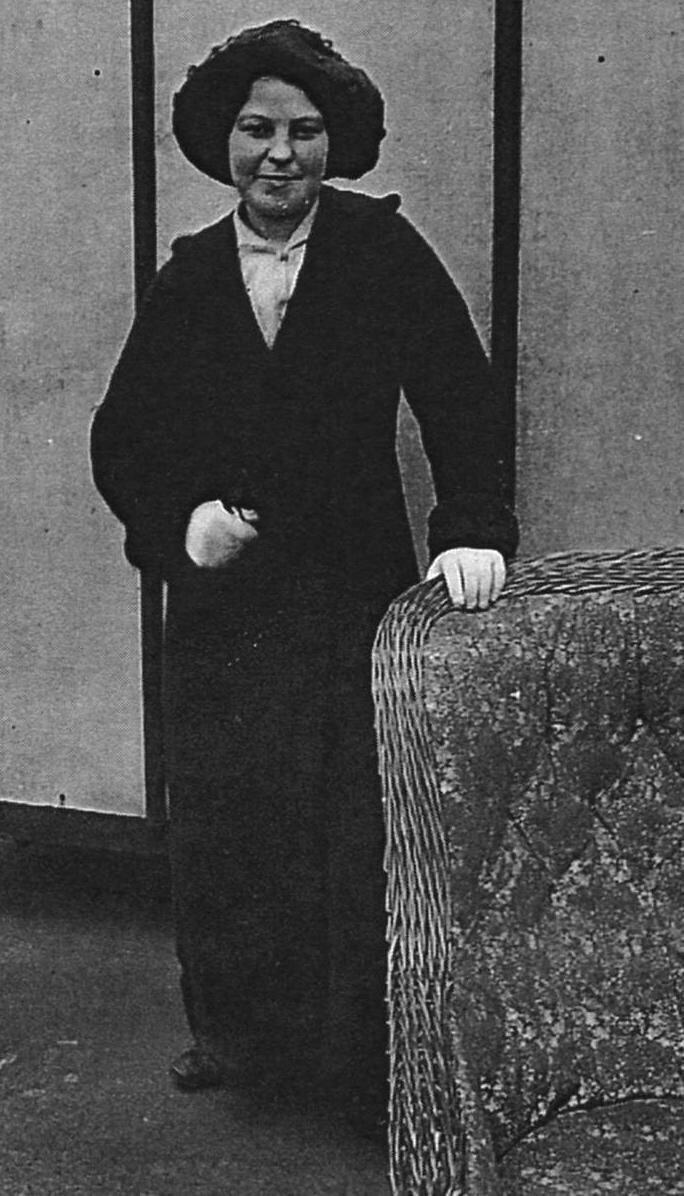
Mary Gorman on a sightseeing visit to the King George V Military Hospital while in London to give evidence at Roger Casement's trial in 1916.

At this time of year, I often think of Mary Gorman, a 17-year-old farm servant from Ardfert, Co Kerry, whose life was upended by what she saw in the early hours of Good Friday morning in 1916.
Her account of it would later turn her into a media sensation in London, but she was considered a traitor or, at the very least, an informer at home.
She ended up in a workhouse and later spent more than a year in a Dublin hospital before feeling obliged to emigrate under an alias, Julia Quinlan, in 1920.
All of that happened simply because she was up at cockcrow on April 21 in 1916 and happened to see three strange men carrying overcoats — that detail would prove crucial — pass the gate of her workplace, the Allman farm in Knockenagh, Ardfert.
She had no idea that the men were Roger Casement, Robert Monteith (the only one to escape) and Daniel Bailey. Or that they had travelled by submarine and come ashore in a small boat at Banna Strand as part of a plan to land guns and ammunition for the Easter Rising.
HISTORY HUB
If you are interested in this article then no doubt you will enjoy exploring the various history collections and content in our history hub. Check it out HERE and happy reading
Mary Gorman had simply seen them and, with four other ordinary civilians, found herself caught up in an extraordinary set of events which would affect them for the rest of their lives.
The nature of those extraordinary events, and Roger Casement’s ill-fated role in them, are very well known. Even so, another new book — by Roland Philipps — chronicles the life and legacy of the slavery-exposing diplomat and Irish rebel who was executed for high treason in August 1916.
Few, however, remember the fate of Mary Gorman and four other accidental witnesses who were subpoenaed to give evidence in London.
Although that is not quite true because Helen O’Carroll, curator at Kerry County Museum, has written an excellent account of the civilian witnesses at the Casement trial and how their testimony, given innocently and without any political motivation, was later held against them.
In early May 1916, two weeks after Roger Casement’s arrest, five Kerry people were on their way to London. Four of them were from Ardfert — Mary Gorman, John McCarthy, Michael Hussey, Martin Collins (aged just 12) — and one was a driver from Tralee, Maurice Moriarty.
All of them suffered as a result but, as Helen O’Carroll points out, Mary Gorman seems to have suffered most; she was the only woman and the one who seems to have borne the brunt of the negative comment when she returned to Ardfert.
At first, it must have seemed like an impossibly glamorous adventure. Mary was lodged in Shaftesbury Hotel in central London, given clothes by Lady Limerick and a daily allowance of £1 a day — a fortune for a farm servant.
There’s a photograph of her and two other witnesses on a sightseeing tour of King George V Military Hospital, but it was the studied portrait of her wrapped in a large cape that appeared in the press under the caption “Kerry Colleen” as soon as she started to give evidence at the Magistrate’s Court in Bow Street in mid-May.
The British press went to town on all of the witnesses from Kerry, depicting them as peasant half-wits. They made fun of their accents, claiming it was near impossible to understand the thick Irish brogue. As the only woman, Mary Gorman became a particular focus of attention.
“Colleen’s Brogue Which Counsel Could Not Understand,” ran the headline in the , above an article explaining that legal counsel Mr Bodkin could not understand the “rosy-cheeked, round-faced” Mary Gorman. After asking her a question three times, he asked her to write the word ‘Rathoneen’, a townland in Ardfert.
It didn’t appear to bother her though; the article went on to comment that she was “a typical Irish colleen [who] showed not a trace of nervousness in the box”.
The christened her “the Irish Molly” in an interview she supposedly gave during a visit to the paper’s offices.
It began: “Sure but London is a great place, I’m after thinking, said Molly, with her face wreathed in smiles and her big brown eyes a-twinkle”.
It continued in the same breathless stage-Irish vein with ‘Molly’ agape at the wonders of the motor buses and electric buses “a-hurrying and scurrying as tho’ they’ve got to catch someone three miles ahead of them”.
The only line she might plausibly have said was this one: “No, we don’t hurry so much in Tralee but we get there just the same.”
The interview, with its claims that she had visited the gardens at Buckingham Palace, Westminster Abbey, Piccadilly, and Leicester Square, were republished in the papers in Kerry.
The of May 27, 1916, at least had the grace to preface the report with this question: “We wonder if many Ardfert people will recognise their neighbour, or if she will know herself as being the person alluded to in this highly coloured and fantastic description?”
While the press made fun of the Kerry witnesses, their testimony was key in linking the men who arrived at Banna Strand with Germany.
Mary’s testimony that she had seen them carrying overcoats proved significant because a train ticket from Berlin to Wilhelmshaven was found in the pocket of one of the coats.
After the trial, Mary Gorman and the other witnesses returned to a changed Ireland. The executed Easter Rising leaders were all heroes while those who gave evidence against Roger Casement were seen as anti-patriotic, even traitors.
Mary Gorman’s job at the farm was gone and she was forced to return to London where she got work in a munitions factory.
In 1917, a snippet in the of April 28, 1917, tells us that she ended up in court herself, charged with committing an offence — which is not specified — with a New Zealand soldier on Hampstead Heath. They were both fined 20 shillings.
Later that year, in November, she returned to her grandmother in Ardfert and sought treatment, under the name Mary Donaldson, at the workhouse infirmary in Tralee. She had syphilis which, she said, she had contracted from an Australian officer.
Her identity was soon discovered and news of her interview before the guardians of the workhouse made all the papers. The of January 7, 1918, for instance, reported that she had married a soldier named Donaldson, but had no marriage certificate or separation allowance.
“Crying bitterly, she exclaimed, ‘I do not care what becomes of me’,” the article concluded.
Two men did care what became of her, though. The infirmary’s medical officer, Dr Coffey, and local government inspector, Alfred Delany, persuaded Dublin Castle to fund her treatment in Dublin at Dr Steeven’s Hospital, away from the gossipers and the finger-pointers.
Mary Gorman assumed a new alias and entered Dr Steeven’s hospital as Julia Quinlan, her grandmother’s maiden name, in April 1918.
She wasn’t yet 20 years old, but this servant girl born in a small rural community on March 23, 1899, had already seen more of life than most do in a lifetime. And there were a few more twists and turns to come.
CONNECT WITH US TODAY



Be the first to know the latest news and updates