Sarah Harte: We must help asylum seekers and drop the ‘them and us’ mentality
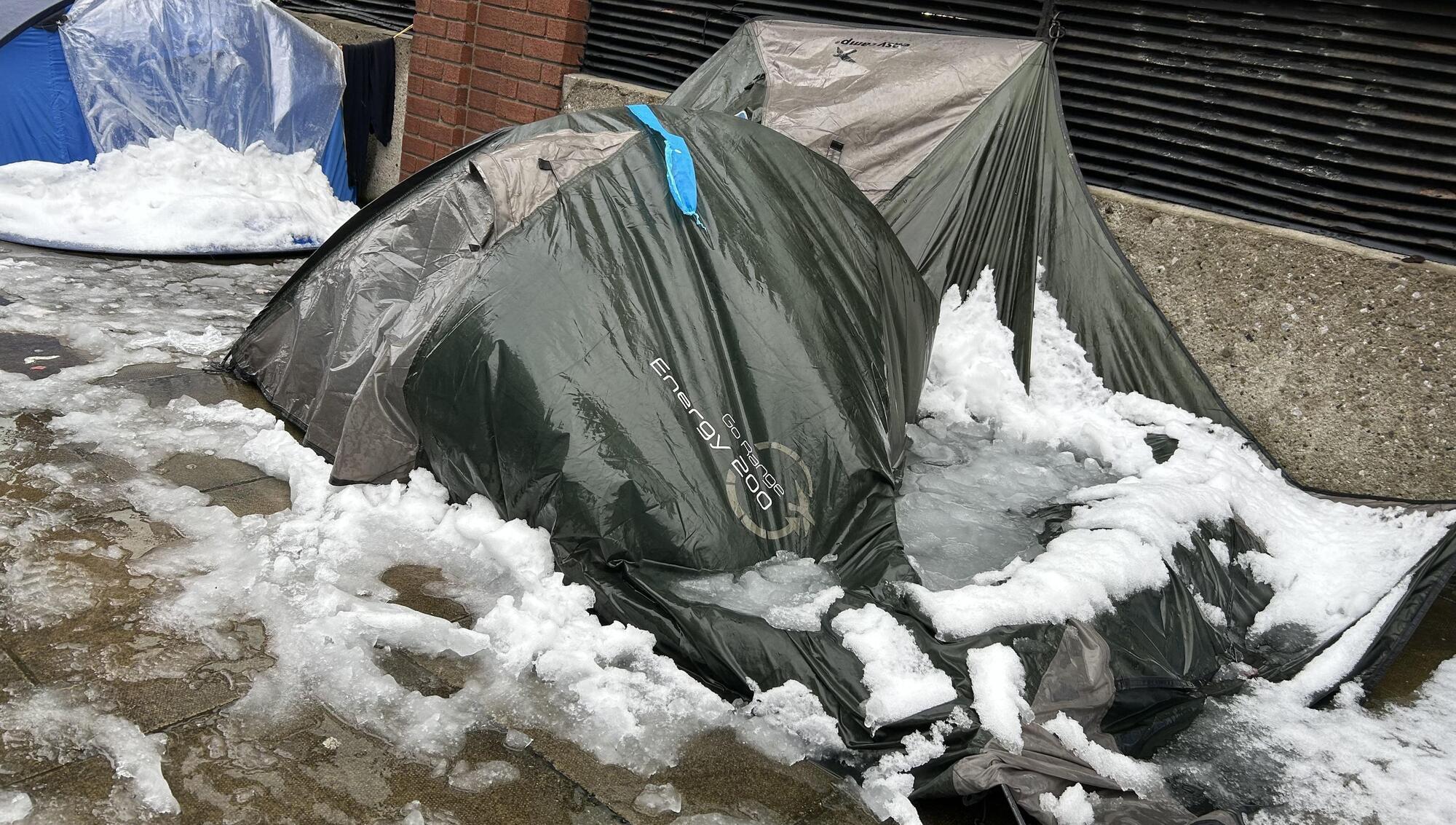
Tents, some flooded and collapsed, used by migrants and other people experiencing homelessness outside the International Protection Office during a period of snow in Dublin. Picture: Cillian Sherlock/PA Wire

Reports this week of two 17-year-olds sleeping in sodden tents outside the International Protection Office in Mount Street have been deeply uncomfortable to hear.
In human rights law, we are supposed to offer asylum seekers, food, medical care, basic hygiene, and accommodation as we examine applications for protection. It seems highly likely the Reception Conditions Regulations have been breached as well as the Charter of Fundamental Rights of the European Union.
According to radio reports last week, people in freezing tents have to walk half an hour to use the toilet, and now children are living among them, the question arises again, what duty do we have to international protection applicants, otherwise known as asylum seekers or sometimes refugees?
Given that the enormity of the migrant crisis currently shaking the foundations of European politics is merely a foretaste of what is to come, these questions are not going away.
Our laws govern the conditions under which applicants can apply to stay here. However, many philosophers would say that our moral duty of asylum exists independently of any law.
They would argue that a country’s boundaries are artificial, arbitrary constructs. As human beings, we co-exist in one natural world. Nationalists vehemently disagree with this perspective, insisting on boundaries, and foregrounding the contractual relationship between a country's citizen and its state. What do the rest of us feel, those who are not philosophers or nationalists?
You’re on the sofa at night, at the close of a long day, confronted by the nine o’clock news of shots of people, usually just their legs with wheelie cases walking down a street, having been turned away.
Since the crisis of accommodation began here for asylum seekers, I have, like so many others, been conflicted on this issue. Part of me thinks we should not accept any more applicants until we can properly accommodate them and fulfil our legal obligations which we are currently not doing. Department of Integration figures published last Friday suggest that 1,103 asylum applicants are sleeping rough.
One young man who had escaped persecution in Afghanistan and sought asylum here speaking to this newspaper described living in a tent on the Dublin streets as “hell”.
Another part of me questions that first part, wondering if what I am unconsciously saying is that we are full up. That in reality concern for the asylum seekers is simply a fig leaf for not wanting any more people to come to threaten our social cohesion and make demands on our services and strained infrastructure.
It can be tedious to be lectured by wealthy individuals, and by this, I mean people who own their own homes and do not have to fight for services or school places. Here I refer to politicians, some senior journalists, and well-paid NGO types.
Also, you wonder how some of those views would hold up if the State was to compulsorily purchase land in some of their leafier suburbs and take away their gardens to build reception centres.
On that subject, Minister for Integration Roderic O’Gorman had indicated that a new plan will involve the State building more than six new centres to house hundreds of asylum seekers. Where they will be located will be a politically sensitive topic, particularly with local elections on the horizon.
Reception centres, both temporary and longer-term, should, where possible, be built in places like Sandymount and Douglas because, as our politicians and talking heads never tire of saying, we have responsibilities as a wealthy country. The time has come for the burden to be spread around more evenly.
Anyway, last weekend, I watched a film on Netflix called which deals with the rehousing of Syrian refugees in a northern English mining community that has been economically gutted by the closure of the pits.

It’s a Ken Loach film, and it could be his final one although I didn’t know that until after I watched it.
It analyses what happens on the ground when asylum seekers are shoehorned without consultation into a community that already has social problems.
The film is a study of the community’s response. The tired, traumatised, displaced Syrians disembark from a bus. Locals watch a group of Syrians being given free clothes, food, and in one case a bike by a group of community workers. Why don’t I get a bike, asks one English boy. The stressed-out social worker doesn’t have a response.
The feelings of the regular drinkers in The Old Oak pub as they discuss the new arrivals are mixed and not set in stone as the story unfolds.
Views range from “we don’t need no rag heads in our pub”, to an obvious discomfort at the plight of the refugees set against an understandable anger at how, as the indigenous population, they have already been left behind. There’s a great line, when one man says: “I’m not against refugees or emigrants, I’m no fucking racist, God my father was Irish.”
Or: “There’s fuck all in this village and we’re supposed to share it with them.” They are worried that the Syrian kids don’t speak English and will hold their kids back.
“They always put them around here, never in Chelsea and Westminster,” someone remarks. “They don’t want them living by them, so they dump them on us by the busload. Posh ones make you out to be a racist, I’m fucking sick of it man.”
A relationship forms between Yara, a young Syrian photographer, the catalyst for the transformations that occur as she documents the ordinary everyday lives of people, and TJ Ballantyne, a depressed middle-aged pub landlord of the Old Oak.
The line “We can’t even look after our own” is arguably at the crux of the movie, that pressing question of who are our own. Ken Loach asks who is our compassion for and why do we feel compassion for some people and not others?
I can’t recommend this film enough. It brought home to me that it is through art that we best ask and answer such fundamental questions. There is nothing more powerful than people's stories.
The last scene in this affecting, beautifully crafted, and raw movie stays with you. No spoilers, but it speaks to our common humanity, and it hits you in the craw that there is no them and us, and no boundaries, there are just people.
CONNECT WITH US TODAY



Be the first to know the latest news and updates