Mick Clifford: Shambolic housing policies here to stay
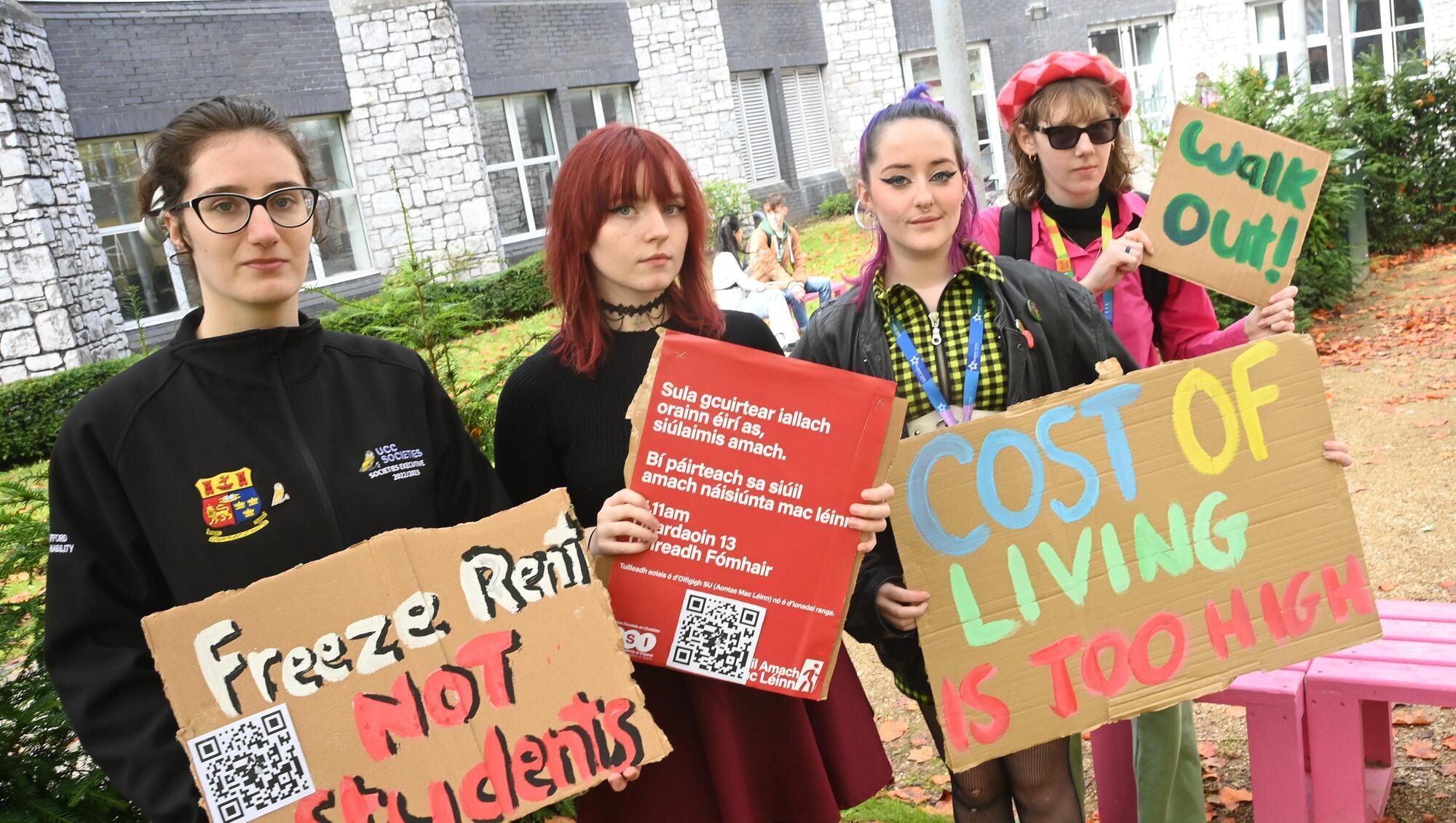
Students Jennifer Clifford, Grainne Stembridge, Orlaith O'Byrne and Maeve Bartley at the USI student walkout protest at University College, Cork as students walked out of lectures to protest living conditions.
On October 4, 2018, the Dáil declared housing to be a national emergency. Earlier that day, over 10,000 people protested about the prevailing situation on the streets of Dublin. The motion to declare the issue an emergency was proposed by People Before Profit and supported by all opposition parties, including Fianna Fail. The government, led by Fine Gael, opposed it but was obliged to act on it.
Following that resolution, precious little was done to reflect that we were living in extraordinary times in relation to housing. The only real radical policy to be implemented at the time to reflect an emergency was the introduction of the concept of Strategic Housing Developments (SHD). These proposed developments of more than 100 housing units, were allowed bypass local planning authorities and apply directly to An Bord Pleanála for planning permission.
The idea was to speed up the process and its implementation followed major lobbying from the construction industry, based on the claim that delays were a huge part of the problem in the “delivery” of new homes. Other interests in the sector, approved housing bodies, academics, unions, economists, and opposition politicians all had other radical ideas, but none were touched.
On the same day, Ukrainian women and children were told they were to be uprooted from their current base in Killarney and moved to Mayo. This disruption to lives already damaged is part of managing a system in which there is a dearth of accommodation of any sort, to the point where some refugees are now sleeping in tents. ( The move was abandoned later in the week following local protests).
On Tuesday, an Oireachtas committee was told that a plan to partner Dublin City Council with developers to build social and affordable housing on sites with unused planning permission received just one application. What might ordinarily look like a good deal for a private developer is apparently just not worth the trouble.
On Wednesday, it emerged that Dublin City Council was considering legal action against ABP over permission granted for 350 homes in an area where the council intends to provide 2,000 homes. This was another SHD plan.
On Thursday, the Housing charity Threshold published a report that showed there were just 716 homes available to rent in the state last August, compared with an average of 9,300 at any one time in the years between 2006 and 2019. It also emerged that construction has begun in just one in five SHD developments in the greater Dublin area, for which planning permission has been granted.
The myriad different problems that arose in a typical week highlight how dysfunctional is the housing sector. It is not, as some government figures claim, just a matter of building more homes. Affordability is a key issue and building more homes isn’t going to solve that. What we have in housing is an emergency without an emergency response.
Since the Dáil vote in 2018, this country has had two other emergencies. In 2020 the global pandemic required major upheaval in all facets of life. The various restrictions and assistances that were necessary were implemented in jig time. For the greater part, the government’s response was commensurate and implemented with speed and a pretty high degree of efficiency.
Then earlier this year, another emergency landed on our shores. The war in Ukraine required a rapid humanitarian response to accommodate those fleeing for their lives. That response has come under serious strain and there have been major kinks in the processing of some forms of accommodation. But all the stops have been pulled out. For instance, within two months of the commencement of the war, the minister for housing ordered the establishment of an Emergency Housing Delivery Unit. Crucially, he also ordered every local authority to appoint a full-time staff member at Director of Service level, “supported by a small team” to co-ordinate the response across society in providing shelter for these war refugees. Again, the actions on foot of an emergency were commensurate and speedily taken.
Why was no director of service in local authorities ever seconded to oversee locating and providing enough housing units to at least make some impact on the crisis?
The only policy anyway radical was the SHD process, which was wrong-headed, counter-productive, and driven by developers who pitched that a cumbersome planning process was at the heart of the problem
Take one current issue that is occupying the body politic — whether or not to implement an eviction ban for the coming months. As things stand, this is going to be a savage winter for many, but particularly for those who could be in danger of losing their homes. According to the Threshold report, a person “facing a landlord-led tenancy termination or a rise in their rent will likely have few alternative options available to them, with limited supply in the market, and market rents in excess of what many renters can afford.”
Why has the eviction ban not been introduced long before now, as we know exactly what is being forecast? Why, in a broader sense, has there been a complete reluctance to implement proposals that would be radical in ordinary times but are just sensible during an emergency?
The reality is that any radical proposals that might impinge on the more powerful elements of society are simply off the table. The robust argument for greater security of tenure for renters would be resisted by property owners. Anything that impacts on the construction industry would be resisted tooth and nail. And anything that might impact house prices for homeowners is also off-limits. So we have an emergency, kind of, but not one that can be addressed as other emergencies have been because it might impact on those who occupy the heart of the electorate.
There is no panacea for the housing emergency. There is no silver bullet, no change of government, no single big idea that is going to make an impact. But until such time as it is accepted that this is actually fracturing democracy, in terms of breaking the social contract, and radical measures contemplated in the public interest, it’s difficult to see how things are going to change.