New offer could see public sector workers get payrises of up to 10.75% over two years and nine months
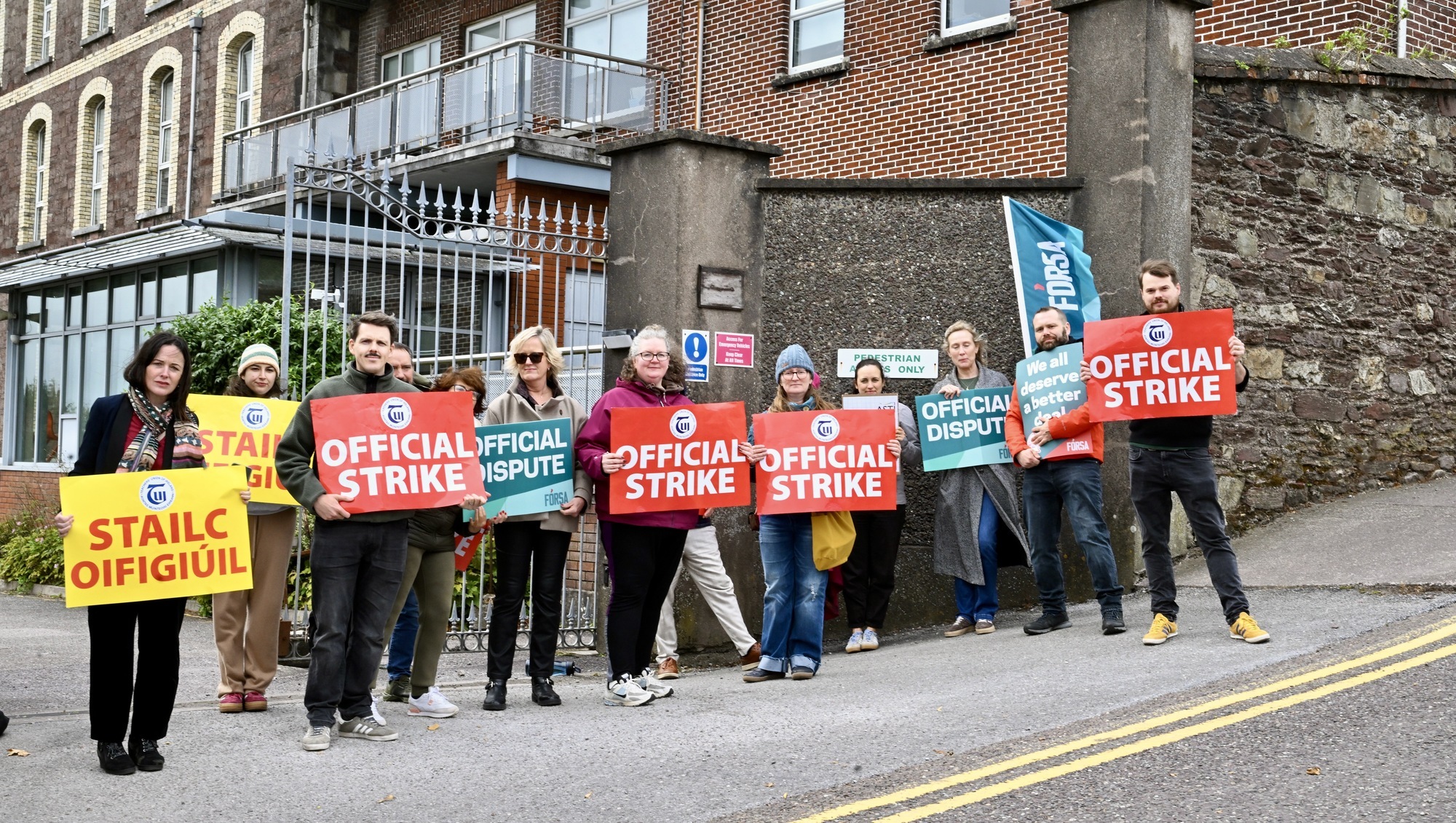
Workers from ASTI, TUI and Forsa unions on the picket at Cork Educate Together Secondary School (temporarily based at Griffith College, Cork) during the national strike by public sector workers last month. Picture: Larry Cummins
Public sector workers could receive payrises of up to 10.75% over two years and nine months, under new terms being negotiated on Tuesday evening.
The understands that the revised terms were put on the table by the Government-appointed group seeking to end the deadlock, which is being led by WRC chair Kevin Foley.
It would include a 2% backdated pay rise from September this year, as well as a 1% rise under local bargaining.
The remaining 7.75% would be paid out over the course of two years and three months.
There would also be provision for lower paid workers, providing them with up to 17% pay rises over the duration of the agreement.
The deal, if agreed, would run up until March 2029.
Talks are still ongoing, with discussions currently focused on the non-pay elements of the deal.
Talks between unions and the Government are still underway at the WRC, with hopes within the coalition that a deal can be reached to avoid strike action on Thursday.
Government sources were hoping that discussions would conclude in the “coming hours”.
The latest offer is another increase from the Government's updated offer from earlier this week, which promised a 10.5% pay rise for all public sector workers over three years.
Earlier, Fórsa general secretary Kevin Callinan said there are a "number of matters outstanding" in talks between unions and Government but added: "We're not optimistic, we're not pessimistic.
"We're seriously going to try and negotiate a public service deal."
Mr Callinan said it is "impossible to say" whether strike action could be called off today.
"It all depends on how the day goes and how quickly we can manage to reach agreement on the outstanding matters.
"We're committed to trying to close out a deal today, but really, that's going to depend on how the talks go."
It is a marked change in tone compared to union leaders' communications in recent days, which have doubled down on the strike going ahead on Thursday.
Any deal reached today would require approval of the Irish Congress of Trade Unions (ICTU) public services committee, as well as affiliate union bosses.
It is understood that a final decision on whether to hold the strike could be made as late as Wednesday.
Talks aimed at agreeing a new public sector pay deal had taken a major step forward overnight.
The engagement process with the Government Appointed Group concluded late last night, with the group identifying a basis for resolving the issues referred to it.
The matter has now been referred back to the Workplace Relations Commission (WRC), which will facilitate discussions between the Government and unions aimed at finalising a new public service pay agreement.
In recent days, the Government tabled a pay offer worth 10.5%, with some lower-paid workers set to receive increases of up to 17.8% over the lifetime of the deal.
Read More
However, Fórsa deputy general secretary Katie Morgan told members on Monday afternoon that preparations for Thursday’s strike were continuing.
Union sources said that unless a deal is approved by Wednesday morning, Ireland faces a second all-out public sector strike in as many months.
Any stoppage would coincide with Ireland’s hosting of the European Political Community summit in Dublin, which is expected to bring together around 50 European leaders.
“Until we hear back from the negotiators on whether an agreement has been established, plans for the strike and rallies on Thursday must continue. So far, more than 50,000 members have indicated which rally they plan to attend,” Ms Morgan said.
Speaking to reporters at Lough Derg on Monday morning, Taoiseach Micheál Martin said he was not presenting the Government’s offer as a “take it or leave it” proposal, but rather as “a very substantially improved offer”.
“I think it meets all the criteria that were identified early on in respect of what would be the needs of a resolution of the issue,” he said.
“The Government wants a national pay agreement.
“We have expanded the public service over the last number of years; we want to be in a position in the future as well to have a sustainable budget that would enable us to continue to recruit teachers and nurses and special needs assistants, and many more public servants, gardaí and so forth, but to be able do that, you do have to have a sustainable budget, and there is always a balance between pay and services and future development.”
Mr Martin said he “genuinely doesn't believe there’s a basis for strike action this week” and that this week’s European meetings would go ahead, despite around 350 staff being set to be affected by a potential strike.
“The hosting of the European Union presidency has been an enormous task. An Garda Síochána have prepared well for it.
“The Defence Forces have, our national cybersecurity centre as well, and so I pay tribute to all involved and the work that people have been doing.
“This week represents the largest ever security operation in the history of the State. It would be bigger than even the visit of an American president. That’s the context.
“I think it’s important that we ensure that these events go off properly, which I’m very confident they will, and that they will be fruitful and productive also, in terms of content and substance of the meetings.”
Harris says agreement is within reach
Speaking in Brussels, Tánaiste Simon Harris said he believed a deal between the Government and unions was “within reach”.
“I think very significant progress has been made,” Mr Harris said.
“I would really encourage everyone to make that last push to try and get an agreement today.” The Finance Minister added that any deal would provide “certainty” for public sector workers and ensure they received a “decent wage for a decent day's work”.
He said it would also restore industrial peace in Ireland.
“I really believe that a deal is within reach and I'd encourage everyone to work intensively towards that today,” Mr Harris concluded.
CONNECT WITH US TODAY



Be the first to know the latest news and updates