Parents crack the genetic code of their child's condition to find personalised treatment

Pic: iStock
When University of Galway academic Katarzyna Whysall gave birth to her daughter Niamh in July 2020, she knew almost instantly that something was amiss.
“She had seizures within the first two days of her life,” Whysall says.
“Within ten days, she was put on an anti-seizure medication, and shortly after, because her seizures were so early and increasing in time and duration, she had her DNA sequenced within a few months of being born.”
Sequencing, the process of reading the 3.2 billion letters that make up a person’s genetic code, revealed that Niamh’s condition was likely because of variations in a gene called ATP6V0A1.
An estimated 300,000 individuals in Ireland live with around 6,000 different rare diseases, but in Niamh’s case, her condition is more obscure than most. “She’s the only known one in Ireland with a variant in this gene,” Whysall adds.
“Our neurologist really didn’t know what this means because this is a newly discovered disorder.”
Three years later, Niamh’s seizures are under control, but she experiences some mobility issues.
Yet because the biological consequences of her particular gene mutation are unknown, no one can predict her future, while doctors can offer little else other than recommend physiotherapy.
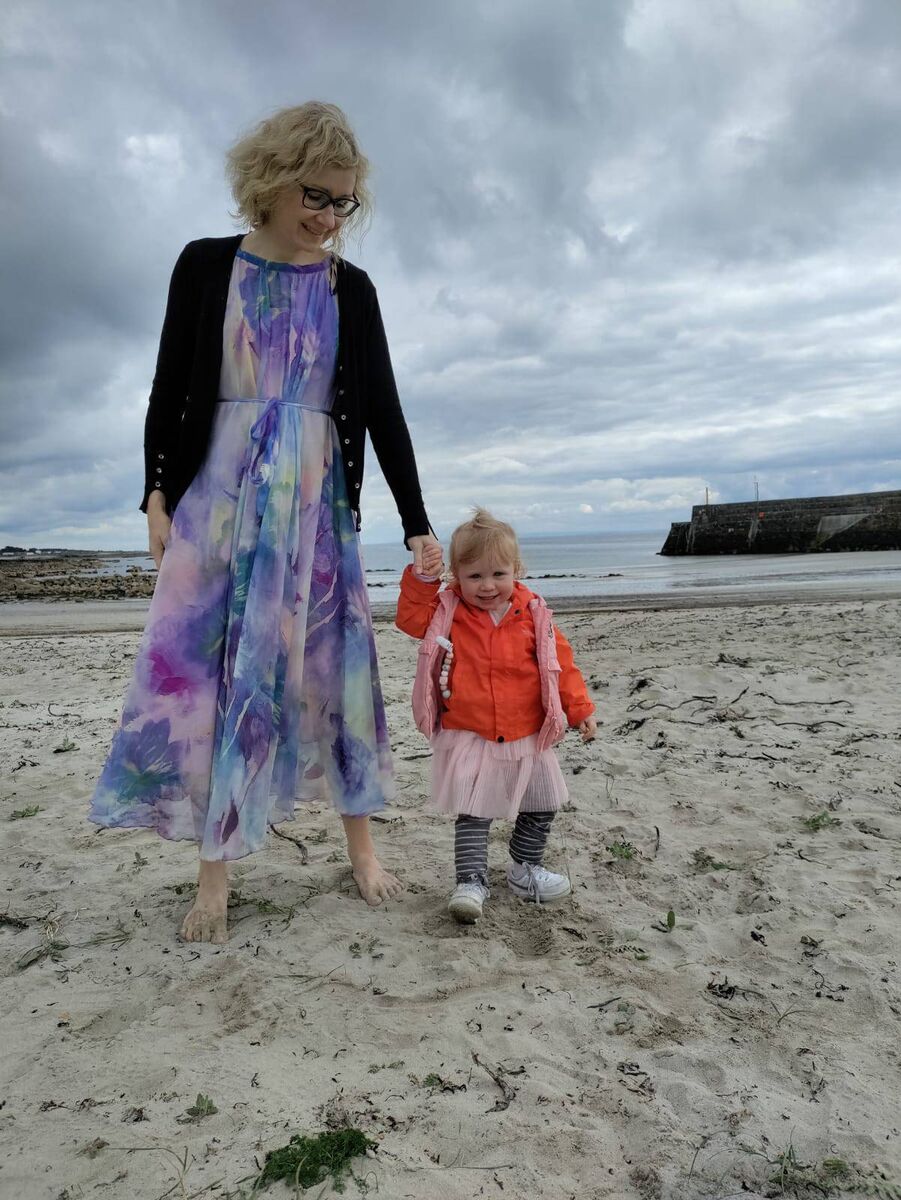
Faced with such uncertainty, Whysall and her partner Brian McDonagh, both biologists, have taken matters into their own hands.
Through painstaking work, they are attempting to recreate Niamh’s specific mutation and understand what it does to the human body.
If they succeed, they hope that this could eventually lead to a tailored medicine, demonstrating a pathway that could be replicated for other children living with rare diseases.
“We’re still trying to figure out what it means and if there is anything available that can prolong her ability to function, in addition to physiotherapy,” Whysall says. “We need to change the thinking that if there’s no cure available now, it’s not worth bothering to understand these ultra-rare conditions.”
Whysall and McDonagh are inspired by the story of American Julia Vitarello, who crowdfunded a personalised medicine for her five-year-old daughter Mila after she was diagnosed with Batten disease, a rare neurodegenerative disorder.
Working with the Boston Children’s Hospital neurologist Timothy Yu, the funding led to a drug they named Milasen in 2018, designed and synthesised in just ten months, a timeframe that normally takes more than a decade.
Though Mila died five years later, the treatment improved her quality of life, reshaping how public health institutions around the world perceive rare diseases. As an example of a novel technology called antisense oligonucleotides that targets mutated DNA and corrects their behaviour, Milasen helped demonstrate that personalised medicines are viable. The same technology has also been used to develop the first treatment for another rare disease, spinal muscular atrophy, and Whysall hopes it could one day be used to develop a treatment for Niamh.
“I think the Milasen story really brings home the perspective of a parent when it comes to rare diseases,” Whysall says. “You wonder, what will happen to my child? But it also shows the amazing things that can be done using science. Ten months is nothing when you think about the development of a drug.”
Improving screening
Last December, the HSE launched the National Strategy for Accelerating Genetic and Genomic Medicine in Ireland, which aims to improve access to diagnostic testing for children with suspected rare diseases.
For Gianpiero Cavalleri, professor of human genetics at the RCSI, Dublin, it is a much-needed change.
“Up to recently, our genetic services have been basically under-resourced,” he says. “But with this, parents will be able to get access to testing faster and even if there’s no treatment available today, that child will be one of the first to go on a clinical trial when one is developed, and for some kids that could be lifesaving.”
At one time, Ireland’s screening programmes for rare diseases were world-leading. In 1966, the Children’s University Hospital in Dublin launched one of the first national programs to screen for an inherited condition called phenylketonuria (PKU).
All babies in Ireland can now have heel prick screening at around five days old to check for PKU and other conditions.
But while other countries forge ahead with genetic screening programmes, comparable services here are lagging. For example, Genomics England recently launched a landmark programme using DNA testing to screen 100,000 babies for 200 rare but treatable genetic diseases.
“It hasn’t changed a whole lot in the last 20 years,” Cavalleri says.
“There is newborn screening here but they’re only looking at seven or eight different diseases, so it’s very limited and they’re not sequencing whole genomes.”
Cavalleri hopes that a number of new initiatives will help shift the dial. He runs a project called the Irish DNA Atlas, which has mapped the genomes of citizens whose great-grandparents were of Irish ancestry and looks to separate normal genetic changes that occur naturally in the population from those that may be related to disease.
He hopes that such information will help stratify genetic diseases such as cystic fibrosis, for which the prevalence is higher in Ireland than anywhere else in the world, and aid the development of more individualised treatments.
Precision medicines are beginning to emerge for various forms of cystic fibrosis, but they rely on doctors being able to identify patients with specific gene mutations who can benefit from those treatments.
“There’s a drug called Kalydeco, which is a great example of precision medicine,” Cavalleri says. “There’s a number of genetic changes which can cause cystic fibrosis and this drug only works on patients who have a subgroup of them. This just illustrates why understanding the precise cause of a disease is the foundation to putting treatments in place.”
Childhood cancer
One of the areas of healthcare where there is the greatest hope for personalised medicine is childhood cancers.
While oncologists are remarkably successful at treating cancer in the short term, patients from birth up to 25 remain at an elevated risk of developing secondary cancers later in life.
In addition, the toxicity of chemotherapy and other standard cancer treatments means that many subsequently develop chronic illnesses.
“Now, 90% of children, adolescents, and young adults with cancer in Ireland are cured of cancer,” Owen Smith, professor of child, adolescent, and young adult oncology at Trinity says. “That sounds fantastic, but it comes at a cost, and that cost is big in terms of chronic disease. They develop bone disease, brain disease, and cardiac disease, and so on decades later, but genomics is going to pull us out of this mire.”
Smith points out that the problem with conventional cancer therapy is it not only kills cancer cells but damages the germline genome, the vast regions of DNA we inherit from our parents, which leads to chronic illness.
He believes the future involves stratifying various common cancers into many different genetic subtypes and developing immunotherapies and perhaps even cancer vaccines targeted at each subtype.
This autumn, Smith is leading a new project that will see all cancer patients under the age of 16 having their full genome sequenced, with the aim of categorising the disease into subtypes, based on mutations.
“We’ve already done that in the commonest cancer in children, acute lymphoblastic leukaemia,” he says.
“There are 28 or 29 different mutational landscapes within the disease, which is giving us new targets.”
But while there is considerable investment being directed towards childhood cancer, Whysall says we need to create more national and international resources for families of children with ultra-rare diseases.
Along with Cathal Seoighe, a colleague at the University of Galway who specialises in bioinformatics, and the patient charity Rare Ireland, she is looking to develop a database to provide them with more information relating to what scientists understand so far about various unusual gene variants as well as acting as a useful resource for companies interested in running clinical trials to help these patients.
“We’re trying to create one website where we integrate data from validated resources around the world so families can search for a gene and get all the information we know so far about the variants in that gene,” she says. “Because of the low number of geneticists in Ireland right now, families will get a diagnosis, but the waiting lists to find out what it actually means are very long. So that leaves people in limbo for a long time.”
Whysall’s experience is a case in point. Having been unable to obtain a geneticist appointment for Niamh for over three years, she and McDonagh resorted to undertaking their own research to understand her condition, striking up collaborations with other researchers in Ireland and worldwide.
It is not always easy, but she says she has no choice but to work to secure a better future for her daughter and other families in the same position.
“Trying to study her condition myself can be quite hard,” she admits.
“Because you see things in cells and think, ‘Gosh, this is very severe.’
“So it’s not easy, but I need to do something. I can’t find a cure for her now, but maybe I can understand it better, and maybe it will help her and other children.”
CONNECT WITH US TODAY



Be the first to know the latest news and updates