Marketing guru uses Ryanair CEO as example to start-ups of raising their brand profile

Vice-chairman of Ogilvy & Mather Rory Sutherland speaking at the Pendulum Summit at the Convention Centre in Dublin. 'Robotics is going to be big in another five to 10 years as well.'
Start-up firms should “optimise for surprise” and don’t spend a lot of time doing things that “nobody will notice” in order to grab people’s attention, marketing guru Rory Sutherland has said, pointing to Ryanair's chief executive as someone who is able to keep things fun.
Speaking to the at the Pendulum Summit in Dublin, Mr Sutherland said that competing with entrenched competitors is unlikely to be effective and instead companies should consider new angles of attack.
Given geopolitical tensions, and the increasing push to move away from US tech firms and for people to find European alternatives, he said it would be a mistake for homegrown tech firms to try and compete with an “entrenched network entity head on”.
“You've got to come in obliquely,” he said.
"Find a territory which has been completely obscured by the fact that your competitors' metrics are placing the spotlight somewhere else. Explore that territory with a torch and you will find something where you can shine."
In terms of where European tech firms could focus, Mr Sutherland said he is not the biggest fan of Meta founder Mark Zuckerberg, but that his bet on “connected spectacles is actually the right bet”.
"Robotics is going to be big in another five to 10 years as well but don't try and replicate what they've done,” he said.
"Instead, create a European augmented reality (AR) layer for wearable devices. It would be really interesting to produce a distinctively European AR which is slightly less liable to enshittification.”
Enshittification is the gradual decay of online systems whereby they increasingly become poorer user experiences in order to maximise profit for the company.
In terms of companies, and chief executives, who are very effective at getting attention, Mr Sutherland pointed to Ryanair boss Michael O’Leary as someone who “stays playful” and “keeps it fun” as a means to further the airline’s brand.
Over the past few weeks, Mr O’Leary has been engaged in a feud of sorts with SpaceX owner Elon Musk over Ryanair’s refusal to install Starlink internet services on their aircraft. The airline boss said it would cost too much, through the cost of installation as well as additional fuel costs due to drag from the antenna.
He also said he doesn’t believe people will pay for the service.
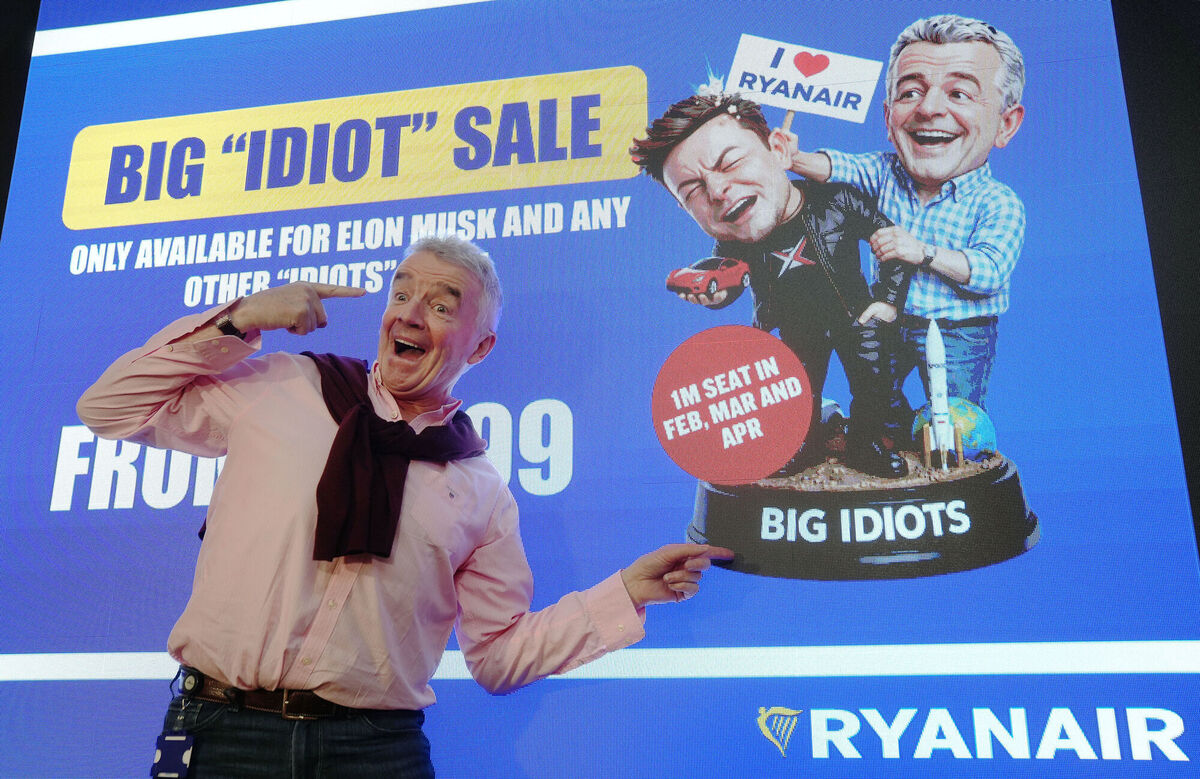
This led to a back and forth with Mr Musk who subsequently asked his followers on the social platform X whether he should buy the budget airline. EU airline regulations prevent non-EU nationals owning and controlling the airline.
Mr Sutherland called Mr O’Leary’s feud with billionaire Elon Musk “fantastic”, and called whoever does the Ryanair social media an “unacknowledged genius of the advertising industry” because of how funny they are.
However, he believes Mr O’Leary is wrong in that there are ways to make it more likely people will pay for internet on flights.
“As a behavioral science person, I don't know what you need to do to make up the fuel cost but there are ways of charging for it. If you could pay €5 or €10 and get unlimited wifi on Ryanair flights for two years, it could be used as a loyalty mechanism,” he said.
"If you found clever ways of pricing it, you could charge for it.”
Mr Sutherland also cited Irish drone delivery company Manna as a “fantastic” firm saying that he thought drone delivery was “pretty dumb”, right up until the firm’s founder Bobby Healy explained the economics.
“The problem you often have when you do something new is that the good is often invisible, and the new problem it creates is very salient,” he said.
"While Manna has been in operation, there have been seven moped accidents that haven't happened but on the other hand, if one can of beans lands on someone's Pekingese dog, it's on the front page,” he said.
On the future of AI, and its potential impact on marketing, Mr Sutherland said the technology presents “significant creative opportunities” for ad agencies as well as the general public.
However, what worries him is when the “bill comes due for AI”, organisations are going to look to savings.
“These organisations which have invested a few trillion dollars, and hardware is the depreciating expense, the bill is going to come due. They're going to have to sell and the easiest way to sell is always cost reduction.
"It's much, much easier to go into a board and say you can reduce your headcount by 27% than it is to go to a boardroom and say you can make your customer service fabulous,” he said, adding that you can have a balanced and nuanced take when it comes to AI.
CONNECT WITH US TODAY



Be the first to know the latest news and updates