Donal Lenihan: Springbok scrum strategy was about more than just punishing Ireland
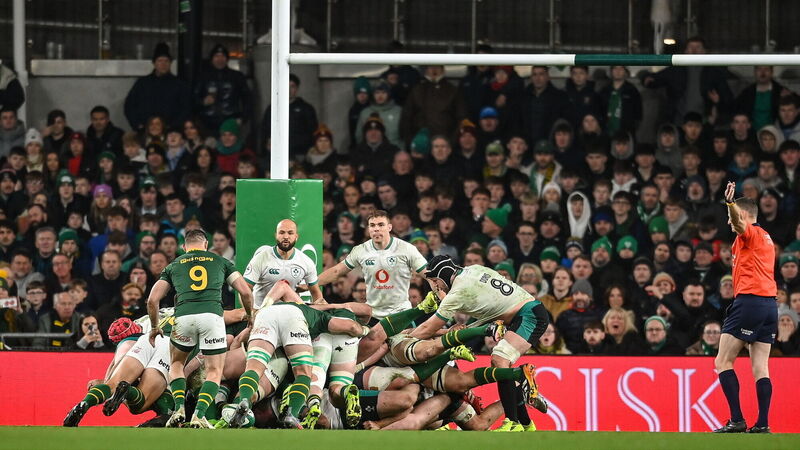
Ireland's analysts and scrum coach will be poring over video from the defeat to South Africa trying to figure out how the Springboks put so much pressure on the Irish pack. Pic: David Fitzgerald/Sportsfile
If I could see this coming, you can be sure the Irish management harboured concerns of their own. It’s not easy when your scrum is being dismantled. I know exactly what it feels like to be part of a scrum in disarray, torn apart on the international stage.
On February 21st next, Ireland face England in London in their third Six Nations game on successive weekends under a revised format designed to generate an extra week in an already overburdened rugby calendar.
With France away on the opening weekend, followed by an ever-improving Italian side in Dublin in round two, Andy Farrell could have done with a kinder schedule. The pressure will be on from day one - believe it or not, a Thursday night opener at the Stade de France. Not too much consideration given there for traveling Irish fans.
The game against England will mark the 40th anniversary of a scrummaging meltdown that lingers for the Irish pack that lined out that day. At least one Englishman still recalls it fondly as it helped launch a stellar international career of Leicester and England No 8 Dean Richards on his debut.
Richards scored two tries off the back of five metre scrums with a penalty try, just like last Saturday, being awarded off a third. Things got so bad at one stage our full back, Hugo McNeill, sidled up to me in the in goal area as we prepared to defend yet another assault.
“Donal, would it help if I joined the scrum”. My reply was pretty succinct. “Hugo, f**k off”. Now if it had been Bundee Aki, I might have considered it. Even more embarrassing for the forwards on duty, despite the concession of those three tries, we lost narrowly, 25-20 at the end.
I can sympathise with Ireland’s pack last weekend. As a front five forward, I know what it’s like. It’s humiliating. It may be a long time ago, but the principle remains the same. As the Springboks are wont to say, no scrum, no game.
It’s very difficult to retrieve a situation like that in the heat of battle, especially when the opposition are more energised by what’s unfolding, knowing they have the upper hand and thirsting for even more blood.
Our scrummaging collapse against England that day had a wider impact in the games that followed as every opposition set out to dismantle our scrum. In the end, a lot of hard work on the training field coupled with a few alterations solved the problem.
Right now analysts and scrum coaches from our Six Nations rivals, especially France and England, are poring over every scrum from last weekend, looking at what South Africa did to apply so much pressure on what is a very experienced Irish front five.
That’s what happens when a potential area of vulnerability is exposed so badly. The irony is, in Ireland’s most recent games against the Springboks, at the pool stage of the 2023 World Cup and the gripping two test series in South Africa the following summer with pretty much the same personnel on board, Ireland had no issues with their scrum.
If anything it’s the Springboks who should be feeling the pinch given they’ve had to replace three World Cup winning props in Steven Kitshoff, Vincent Koch and Frans Malherbe for a variety of reasons.
On the flip side, Ireland has placed an over-reliance on Andrew Porter in particular, who, in recent seasons has been tasked with playing into the 70th minute due to lack of viable cover. At least, with Tadhg Furlong ruled out through injury for long periods, Finlay Bealham and, latterly, Tom Clarkson have been offered plenty of exposure.
For me, 22-year-old loosehead Paddy McCarthy has been the most exciting player to emerge this month. I’d be shocked if he doesn’t go on to have a long and productive international career. Despite seeing yellow, along with three other Irish players last weekend, he’ll have learned so much from the experience of facing that South African scrum.
Since that test series against Ireland in 2024, Rassie Erasmus has looked at their stock of props, and spread the net even further. It’s been suggested that their ever inventive coach selected 6’2”, 124 kg loosehead Boan Venter, whose been playing URC rugby with Edinburgh since 2021, to make sure he didn’t qualify for Scotland on the basis of residency.
Venter has a way to go to match the scrummaging power of Ox Nche but for Erasmus, it’s all about building depth. With Nche absent due to an injury sustained in their opening tour game against Japan, Erasmus saw his absence as an opportunity to generate further game time for back-up looseheads in Venter and Gerhard Steenekamp. 21-year-old Stormers tight head Zachary Porthen, a former Junior Springbok captain, is another highly rated young prop who also made his debut against Japan that day.
He and a number of other young South African-based props, including Jan-Hendrik Wessels and Asenathi Ntlabakanye, have been working on an individual basis with scrum coach Daan Human on his farm in Bloemfontein, aimed at making them more explosive from a scrummaging perspective.
Either by accident or design - you wouldn’t put it past Rassie - videos have emerged on YouTube of Human’s punishing one-on-one training sessions designed to fast-track more depth in the front row turn their scrum into a lethal weapon.
Much of what Human does revolves around conditioning specifically designed to increase explosive scrummaging power, especially on the all important hit. He also uses what he calls a technique machine, used by one prop at a time, with the facility to apply varying forces at different angles.
I strongly suspect the Springbok persistence in taking scrum after scrum off the multiple penalties engineered from that source on Saturday was not only designed to punish Ireland but to send a message to international opponents around the world.
Ten of the 12 scrum penalties they won on Saturday were on their put in, an indication of the ruthless mindset Erasmus is nurturing. He knows that opposition scrums will look to get the ball in and out as quickly as possible on their own feed, as Ireland did with success from the outset.
It’s on their own put in, where the No 8 has the option to keep the ball at his feet and call a second drive, that enables them manufacture penalties. Erasmus took their desire to scrummage to a new extreme last July when South Africa deliberately kicked short of the required 10-metre line from the kickoff in order to generate a scrum with the intention of buckling the Italians from the off.
Once again this was a brilliant innovation from Rassie. It subsequently backfired when World Rugby confirmed after the game that it was an intentional “illegal violation” and that a penalty should have been awarded to Italy.
Outside of the set-piece failings that hampered Ireland throughout this Quilter Nations Series, the other area that badly needs to be addressed is the team's growing indiscipline.
In advance of last weekend’s contest, I highlighted the concern that one of the risks in attempting to match the gargantuan Springbok pack with a ferocity and physical intensity required to go toe to toe with them was the likelihood that it would lead to going beyond the bounds of what’s acceptable.
James Ryan’s reckless cleanout and subsequent 20-minute red card proved the perfect manifestation of this. He was lucky not to see a straight red which could still be applied on review.
On the basis of everything we’ve seen throughout a month of intense action, Ireland have lost ground on England and France. Having to face both on the road come Six Nations time, that challenge looks even bigger now than it did a month ago. Andy Farrell has a lot to address between now and February.
CONNECT WITH US TODAY



Be the first to know the latest news and updates