Kieran Shannon: Many Irish rugby relationships eventually strained. Not Farrell and Schmidt.
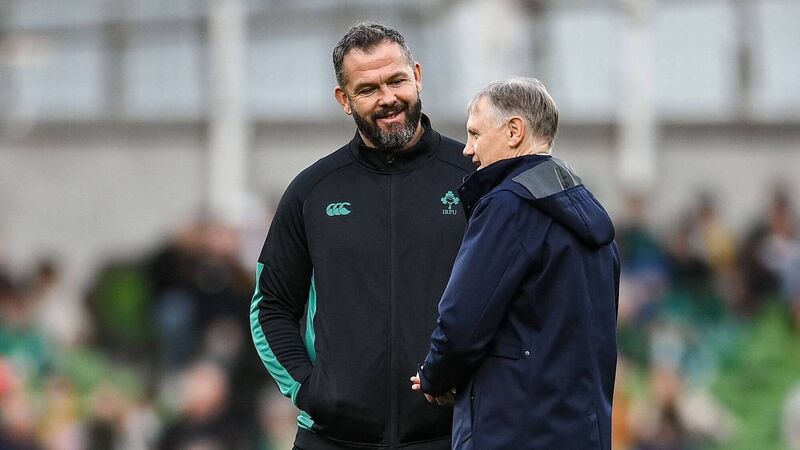
Ireland head coach Andy Farrell, left, and Australia head coach Joe Schmidt before the Autumn Nations Series match between Ireland and Australia at the Aviva Stadium in Dublin. Photo by David Fitzgerald/Sportsfile

About as intriguing a passage as any in Andy Farrell’s fine new autobiography explains how he steeled himself as Ireland’s new defence coach to persuade Joe Schmidt that he should fundamentally change how Ireland set up. As Farrell bluntly puts it in , “My ideas on defence were the opposite of his.”
Schmidt had been reared on the New Zealand method of defence where the emphasis was on watching the man. Farrell felt Ireland should switch to a defensive system heavily influenced by his own years playing rugby league where it was all about watching the ball.
“I wanted our defensive line to be able to adapt to whatever was in front of them, to present the fly-half or first receiver with a picture that was false,” he’d expand. “To ‘tell lies’ to keep the attacking side guessing.
“I think Joe [hired] me to bring new ideas and challenge his way of thinking but my philosophy was so far from his that it would be a major job to convince him to change… You’d have to be on point to convince him.”
The court where he’d make his case was Schmidt’s office at IRFU headquarters on Lansdowne Road in the months leading up to the tour of South Africa in 2016. “I made numerous presentations, involving hours of footage. It went on for weeks and rightly so.”
If Schmidt was to sell this to his players, he’d have to first fully buy in to Farrell.
Farrell likened the challenge to learning how to drive a car or play the guitar. In the middle of it you can feel overwhelmed. “How in the hell am I going to do this?” The key, he’s found to learning or achieving anything, is to persist and push through that middle part. Like he did in those meetings in Schmidt’s office, facing cross-examinations.
A couple of days before the Irish squad met up for camp in Carton House, Schmidt let Farrell know he was going with his plan. Soon therefter, Ireland were motoring, playing sweet music.
In the glut of Irish rugby books released over the last year, a recurring subtheme is how certain relationships became strained. Murray and Rowntree. O’Sullivan and Hennessy. Even, going by Brendan Fanning’s excellent , Farrell and Lancaster.
Not Farrell and Schmidt. While a source of Fanning’s in the Irish camp would confide that a part of Schmidt would have envied how players gravitated to Farrell because “he was direct and open and had that human touch that wasn’t forced”, at all times Farrell remained loyal to, and mindful of, the hierarchy. This was no Eddie and Gatland. Farrell gave the air of someone solely there to serve his head coach rather than sniff and seek out the position.
Schmidt had similar faith in Farrell. Johnny Sexton in his autobiography recalls meeting Schmidt for coffee months out from the 2019 World Cup and hearing how he envisaged Ireland playing and beating South Africa in the quarter-final. He had huge confidence that “Faz could get us in the right mental state to meet the enormous physical challenge that South Africa always present”.
When it didn’t pan out that way with a lame exit to New Zealand, Farrell, in his own words, “was gutted for Joe”. The king was dead. But now he had to live long himself.
To do that he had to do it the only way he knew while retaining some of the ways Joe did so well. “Joe had left behind an outstanding environment… I understood there were a thousand things that we were already good at so there was no way I was going to ditch them. All that intellectual property from Joe’s time stayed where it was… Yet I knew I had to make changes.”
It’s been well aired how more relaxed Carton House became, not least because there was a clear demarcation between it and the training ground. For starters, the training ground was now in Abbotstown rather than on the grounds of the hotel. “He knows that players don’t always want to be on,” Andrew Porter observes in . Conor Murray could smuggle a Big Mac meal into Carton without fear of his head coach getting the waft of chips in the elevator.
He brought a sense of levity, borrowing a page of Phil Jackson’s playbook by using humorous clips in the video room. When presenting Mike Catt to the players as their new attack coach, Farrell resurrected clips of Jonah Lomu running around and over a hapless Catt at the 1995 World Cup, with scrum coach John Fogarty adding commentary, sending Sexton and his colleagues into hysterics.
Yet Farrell was even more demanding on his players on the training ground and in the meeting room than Schmidt. “The big difference was that we would no longer be passive learners,” observed Sexton. “Joe’s voice had dominated meetings. And I had liked that. No babble. Only clarity.”
But Farrell encouraged players to ask questions because in his eyes there was no such thing as a silly one, though there was sometimes confusion. “At times,” says Sexton in , “I had to check myself from throwing my eyes up to heaven. But people were taking risks, people who would have hidden previously in meetings.”
On the training ground they began doing what Sexton had urged Schmidt in 2019 to do more of: scenarios rather than setplays; more games than drills.
To steel themselves for pressure, he’d set up situations where it would be 12 defenders against 17 attackers, or 17 defenders against 15 attackers. “It would force them to find space and when there wasn’t any, ask, ‘What are we going to do now?’” Farrell writes: “It all centred around decision-making.”
It has largely worked. Up to now. As Ronan O’Gara noted in these pages Friday, Ireland need a new stimulus and some fresh-thinking midway through a World Cup cycle – if they are to finally max out at the end of that cycle.
Irish players could detect a problem at the end of the 2019 cycle. In Fanning’s book there is a remarkable passage where a year out from the World Cup the author Matthew Syed spoke to the group about the benefits of the growth mindset. But during his talk a few players looked at each other: But we’re now fixed mindset. We were growth but we aren’t now!
Farrell says as much in his book. How a lesson from 2019 was that Ireland didn’t know how to make the boat go faster; they seemed content to just keep going at the same pace.
He learned that lesson under Schmidt, just as he learned many other invaluable nuggets. His next meeting with Schmidt at Lansdowne Road will give us an idea if Farrell has learned and devised further new ways for Ireland to evolve and finally have a book with a fairytale World Cup chapter and ending.
CONNECT WITH US TODAY



Be the first to know the latest news and updates