Christy O'Connor: How can Tipperary break the damning pattern of history?
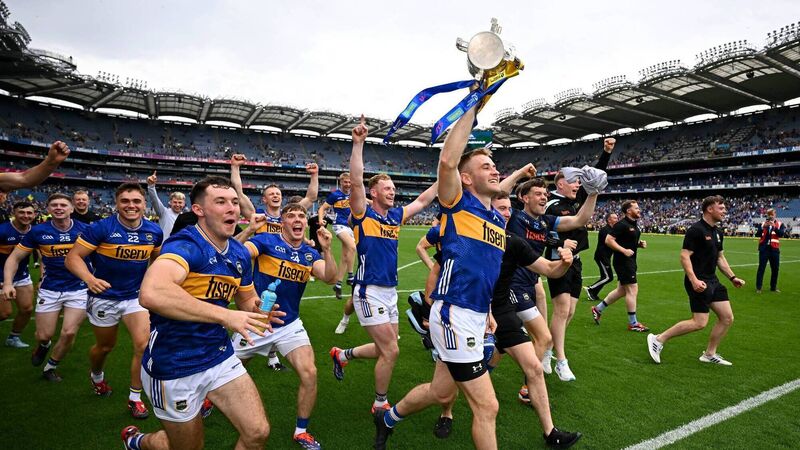
In the 61 years since Tipperary last defended their All-Ireland title, Kilkenny have successfully managed that feat eight times; Cork, three; Limerick have put four-in-a-row together. Pic: Seb Daly/Sportsfile

After Tipperary eviscerated Waterford in the 2011 Munster final, the historic data was strewn around like confetti. Tipp’s 21-point victory was the biggest winning margin for 29 years. Their seven goals was the most green flags raised in a Munster final since Limerick bagged eight in 1936. Lar Corbett’s 4-4 bettered the modern individual scoring record set by Mark Foley for Cork against Tipp in the 1990 final.
Corbett’s four goals came just ten months after his hat-trick against Kilkenny in the 2010 All-Ireland final. Since their 2010 All-Ireland quarter-final win against Galway, Tipp’s goalscoring average was then running at four per match.
Waterford were just the latest team to be ransacked by Tipp’s bewildering and blistering movement, pace and attacking fluidity.
Tipperary looked on a completely different level that afternoon. After halting Kilkenny’s bid for five-in-a-row the previous year, Tipp were playing with such devastating conviction and class, and appeared to be in such a lustful mood for more, that they looked set to dominate the decade.
Read More
And yet, history, and Tipperary’s form as All-Ireland champions, had taught Corbett to be wary of what might come next.
“There’s a huge hole there for Tipp to fall into, to get complacent,” said Corbett shortly after scoring those four goals. “We’re in an All-Ireland semi-final but we’re under no illusions, we can’t let minds soften.
“We have to drive on to the next level. If we stay at this level, we’ll pay the consequences for it the next day. Isn’t that sport, that there’s always another level? If you ever think you’re at the top of anything, it’s the biggest mistake you could make.”
Corbett was right. Tipperary stumbled past Dublin in the All-Ireland semi-final before Kilkenny convincingly beat them in the final. Corbett set up 1-1 the day but never struck the ball once with his hurley. When Tipp ran into Kilkenny a year later in the 2012 All-Ireland semi-final, the abiding memory is the farcical sight of Corbett following Tommy Walsh around the pitch, a tactic that blew up in Tipp’s faces in their annihilation by Kilkenny.
It took Tipp a while to recover, and another six years to win another All-Ireland. As soon as they did in 2016, they were purring again at the outset of the following season. Tipp drew with Kilkenny and won their other five league matches by an aggregate margin of 59 points. They went into the final as overwhelming favourites but Galway hammered them by 16 points.
Tipp were still hotly fancied to overcome Cork in their opening Munster championship match in Thurles but a young side turned them over. Tipp spent the rest of that summer playing catch-up before eventually running out of road in the All-Ireland semi-final against Galway.
Tipp were unlucky to lose by one point but that 2017 season was still written off as a failure. The entire nature of that year, and their wildly oscillating form – they struggled past Westmeath in the qualifiers – again underlined Tipp’s struggles to recapture that form and maintain any real consistency the year after they win an All-Ireland.
Every team was restricted in 2020, during the Covid-19 winter championship, but Tipp never caught fire that year either as the reigning All-Ireland champions. After losing to Limerick in the Munster semi-final by nine points – albeit in horrendous conditions – Galway edged past them in an All-Ireland quarter-final.
Since Tipp last won successive All-Irelands in 1964-’65, they’ve never got to grips with that task of retaining the Liam MacCarthy. In four of the seven years after winning the All-Ireland, Tipp contested either a Munster final, All-Ireland semi-final or final. But in those four seasons – 1990, 2002, 2011 and 2017 – Tipp never consistently hit the same standards that they’d reached the previous year.
Why?
“We have a habit of going to sleep after we get one,” Liam Sheedy, who manged Tipp to All-Irelands in 2010 and 2019, observed in 2017.
Brendan Cummins had a different perspective on it all in 2009. “I’m hoping our cycle is coming around sooner rather than later,” he said. “Is this the start of a cycle? Not until you win an All-Ireland and put another one with it. Only then can you talk of cycles. In Cork and Kilkenny they win one, January comes and they think, ‘We’re no longer All-Ireland champions’. Not in Tipp. It’s a culture thing.”
Tipp were unlucky to be around at the same time as possibly the greatest team of all time in Kilkenny. Tipp did win three All-Irelands in that decade. They could have won at least one, if not two, more. Yet, similar to the period after he won his first All-Ireland in 2001, Cummins again saw the massive gulf in culture between Tipp and Kilkenny after securing his second medal in 2010.
The impact of Sheedy’s departure after the 2010 final was huge. Discipline cracked in 2011. Tipp never recovered from the league final hammering in 2017. The 2020 season, after Sheedy’s second win, was always going to be a huge challenge in such demanding circumstances. But the same pattern continued.
In the 61 years since Tipp retained the All-Ireland, Kilkenny have successfully managed that feat eight times; Cork, three; Limerick have put four-in-a-row together.
In the immediate aftermath of the 2016 All-Ireland win, manager Michael Ryan pointed to the Liam MacCarthy Cup on the dressing room floor and said if anyone was content with winning it once they should leave now. Across the next two seasons under Ryan, Tipp won just three out of nine championship matches.
So can Tipp break that damning pattern of history in 2026 and retain the All-Ireland? That’s the least of their worries for now. Getting out of Munster will be enough of a challenge.
In the history of Monaghan football, one of their most memorable victories was the 1988 Ulster quarter-final win against Cavan. Monaghan went on to win the Ulster title, beating Tyrone in the final, but that victory against their neighbours and rivals in Clones was still probably the highlight of that season.
Why? Because it was Monaghan’s first championship win against Cavan in 20 attempts, a drought that had stretched for 58 years, all the way back to their 1930 Ulster final win against Cavan in Carrickmacross.
It was so sweet that Monaghan got used to the taste, defeating Cavan in their next two championship meetings, 1993 (replay) and 1994. When Monaghan finally became a force again in the province in the last decade, winning Ulster titles in 2013 and 2015, those victories were even more cherished when they had overcome Cavan, by just one point, in each of those seasons.
When Monaghan defeated their neighbours again in the 2017 Ulster quarter-final, it was their sixth victory (along with one draw) in nine games since that breakthrough match in 1988.
For the first time since the 1920s, it appeared as if Monaghan had cracked the Cavan code. And then Cavan reminded them of how history has always been on their side. A victory in Sunday’s Ulster quarter-final will be a fourth successive championship win against Monaghan.
So as Cavan seek to return, and maintain, the relationship to its historical order, Monaghan are desperate to break it.
Again.
Not long after he was appointed Dublin hurling manager in late 2022, Micheál Donoghue found out that a raft of the squad weren’t going to be around in 2023. After radical reconstruction, Donoghue then had to plan without another cohort in 2024.
Were the players there to compensate for a 50% change in personnel in just two years? With the playing numbers in Dublin, in theory, at least, the raw material should exist. The challenge was to find it. And Donoghue and his management did.
The results of the search was a masterclass in player development. Conor Donohoe, Dublin’s centre-back that season, was only on the fringes of the panel in 2022. So was Seán Currie. When management went to see Naomh Barróg play to watch two players in a Division 3 game, they picked out Paddy Doyle, who was still under 20 in 2023.
Brian Hayes, who is now one of the best midfielders in the country, had never played county minor or U20 before being spotted by Donoghue with Kilmacud Crokes. Nobody had heard about Darragh Power from Fingallians but he has turned into a key player too.
Dublin made huge progress that season, beating Galway in Galway to reach a Leinster final. Kilkenny hammered them but Dublin gave Cork a right fright in the All-Ireland quarter-final. Donoghue walked away afterwards before returning to Galway.
Now in Year 2 of his second term, this is when Donoghue is usually at his best. Similar to Year 2 in Dublin, Donoghue and his management have overhauled the side, brought in and developed young players and made the team more comfortable in their system of play.
He did take over a team in 2016 that had been in the 2015 All-Ireland final but Galway were All-Ireland champions for the first time in 29 years in Year 2 of Donoghue’s first term.
Now in his second year of his second term, Galway could be a real threat in this championship. Because this is when Donoghue does his best work.