1996 and all that: Wexford's golden summer left no legacy other than itself
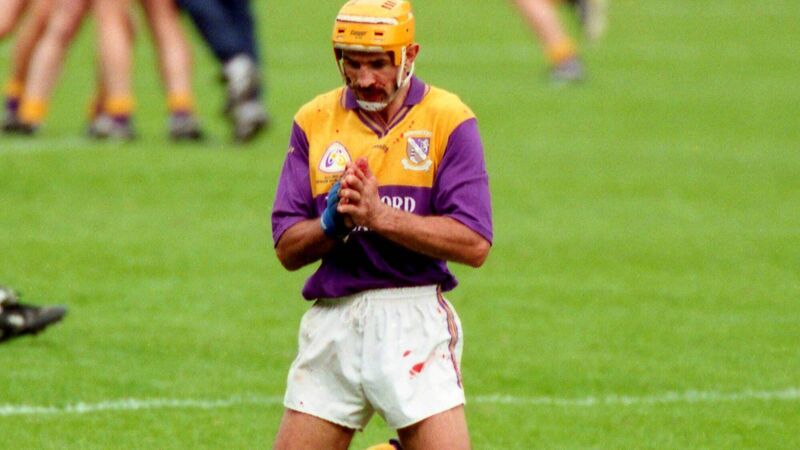
George O'Connor praying after the All-Ireland victory in 1996. Pic: Kieran Clancy
The IRA bombed Manchester. England failed on penalties (naturally) to Germany (naturally) in the semi-final of the Euros. Francie Barrett was off to Atlanta. Tom Cruise was starring in the first instalment of what would become the franchise. The nation reverberated to the sound of the macarena. And the entire hurling world was, to paraphrase Sean O’Casey, in a glorious state of chassis.
It was the summer of 1996 and it climaxed with Wexford lifting the MacCarthy Cup, the third Leinster county in the space of four years to do so. Will that happen again before the end of the century? Will themselves or Offaly win another All-Ireland while any of us is alive to witness it?
As another indicator of how long ago it was and how foreign a country it was, try this. The All-Ireland final produced 28 scores. Twenty eight. The first half of last year’s All-Ireland final produced scores.
They did things differently in 1996, no question. The action was slower, messier, less calculated, less skilful. There are myriad other holes to pick. This was hurling as it as it had been since the foundation of the GAA, an affair comprising 14 mini bouts of hand to hand combat.
Yet the visceral appeal of that iteration of the sport is not to be lightly dismissed. There was a place for slow but dogged corner-backs, for goalscoring full-forwards blithely unacquainted with the notion of defending from the front, in a way there isn’t today. These were hurlers rather than finely-honed athletes and game was none the worse for it.

One thing Wexford did have going for them was their timing. Unlike Waterford’s a decade later it was serendipitous. Cork were about to hit their lowest point since the early 1960s. Kilkenny and Tipperary were both at the bottom of their respective cycles, stuck halfway between their last All-Ireland and their next one. Galway, being Galway, were anybody’s guess in any year.
Some championships are hinge championships. Think 1989, ’99, 2006, 2018. The 1996 championship thing wasn’t. Nor was it the most bountiful of championships in terms of quality – most championships aren’t that either - but it was inarguably one of the more eventful.
Most of the fun happened early on. Wexford took Kilkenny out at the first hurdle. Limerick travelled to Páirc Uí Chaoimh and inflicted a beating of historic proportions on the hosts and their new manager Jimmy Barry Murphy. The world stood still on a sunny day on the Ennis Road as Ciaran Carey dethroned the All-Ireland champions. The Munster final went to a replay and that would matter; in beating Tipp second time around Limerick had played their fourth game of the summer and it was still only mid-July.
The same afternoon the match of the year took place at Croke Park. Offaly and Wexford shot the lights out and, astonishingly, Wexford won. It was Bastille Day in more ways than one.
Provincial success afforded them the opportunity to dabble in the novel world of tactics. They’d never done tactics before because they’d never had the opportunity. Now they had three weeks to the All-Ireland semi-final and a dry pitch in training each night to try stuff. They even went in for – God save us all – a yoke called mental visualisation.
They also had Rory McCarthy, a perfect hunk of clay for the manager to mould. McCarthy was young. He was smart. He wasn’t inured to defeat or compromised by bad habits the way the older guys were, among them Liam Dunne, whose habit of moving the sliotar five yards forward any time he won a free drove Liam Griffin nuts. Griffin frequently fretted about whether he getting through to some of his players and if they were even listening to him. With McCarthy he had no qualms.
For the Galway game they worked on McCarthy ghosting in behind the opposition half-back line and going for goal. Evening after evening they rehearsed it. Night after night McCarthy visualised it in bed. Pulling the trigger and the ball hitting the net.
Shortly before half-time in the All Ireland semi-final Dunne hit a long-range free that Paul Finn broke down near the goalmouth. McCarthy was onto it in a flash. One touch to flick up the hopping ball to himself, a second touch to smack it home. The rigging danced. Practice had made perfect.
Fail to prepare, Griffin once declared, prepare to fail. He said that in 1995. Roy who..?
The Limerick press night took place in UL and was a low-key affair. The players were polite and helpful and said nothing untoward but there was a faint – a very faint – undercurrent of expectancy detectable. It was as if having paid their dues in defeat two years earlier they were sure their turn had come. This was only a vague impression but an impression nonetheless.
Someone enquired who each of us reckoned would win the final. I hadn’t even begun to ponder the matter, the game being a fortnight away yet, but my instant and unthinking response was Wexford. “Because they have the momentum?” Ah. was it. That’s what had been bubbling under in my thought processes but not yet clicked in my consciousness.
Limerick’s early-summer wave had subsided; the semi-final against Antrim hadn’t done them any good; Wexford were the ones with the wind at their backs. Having opposed them against Kilkenny, Offaly and Galway I had finally succumbed and was now glugging down the Griffin Kool-Aid. No apologies. Resistance was futile.
The Wexford press night was not low-key. It was nothing short of a carnival albeit in a good way. It doubled as an evening for the kids of the county, who were allowed enter the field and get autographs. The players, encouraged by management to embrace the occasion, answered every question thrown at them no matter how fatuous. (“So, Damien Fitzhenry, are you looking forward to the All-Ireland final?” Etc.) Afterwards, as if to gild the lily, there was a press conference in the Talbot Hotel. Few questions were asked because there was nothing left to be said. Even Griffin seemed at a loss for words.
The final itself? Wexford played the match. Limerick, as though afflicted by PTSD from 1994, appeared to play the occasion Every tribe lost in the desert needs a Moses. Clare had Ger Loughnane. Wexford, a county that between May 9th and July 18th 1993 contested five major finals and won none of them, would have Griffin. It might never have come to that. Picture an alternative history of hurling in the mid-1990s.
It is a fact that that particular Wexford cohort, with a young Adrian Fenlon providing an extra dimension at midfield, reached their peak in the summer of 1993 under Christy Kehoe. So let’s say they win one of those three league finals against Cork. Four points up with time running out against Kilkenny in the provincial decider they consequently have the confidence to close the game out instead of succumbing to Eamon Morrissey’s late equaliser. Now surfing a wave of monstrous dimensions they have altogether too much for Galway on the big day and thus end a 25-year famine.
What’s more there’s an epilogue. Because George O’Connor and the old hands still have a couple of years left in them Wexford come back and win again in, say, 1995. Christy Kehoe is still the manager. Liam Griffin’s services will never be called on.
While we’re at it, how about this? Limerick hold out against Offaly in 1994, snapping a 21-year hiatus, and they too become new men. Thus they follow up in 1996; in ’95, the celebrations having left an understandable residue, Clare do to them in the Munster final what Clare actually did to them in real life in the Munster final. Tony Considine still gets to show off his singing prowess. And Clare go on to win the All-Ireland in 1997 and Offaly do so in 1998.
In the world we lived through, however, 1996 happened as know it. It took Limerick 11 years to reach another All-Ireland final and 22 years to lift the MacCarthy Cup again. They couldn’t have known in ‘96 that they were only at the midpoint of the famine. As for Wexford, that golden summer left no legacy other than itself. The gap from there to here is bigger than the gap from 1968 to ’96 had been.
Hey macarena? Maybe not.
CONNECT WITH US TODAY



Be the first to know the latest news and updates