Subscriber

Mick Clifford: Building regulation practice begs to differ from theory
What is at stake in building regulation is so enormous that actively ensuring standards are applied rigorously should be a basic function of any government
Mick Clifford: Building regulation practice begs to differ from theory

One small move to reassure the public of proper building regulation would be to hike up the inspection process. Apart from the greater confidence it would inject into the system, it would be far and away a more prudent way to spend money rather than mortgaging future development through the establishment of retrospective redress funds. Picture: Dominic McGrath/PA

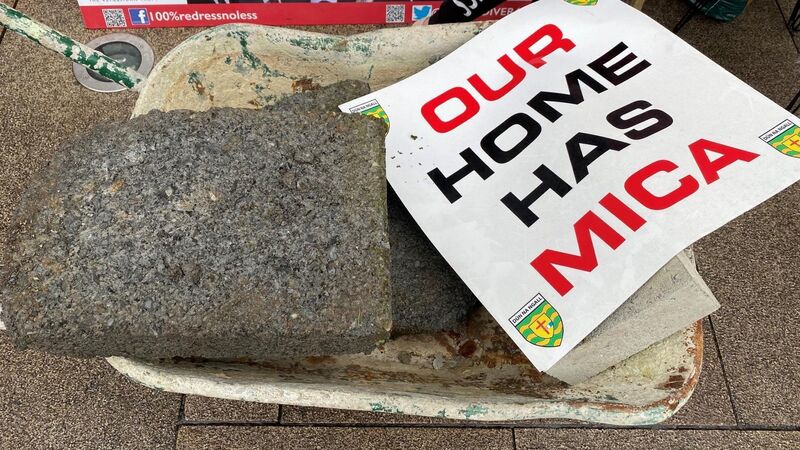
Four candidates from the 100% Redress Party were elected to Donegal County Council in the recent local elections. The party is campaigning for a 100% redress scheme to be implemented for those whose homes have been damaged or destroyed by mica, the rogue mineral found in building materials.

Ali Farren, Joy Beard, and Denis McGee were elected in north Donegal electoral areas and Thomas Sean Devine for the Letterkenny area. The success has led to suggestions that the 100% Redress Party will stand candidates with a realistic chance of success in the upcoming general election.

In 2022, an analysis in the Department of Housing estimated that up to 7,500 homes have been affected by mica or the defective blocks in which the mineral is found. A scheme set up by the Government, which does not cover 100% of all costs, is expected to require a fund of at least €2.2bn. In July 2022, the Cabinet was told that when inflation is taken into account, the bill here could rise to €3.65bn.

In 2014, another redress board was established after the discovery of pyrite in up to 4,000 homes in the east and north-east of the State. The latest estimate for this scheme is a cost of €230m.

And then there is potentially the biggest redress scheme of them all, that for defective apartment buildings constructed between 1991 and 2013.

The cost of this scheme, which is to cover up to 100,000 apartments, is currently coming in at around €2.5bn. Should the final bill end up in that neighbourhood, it will be more than just a pleasant surprise.

Behind all of these schemes and the billions are thousands of lives that have been adversely affected by poor and shoddy standards and building methods. 

The devastation on everyday lives of those affected by mica, particularly but far from exclusively in Donegal, have been aired frequently in recent years. The same applies to the apartment owners whose homes are potentially dangerous due to fire safety defects.

What all of these schemes have in common is that their origins lie in a lack of regulation. The regulation of building materials was poor, sometimes non-existent.

During the Celtic Tiger years, which are covered by the fire safety defects scheme, there was a light-touch regulation system in operation. The State basically left it up to builders and developers to regulate themselves. At one point when the building boom of the 2000s was in full swing, there were more dog inspectors than active building inspectors in the State. The idea that this was not going to result in major catastrophe now looks entirely naive.

The past, however, is a different country. There is broad acceptance now that regulation was sorely lacking back then. For instance, the fire safety defects scheme runs up as far as 2013 because the following year, on foot of emerging scandals, there was a revamp of building regulation to put in place a more robust model of regulation to ensure that standards and the law were being properly observed.

That is the theory. The practice to a large extent begs to differ. Last week, on his appointment as president of the Society of Chartered Surveyors of Ireland, Kevin Hollingsworth said a “cultural shift” was required in regulation, including the application of a proper level of resources.

Mr Hollingsworth, who has plenty of personal experience working around fire safety defects apartments, noted that under current regulations local authorities are required to inspect just 12% to 15% of new buildings. 

According to the National Oversight and Audit Commission’s local authority indicator report, many authorities exceed this low threshold. In 2022 in Dublin, for instance, 80% of new builds were inspected.

However, in the same year, Mayo and Sligo councils inspected just 7% and 11% respectively, while others just about reached the minimum target.

Mr Hollingsworth pointed out that while the current estimate of the various remedial schemes is around €5bn, it should be viewed as a minimum figure that could rise to €7bn.

“In 2023, local authorities spent a fraction of this sum, around €20m in total, on enforcing building control regulations,” said Mr Hollingsworth.

“If you subtract the €5m they made from fees, the figure is just €15m. Our members tell us that many local authorities view enforcement as a cost they have to shoulder and that there is no incentive for them to increase their level of inspections.”

The point is well made, particularly in the context of modern methods of construction, which are designed to speed up the building process, particularly at a time of a housing shortage. These methods — the most common of which is timber frame construction — entail prefabricated sections being assembled off-site which can then be fitted on-site with comparative speed.

One issue that arises is that a high degree of precision is required. A small error in this respect can have comparatively huge impact. For instance, in fire safety defects uncovered in timber frame apartments and houses built during the Celtic Tiger years, the failure to build according to that precision had disastrous outcomes. It is, therefore, today more important than ever that a robust inspection regime is in place.

In the UK, they take these things far more seriously. The compliance requirements there mean that all “active” building sites must be visited every 28 days and at least one every three months for “non-active” sites.

Currently, in this country, a system of quasi self-regulation still exists through the “assigned certifier” regime introduced in 2014, which does leave a paper trail but also raises major questions about potential conflicts of interest as the certifier is employed by the builder. One small move to reassure the public of proper regulation would be to hike up the inspection process as suggested by Mr Hollingsworth.

Apart from the greater confidence it would inject into the system, past experience has shown that it would be far and away a more prudent way to spend money rather than mortgaging future development through the establishment of retrospective redress funds.

'Cultural shift'

The surveyor also has a point about the cultural shift that is required. In December 1991, when State-wide building regulations were first introduced, the then minister for the environment Rory O’Hanlon stated that he was satisfied that “the vast majority of construction industry professionals would comply with the new rules”.

However, building control officers expressed concern to The Irish Times at the time that the new regime would give a carte blanche to “rogue builders”.

As it was to turn out, it was more than just a few rogue builders who were in a position to ignore the regulations. In any event, building control should not be about having trust in those who are doing the building. What is at stake is so enormous that actively ensuring standards and safety are applied rigorously should be a basic function for any government.

More in this section