Clodagh Finn: ‘Lelia and Margaretta were moving mountains long before hashtags’
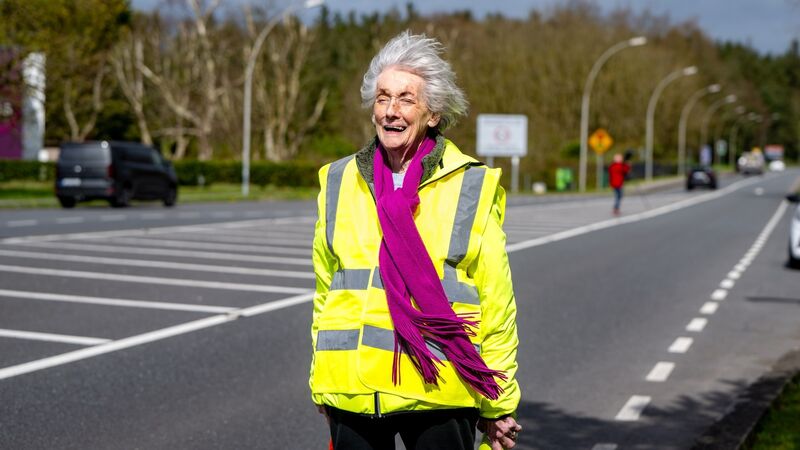
Lelia Doolan looks ahead to the long road before her as she begins her walk from Shannon Airport to Dublin, a journey aimed at raising awareness around peace and Ireland’s neutrality. Picture: Chani Anderson

“She’s as bold as brass.” Lelia Doolan, the 91-year-old peace activist en route from Clare to the Dáil to protest at the US military’s use of Shannon Airport, is talking about the other reason she’s setting out across the country on foot — to honour her dear friend and fellow agitator Margaretta D’Arcy.
The two women had been hatching a plan to take some kind of action when Margaretta “went off and died” last November, at the age of 91.
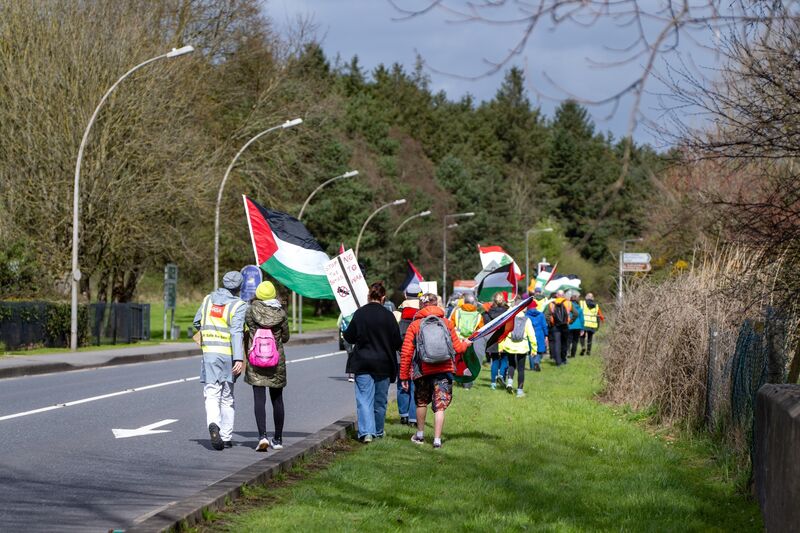
“She was a powerful warrior for peace and I’m just travelling along in her footsteps,” Lelia Doolan tells after day two of ‘Walk with Lelia’, the anti-war pilgrimage that will culminate with a request to meet Taoiseach Micheál Martin in Dublin in a few weeks’ time.
Mind you, it’s hard to believe that the woman Archbishop John Charles McQuaid once famously described as “mad, bad and dangerous” is following in anyone’s footsteps.
It’s not clear when he issued that damning assessment, but it was probably in the late 1960s as a response to her work as producer and director at RTÉ.
HISTORY HUB
If you are interested in this article then no doubt you will enjoy exploring the various history collections and content in our history hub. Check it out HERE and happy reading
Lelia Doolan herself wasn’t too impressed with the commercial bent of the state broadcaster at the time and resigned, with others, in 1969. Soon afterwards, in 1971, she was appointed first female artistic director of the Abbey Theatre.
If the archbishop had considered her creative exuberance morally suspect, by stark contrast the actively celebrated it.
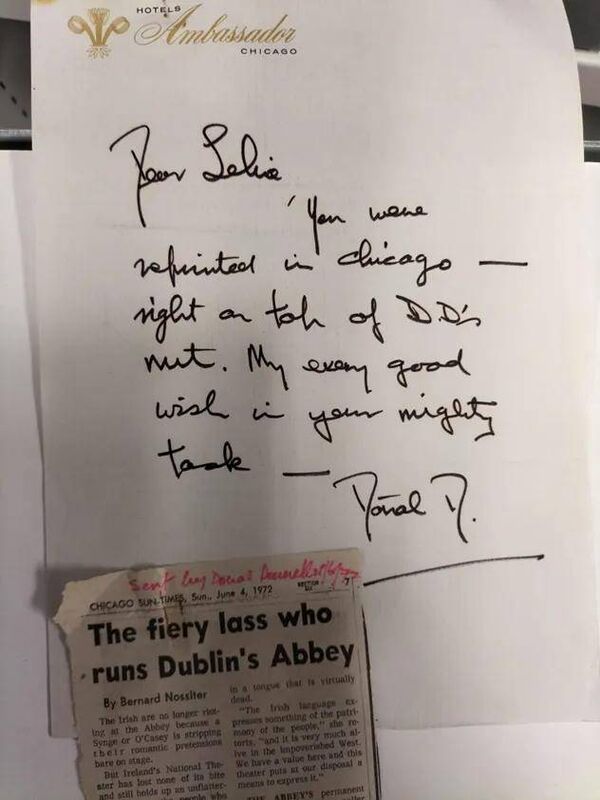
“The Fiery Lass who runs Dublin’s Abbey,” trumpeted the paper in June 1972 over an article about her history-making tenure at the national theatre.
When I mention it, she says: “I’m a very calm, quiet person, you know.” There’s truth in that too because she talks with conciliatory calm about the need to come together in solidarity to speak out against war and the use of Shannon Airport by the US military.
That is a campaign of longstanding, but one with international resonance now as Spain bans US military flights from its airspace and other European countries push back against US military operations.
Margaretta D’Arcy, artist, filmmaker, Aosdána member and jailbird — she spent three months in prison because of her Shannon activism — might be heartened to see that. Shortly before she died, she again expressed her fierce opposition to US troops using the Co Clare airport There were many other causes too. She and Lelia Doolan camped outside the Dáil in 2024 to put pressure on the Government to enact the Occupied Territories Bill.
The following year, they both returned their honorary doctorates to the University of Galway in protest against the university’s links with the Israeli institute Technion.
While Lelia was on her own when she did a parachute jump on her 90th birthday last year to raise funds for Médecins Sans Frontières, the spirit of her friend-of-decades is with her now as she journeys “little by little”, as she puts it, along a 200-plus kilometre route.
“She was always herself,” Lelia says of her. “She always spoke out directly. She was interested in people’s reactions to everything, which is always very unusual. And she listened to people with whom she disagreed, or who disagreed with her.
“And that to me is the most important quality; to be able to listen without shouting back at people who perhaps have a different view and bring them slowly around, perhaps, to reflecting on that.”

Having said that, Margaretta was a great woman to shout at her friends too, Lelia adds. “She’d tell them that they weren’t getting the message, which of course, very often they weren’t, because she was a bit ahead of most of us anyway.” Some people did get the message, such as Emma O’Grady, the artist who filmed the two friends in Mad, Bad and Dangerous, her inspired 2020 documentary series celebrating older, ‘difficult’ women.
(On an aside, can’t you just hear US writer Karen Karbo’s oft-quoted line: “It actually doesn’t take much to be considered a difficult woman. That’s why there are so many of us.”) Mind you, O’Grady recalls how quarrelsome her subjects were: “In making the episode with them, I learned so much about women’s intellectualism and how it connects with the heart. They were moving mountains long before hashtags. But the main thing I remember is how argumentative they were.
“We filmed while they shouted and roared and disagreed — seriously — with each other, but then one of them would make a joke and you could feel the love and fun. I learned a lot about listening, how to argue with love. That and how much of a pro Lelia is. And I loved Margaretta’s playfulness; she was an imp... they both are. People don’t realise that you can be both silly and formidable; they aren’t mutually exclusive.”
It’s not entirely surprising, then, that Emma O’Grady is co-ordinating this month’s walk — “she’s a marvel,” says Lelia – or, indeed, that she has followed Margaretta D’Arcy’s example and is now facing trial with two others for taking action against the US military’s use of Shannon.
But this two-week trek across the country is not just a call for peace and solidarity but a way of celebrating the special friendship between two indefatigable women who forged new paths in so many spheres.
Read More
Margaretta D’Arcy, to quote President Catherine Connolly, “was a woman of extraordinary conviction, an actor, playwright, filmmaker and writer who brought a radical honesty to her work. Her lifelong dedication to peace and anti-war activism was equally profound.”
It’s almost impossible to sum up the work — to date — of Lelia Doolan, but here is one list of adjectives that captures some of it: “Broadcaster, television producer, filmmaker, theatre director, lecturer and environmentalist.” She is also a gifted writer and a person whose horror of war goes back many decades. She recalls vividly how she heard of the crushing of the freedoms of the Prague Spring by Soviet and Warsaw Pact allies in 1968.
She was on holidays in Camp, Co Kerry, and recalls lying out, on starlit nights, trying to get a signal on shortwave radio to hear updates from New York on UN meetings. She recalled the Czech plenipotentiary pleading with his global compatriots to come to their aid.
“On that crackly radio, his voice was urgent and emotional and his words were most affecting. I was riveted. I could see those tanks, the horror of the people, the suddenness. It is still an unforgettable moment for me, the shock of war.” The only reason she was up, she says with a laugh, is that she played 110 nearly every night with the neighbours, “which is one of the great card games of the universe”.
That dance between the everyday — the fun and joy of chatting to people while sitting on a wall to rest — and the deadly seriousness of the impact of war sums up the essence of ‘Walk with Lelia’.
In the end, though, she hopes that the action of the few will influence those in power: “Look, I mean, every single human being has the ability and the courage to see that what’s going on in Shannon is not right, and that the government has got to pay attention to the fact that it has the courage to change what it’s doing, just as Spain and Italy have done.”
The walk is also a reminder of all that is good in life, such as friendship, she says, before signing off with this: “People need each other; that is a simple and often forgotten truth.”
CONNECT WITH US TODAY



Be the first to know the latest news and updates