Fergus Finlay: We must block Grok, it’s that simple — so why aren’t we doing it?
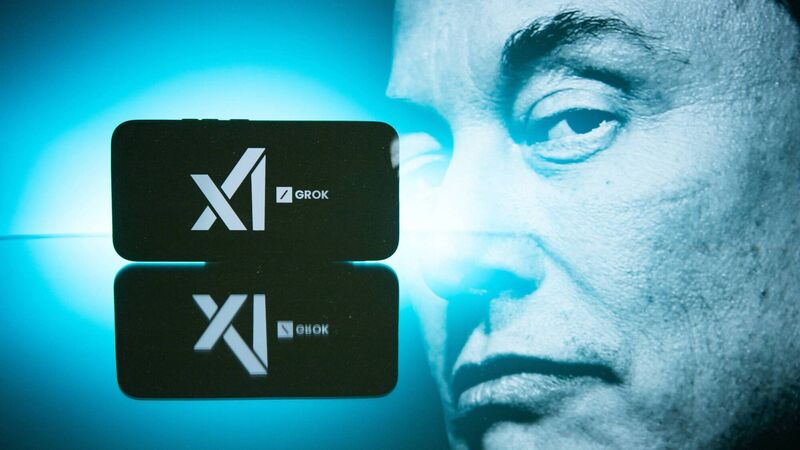
Elon Musk had long allowed X to be a sewer of hate. Its AI extension, Grok, brings it to a new low, allowing users to generate, without consent, sexualised and otherwise objectionable images based on photos of real people including children. Picture: Vincent Feuray/Hans Lucas/AFP/Getty

Block Grok. It’s that simple. It’s a tool that enables the abuse of women and children. It masquerades as a search engine, a can-do machine that’s supposed to make everyone’s life better by harnessing the power of AI for research and creativity. But it has built-in capacities that enable users, at the touch of a couple of buttons, to generate dangerous and illegal images.
It needs to be blocked.
It was built and owned, as we all know, by Elon Musk’s companies.
It was sold as an adjunct to Twitter, now called X. Musk has allowed X itself to be turned into a sewer of hate. But Grok is its evil twin. So block it. How, you ask?
Well, a couple of years ago, a Brazilian supreme court judge ordered Twitter to remove elements of hate speech, and speech that was inciting violence, from its platform. Twitter refused. So he ordered the internet service providers of Brazil to remove Twitter from their internet offerings. They had no choice but to obey, so suddenly Twitter disappeared from every mobile phone and every computer in Brazil.
After a bit of huffing and puffing, Twitter decided to obey supreme court rulings in that country.
Of course, it’s possible to get around anything. You can add something called a virtual private network (VPN) to your system. They’re not free — you have to subscribe — and they can be traced when they have to be. Very few people in Brazil opted to get around their internet providers that way.
Before we go any further, I need to remind you what an internet service provider is. If you have any access to the internet, it’s an internet service provider that is supplying it to you.
In Ireland, there are a few main providers — with household names such as Eir, Virgin, Sky, or BT — and then there are some regional ones. All are reasonably successful and pretty good at what they do.
The internet service providers have to obey the law. They’re not Elon Musk.
We could force the providers to get rid of the abuse built into Grok just as directly as Brazil did. Europe could do that too. But, for some reason, every time you mention internet service providers, the subject gets changed.
That’s a really draconian thing to do, we’re told. It’s a step on the road to the ending of free speech altogether. What about all the good that social media has done, and can do?
It’s even said in these discussions that we have to protect the misuse of AI because, after all, it’s all about free speech, and wouldn’t the reintroduction of censorship be terrible altogether?
I’m sick to my back teeth of listening to those noises, because they’re not really arguments anymore.
Here’s the position in Ireland: A few years ago, we apparently decided that self-regulation wasn’t really working in Ireland.
I have written and campaigned about that here in the for years. So we now have statutory regulation in Coimisiún na Meán. It has issued a statement on Grok.
It says: “The sharing of non-consensual intimate images is illegal, and the generation of child sexual abuse material is illegal.
When I read gobbledegook like that, I feel like throwing up.
Can we look at Hotline for a minute?
In its most recent annual report, there are all sorts of welcomes from various ministers and there’s a CEO — a nice-looking man called Mick Moran. I think I met him once years ago when he was a garda and seconded to Interpol, and I was very impressed by him. So, of course, I wish him well.
But the very name Hotline is copyrighted to an organisation called the Internet Service Providers Association of Ireland.
That organisation, which used to own Hotline and still owns its name, has ceased to exist. So I haven’t a clue who owns Hotline.
It describes itself as a non-profit company and, in the last year, it reported it received a little over €100,000 — out of €500,000 in income — from the Department of Justice.
It’s very heavily dependent on the money its members give it.
Those members, of course, are the same internet service providers. The people who may need a bit of regulation around internet safety are the ones who mostly fund the regulator.
According to the Hotline website, there are 21 members — many of whose names you’ll know well.
They’ve adopted a code of conduct, God between us and all harm.
It sets out a number of so-called “minimum requirements” each member must adhere to.
Minimum requirement number four says: “Members will include and promote on their corporate website the Hotline.ie logo [having regard to Hotline.ie brand guidelines] and link to www.hotline.ie.”
I followed the links on the Hotline members page to go to each of the 21 websites of their corporate members to try to find out how many were doing that.
I found two references to Hotline.
Credit where it’s due, it was two smaller regional providers, NuWave and Westnet, that honoured their obligations.
It’s possible that, if I spent a half hour on each of the other 19 websites, I’d have found more links to Hotline. But the truth is 19 of them either didn’t bother or buried the Hotline link in the later pages.
Not a single one of them is going out of its way to promote the basic idea. They are all too busy selling products and packages.
They’re not alone.
Unless you search hard, you won’t find the Hotline logo on any government website either — it is there, a couple of times, but well hidden.
To my astonishment, I couldn’t even find the Hotline logo on the internet regulator’s own website. In the statement I referred to earlier that the regulator issued about Grok, there’s a reference to Hotline and a link that will take you there.
However, there is no attempt anywhere to promote the only tool that citizens have — apart from going to the gardaí — to protect their children from illegal content.
To be honest, I think there’s only one conclusion to be drawn. There are more mobile phones than people in Ireland. According to the CSO, 96% of us use those mobile phones to access the internet. We are utterly on the hook where our phones are concerned.
Which means the companies who sell us our mobile phones, our TV, and internet packages are more and more profitable.
They couldn’t care less about the filth that is carried on the packages they sell. They laugh at the idea of regulation. Their actions prove they can’t even be bothered honouring the simplest requirements.
Only one thing will change that: An act of political will that gets between them and their profits.
A Brazilian judge showed it can be done. We have to stop bleating about how awful it is that AI is willfully being used for evil and exploitative purposes, and use the law of the land to stop it. We can — here and across Europe — order the providers to block pernicious filth.
What the hell is stopping us?
• Coimisiún na Meán's January 8 statement on Grok is here on www.cnam.ie.
Read More
CONNECT WITH US TODAY



Be the first to know the latest news and updates