Michael Moynihan: Cork asked for a park — and got a pathway of concrete instead
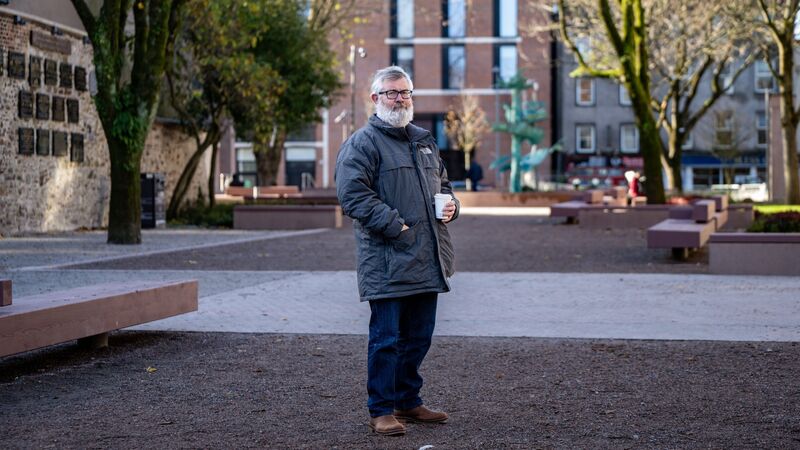
Michael Moynihan: 'Why did the Bishop Lucey project take so long to finish?' Picture: Chani Anderson

I don’t like to say: "I told you so".
(Just kidding. I love saying "I told you so", like everyone else.) It’s one of the cardinal rules of column-writing that you don’t really return to the subject you wrote about the previous week unless the circumstances demand it.
The circumstances seem to demand it this week.
Last week, I wrote about the refurbished Bishop Lucey Park, which duly opened last Friday. To say the reaction to the new park has been mixed would be a considerable understatement.
A close acquaintance described it as a pathway rather than a park, and when I strolled through on Sunday morning, the lack of greenery was certainly noticeable, though not as noticeable as the takeaway wrappers and empty coffee cups blowing around the place.
A glance at social media revealed some far harsher opinions, ranging from criticism of the Soviet era/70s brutalism feel of the new facility, to queries about the carbon footprint of the concrete. This is not to mention the estimated cost (€7m, according to the Cork City Council meeting last week) and whether that represents value for money.
In roughly reverse order ...
As noted here last week, why is anyone up in arms about value for money? When it comes to building anything in Cork, we might as well be spending John Wick’s strange doubloons or the galactic credits of .
In the general surprise at the new Bishop Lucey Plaza — Park, sorry — readers may not have picked up on a story from Paul Hosford which also featured here last week: “Arts minister Patrick O'Donovan told Cabinet... the full capital cost of the Crawford Art Gallery redevelopment project is now estimated at €93.1m, which includes Vat and a provision for contingency.
"He told ministers €6.5m had already been spent to date. An original estimate of €28.86m was arrived at in 2020, prior to the planning and design phase, and the project has changed substantially since then, ministers were told."
The words "changed substantially" are doing a lot of lifting here, and we’ll be returning to this matter long before the gallery reopens (in three years), but this is the standard; if your estimate can jump from €28.86m to €93.1m, then figures mean nothing.
The difference, of course, is that firing your empty chip bag around the park is objectively wrong, while your architectural opinions are subjective, even if the criticism on the latter score is pretty deafening.
It very grey-looking, no? By way of comparison, there seems to be no rush to concrete over green parts of Stephen’s Green or Merrion Square, say, but no matter.
The carbon footprint-climate change-green agenda piece is interesting. In September 2023, a study was carried out on behalf of Cork City Council’s Climate Action Unit which found 92% of participants wanted more parks, biodiversity, and green spaces in Cork City: 89% wanted more trees on city streets.
The research was undertaken to inform the draft Cork City Climate Action Plan, though it should be pointed out the council’s climate commitments can be fluid enough (remember the change to the Cork City Development plan to allow more parking? May 2023 if you’re struggling to remember.)
The new version of Bishop Lucey Park is no great advertisement for green planning. What greenery there is seems peripheral to the space, off to the sides, rather than being central to the experience of using the park.
If one stands at the South Main Street end and looks across at the Counting House plaza, there may be some sense to this, though that plaza has been closed for years, having been open for a fleeting weekend in 2023.
There may be an argument for having an open access route between the South Main Street, with its (unbuilt) event centre, student accommodation, and the Grand Parade with its transport hubs (bus stops) and new central library (to be updated at some future date).
(Of course, there’s always Tuckey Street for all of that.) It is gravel and concrete down the centre of the old park, a path to help access destinations that don’t exist. There is a nice view of the back of the Freemasons’ place, mind.
Some other questions.
Where are the gates and railings and other fixtures from the old park gone? Hopefully the Fireman’s Rest is not the template here, with these items stored somewhere they can decay for years, only to be fixed up decades later for hundreds of thousands of euro.
Glass half-full on this one, eh?
When will the place be finished, when it took almost a year longer than expected? Why did it take that long? That pod on the Grand Parade is to be removed next year, according to the council meeting last week: why so long? How about a nice kids’ play area?
Most important, why take the opposite tack to other cities?
In Paris, the plaza in front of the Hôtel de Ville has been transformed into an urban forest with 150 trees — including species resistant to climate change — and over 20,000 plants, including shrubs and ferns.
(They started in late 2024 and unveiled it last June. Just saying.)
Barcelona creates parks at traffic intersections. Australian cities? Urban forest strategies.
Cork is concrete.
A good example to follow might be Rotterdam, where a concrete car park was recently converted into a public garden which acts a sponge for heavy rain. It’s also come up with the "water plaza"
As reported by Reuters, the latter features"... wide steps [which[ lead down to a sunken sports area with football goals and basketball hoops, while the upper level has skateboarding areas, small swathes of garden and even an outdoor bronze font for baptisms.
“Arnoud Molenaar, Rotterdam’s chief resilience officer, said such squares, which can collect runoff from heavy rains, were about much more than storing excess water and preventing floods.
“‘Instead of making bigger sewer pipes, we made a choice to invest in redesigning public space in a way that contributes to a nicer, better, more attractive district," he said.
A water plaza can keep 8,500 bathfuls of rainwater out of the sewers and available for reuse, apparently.
So, a city which suffers from flooding uses an open space in the centre of that city, reworks it imaginatively with benefits in terms of flood relief, sports facilities, water storage. Greenery. Sparing the infrastructure.
That’d be worth €7m.
- X: /mikemoynihanex
- Instagram: /mikemoynihanex
- TikTok: /mikemoynihanex
CONNECT WITH US TODAY



Be the first to know the latest news and updates