Fergus Finlay: Labour's vision has never been to force a unity vote
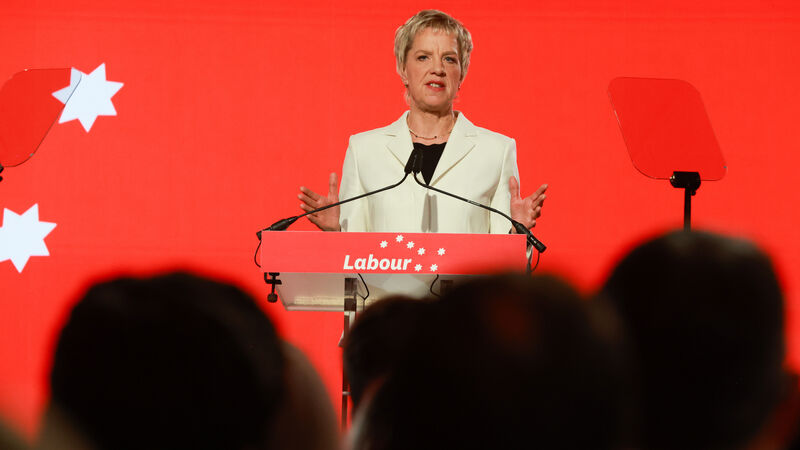
Labour Party leader Ivana Bacik speaking during her speech at the Labour National Conference at the Radisson Blu Hotel in Limerick. Pictures: Sasko Lazarov/Photocall Ireland

Ivana, I know you’ll think it’s none of my business to be disagreeing with you. And maybe you’re right. I’ve always believed in — and tried to practice — the notion that political parties (and most other organisations too) don’t need a retired oul’ fella in the corner going on about how we used to do things in our day. I’ve been a member of the Labour Party all my adult life, but I’m not in charge of anything now.
That’s your responsibility. The day you were elected I wrote a long piece here wishing you well and expressing the belief that you could help the party recover more than most people.
Even before that, when you were running in that by-election in Dublin Bay South, I wrote here about how you’d always been a leader, in every campaign for social change we’d ever been involved in — whether we won or lost.
“She was there from the start,” I said. “Even when those issues inspired hate and loathing. She has stood up to abuse time and again in her life and career. She did it because she is passionate above all about getting rid of inequality. Again and again she has been proved right.”
So I’m not finding it easy to say that there were bits of your speech to the Labour Party Conference at the weekend that really jarred with me. One small one, and one much bigger. I wasn’t able to watch it live, but I read it in full on the Party’s website.
I will say that I applauded your references to the pernicious use of the Irish flag as a way of othering immigrants in Ireland. I’m guessing we all hope that the extraordinary exploits of a young Dubliner called Troy Parrott will play a huge role in helping us to get our tricolour back to celebrate and never to intimidate.
As leader of the party I belong to, you know I didn’t agree with your approach to the presidential election and I wanted you to go a different way. But you were vindicated — your decision produced a winner, and Labour can claim, for the third time, to have been instrumental in giving Ireland a decent choice, albeit in the most shambolic election in our history. And hopefully that outcome can be built on as part of the building of a genuine and decent left-wing alternative in Irish politics. Heaven knows how badly that is needed, especially with your values and determination in leadership.
But I’m sorry to say that I found your defence of Irish neutrality in your speech, and your call for a referendum to enshrine the so-called “triple lock”, missing at least one core element.
I’ve been attacked recently for apparently calling for the abandonment of Irish neutrality. I haven’t, and I want to see the honourable role Ireland has played as a peace-keeper in the world embellished, if anything. But if we’re going to have a referendum, we must, we simply must, redefine that term, “the triple lock”.
Right now, triple lock means that Irish troops can only be sent overseas after a decision of government, a vote of the Dáil, and a mandate from the United Nations.
That means that we will never again be allowed to participate in a UN mission unless it has Vladimir Putin’s blessing, because he can veto anything we want to do with a click of his finger on the UN Security Council.
It’s not beyond the bounds of imagining that a peace-keeping force might be required to protect a border that might emerge from a negotiated truce or ceasefire in Ukraine. It’s not beyond imagining that peacekeepers might be needed to protect the people of Poland or Moldova from incursions by land.
So by all means let’s have a referendum. But that in turn requires Labour to lead a debate to frame a meaningful triple lock that never depends on the goodwill of a Russian (or any other) autocrat. I’d much rather that we built in something like a two-thirds majority of the Dáil. To enshrine the triple lock as it presently exists in our Constitution would be a terrible mistake.
That was my lesser quibble. But what really pulled me up short in your speech was the passage that you began by referring to Labour as “a party of Connollyite Republicans”. Honestly, I don’t know what that even means.
I can’t claim to be an expert where James Connolly is concerned, but I do know that in his most famous passage, where he said “Ireland without its people means nothing to me”, he referred to the country, as opposed to its people, as a combination of chemical elements. You don’t have to search too hard to find Connolly asserting that after Ireland is free, unless socialism is also achieved, “we will protect all classes, and if you won't pay your rent you will be evicted same as now. But the evicting party … will wear green uniforms and the Harp without the Crown…
“Now, isn't that worth fighting for?,” he asked.
I guess what I’m suggesting to you, Ivana, is that here is no real basis in Connolly for demanding a “clear timeline for the holding of a Unity referendum”. And I have to admit I found that passage of the speech quite shocking. For one main reason.
I said I’ve been a member of the party all my adult life. Brendan Corish was leader when I joined, and he was succeeded by Frank Cluskey. I’ve always been proud of the fact that Frank Cluskey was the first Irish politician to articulate the principle of consent. And he couched it (in my memory) in Connolly’s language — I have no interest in a country where some of our people feel coerced.
Every Labour leader since then, and all leaders committed to a democratic way forward, have committed themselves to the principle of consent. Our former leader, Dick Spring, was very instrumental In ensuring the principle of consent was central in the Downing Street Declaration. It has featured strongly in every seminal document since, and after the Good Friday Agreement we wrote the principle of consent into the Irish Constitution.
But I’ve read and re-read your speech several times, and I can find no reference to the principle of consent. I don’t know if that’s an error, an oversight, or a deliberate shift in policy. But it’s fundamentally wrong and must be corrected. Without that commitment the passage read like something Mary Lou would say, not something you would say.
I know this might sound like nit-picking on my part, but I assure you it’s not. Your speech wasn’t just for the moment, but for the record. I believe you have to acknowledge that achieving consent might take years, a generation or more, but if that’s the case we have to embrace that. Because, as a Connollyite Republican might say, Ireland without her people means nothing to me.
CONNECT WITH US TODAY



Be the first to know the latest news and updates