Dion Fanning: These are days that are unexplainable and enriching. They have been as good as it gets
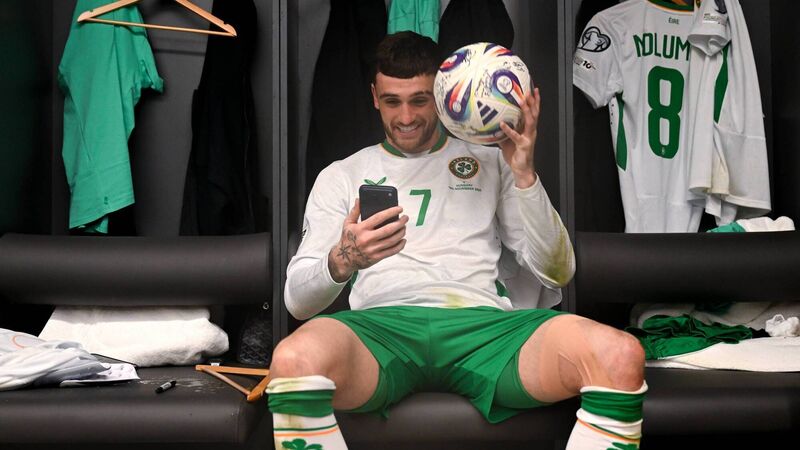
NO FILTER: Troy Parrott of Republic of Ireland celebrates with the match ball in the dressing room. Pic: Stephen McCarthy/Sportsfile
There are so many parallel universes to the one that unfolded in the Puskas Arena on Sunday afternoon that to consider them all could lead to profound disorientation.
Even the moments leading to Troy Parrott’s winning goal could, with a step or two in a different direction, have led to a world more ordinary, an Irish football universe we are more familiar with.
As Caoimhin Kelleher launched his ball towards Liam Scales’ head, Parrott began to move from the edge of the box. As he anticipated the header being won, there were opportunities for a Hungarian defender to interrupt his flow.
If Hungarian substitute Attila Mocsi had not been transfixed by the flight of the ball, he might have noticed Parrott a fraction earlier than he did. By the time he attempted to stop Parrott’s move towards where the ball was going to be, it was too late and all he could do was attempt an elbow, which might have resulted in a penalty. A moment earlier and he could have blocked Parrott. What became history, might have been just another frustrating incident in the second half for Ireland.
But that fits in with the normal rhythm of sport, these huge events turning on a second’s decision or indecision. From those moments, we retrospectively apply an entire narrative arc. The greatest era in Irish football history began in 1987 with a referee playing advantage when Hristo Stoichov fouled Gordon Durie on the wing. Rather than stop play, the ball went to Gary Mackay who altered the course of Irish sporting history.
But there are always other moments and other lives. In some ways, Troy Parrott was meant to have a different career.
On July 17, 2018, the headline on the RTÉ website stated “Irish starlet Troy Parrott signs first contract with Spurs”. Parrott was 16 and Ireland was becoming giddy. “His technical excellence turned the heads of scouts from some huge clubs across the water, including Liverpool, Celtic and Chelsea, but Parrott - who cites Wes Hoolahan and Harry Kane as major influences - opted for Spurs,” the report read.
Irish football was invested in Troy Parrott. It had expectations for his future that were clearly defined and prescriptive: become a Premier League star then, when the time comes – and it won’t be long – save Irish football. We are limited in our imagination and ask only for the world.
Parrott’s career didn’t go in that straight line. How it unfolded has been chronicled everywhere in the past five extraordinary days but it could tell us something about how we invest in sportspeople and what we demand of them.
Injuries are a routine part of a sportsperson’s life, but they can also change everything about a routine.
How revealing was it that Parrott’s mother said her first concern watching her son play against Portugal last Thursday was that he didn’t get injured?
Parrott and his family have lived with that anxiety for some time. When he was sent on loan by Tottenham to Preston in 2022, it was his fourth spell away from his parent club.
In October of that year, he scored his first Championship goal, when his left-footed shot took a deflection off a defender and beat the Norwich goalkeeper Tim Krul. When the camera cut to Parrott for the routine shots of him celebrating, he was on the ground holding his left hamstring. He had an operation on his leg and didn’t play a full 90 minutes until February 2023.
Five years after the headlines about the Irish starlet, Parrott spoke to the media during an Ireland training camp in Portugal in June 2023. He was no longer the player we had burdened with expectation. He was now cast in another role, a supporting part: the wiser, more reflective character offering advice to the next big thing, in this case Evan Ferguson. Troy Parrott was 21.
He resisted the idea that he could give advice to anyone essentially the same age, but offered encouragement. Even in print, some of that self-containment that has been so notable in his interviews in the last five days, came across.
Ferguson now struggles with his own injury problems and, if he had been fit, would probably have started the games against Portugal and Hungary. That is another parallel universe as well.
There are those, too, who still keep trying to return Parrott to the original plan.
Parrott was asked before the Portugal game if, given his run of form in Holland, he would like to return to English football one day. “This is where I've also changed a little bit, where I'm not focused on what's going to happen in the future,” he said. “I'm letting that be. I believe whatever is going to happen is going to happen.”
What happened has transfixed a nation and captured the attention of the world. But for Parrott there is something profound in what he said too. Players like Parrott and Ferguson are told endlessly that the future is theirs. No matter how well protected a player is, this is the story they will hear. They can concentrate on the moment but an expectation builds around them that the future must be a certain way.
When it turns out another way, it often takes something remarkable for us to look again. It also takes remarkable character for them to persist.
That is what happened last weekend. It was the most astonishing three days in Irish football since Ireland beat England in Stuttgart on a June Sunday in 1988 and Ronnie Whelan scored the extraordinary opening goal against the Soviet Union the following Wednesday.
There is an atmosphere that matches anything from that golden age. One of the most striking interviews after the game was with Dara O’Shea. O’Shea made his debut for Ireland in 2020. It has been a tough five years to be an Ireland player. “We’ve suffered a lot as a group, we’ve been through a lot and we’ve been wrote off,” he said.
As importantly, the Ireland team have been anonymised. The Irish football team has become a symbol for something else. A symbol for our failed structures, a symbol for the FAI’s incompetence, a symbol for how things aren’t as good as they used to be. They were symbols, not a team, not footballers. We might also have struggled to recognise the players, but they were interchangeable, so did it really matter?
That changed in Budapest on Sunday and now nothing else really matters. This week, we will learn about the play-off opponents but can anything be better than what we have experienced over the weekend?
These are the moments that sport is for. “This is why we love football, because things like this can happen,” Troy Parrott said, shaping a phrase to stand beside, “Football, bloody hell” when we try to make sense of the illogical.
“Troy Parrott…I don’t need to say anymore, just Troy Parrott,” O’Shea said in Budapest and it captured how a country felt.
In those remarkable interviews, Parrott has also shown what he embodies on the field. There is a stillness that grants time to make things happen. This self-containment was present for every goal in Budapest, somebody understanding that he doesn’t have to chase it too hard, someone in possession of a hard-fought wisdom that a 23-year-old shouldn’t have.
So now we look to the future again, to the play-offs and beyond. It will be joyful and expectant, but maybe we shouldn’t look too far ahead either. We have experienced days that are unexplainable and enriching. They have been as good as it gets.
Why ask for anything more?
CONNECT WITH US TODAY



Be the first to know the latest news and updates