Donal Lenihan's Nations Championship talking points: crucial for Ireland to hit the ground running
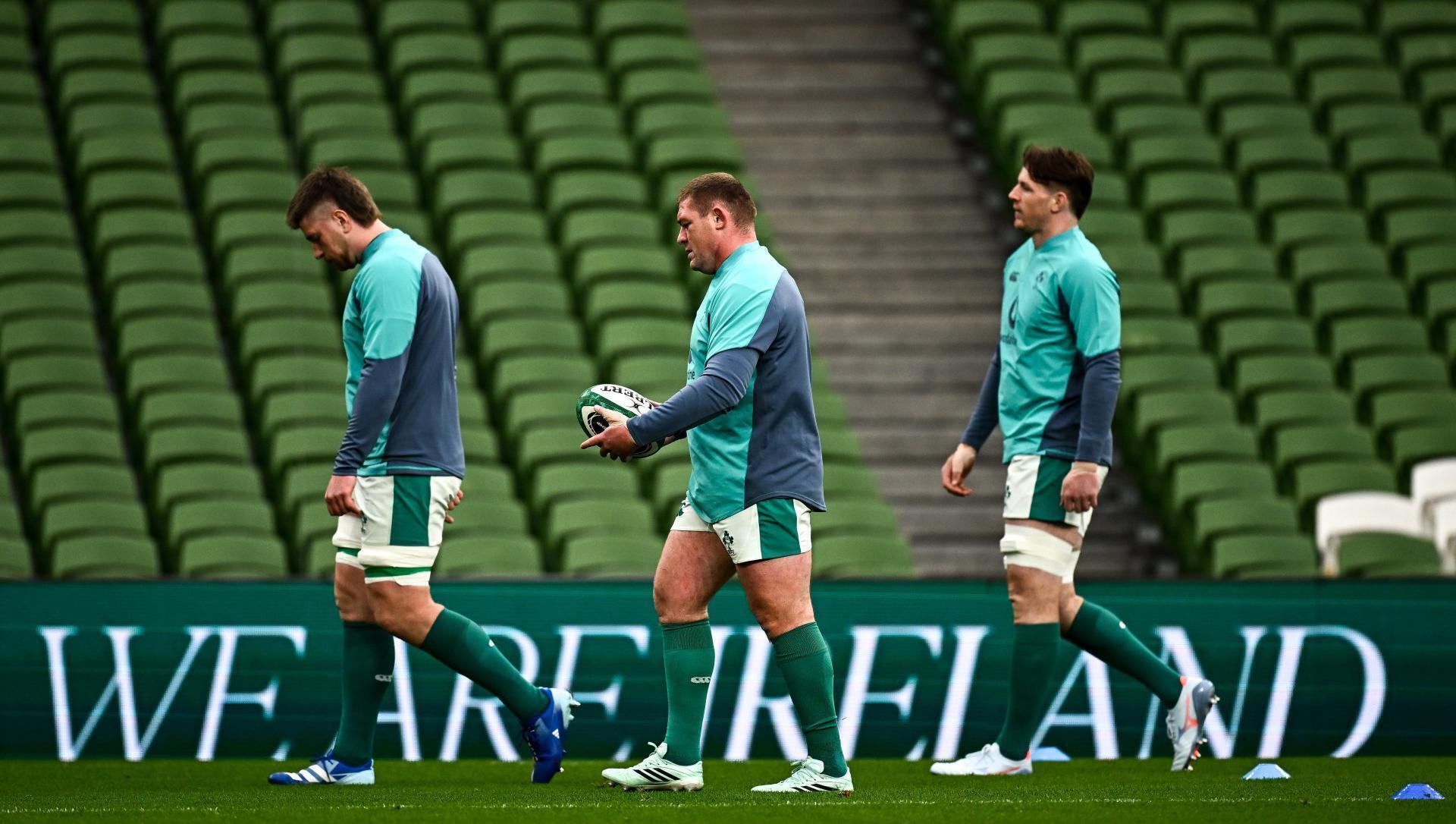
Tadhg Furlong with Joe McCarthy, left, and Ryan Baird during an Ireland Rugby captain's run at the Aviva Stadium. Pic: Seb Daly/Sportsfile

Before we get into of the intricacies surrounding Friday night’s game against Argentina in Dublin, a reminder of what’s at stake.
Normally at this time of year we are treated to a series of stand alone test matches. The advent of the Nations Championship last summer changed all that with every game in each international window contributing towards a climax with four finals contested in Twickenham over a three day period at the end of the month.
The aim for everyone is to make the decider on Sunday November 29th when the top-ranked northern hemisphere side takes on their southern hemisphere equivalent. Ireland beat Japan and Australia on their trek down under last July but were comprehensively beaten by New Zealand in Auckland.
As a consequence they currently sit fourth on the northern hemisphere league table, two points behind leaders France with Scotland and England occupy second and third slots. With home games against Argentina, Fiji and South Africa over the next three weekends, Ireland have ample opportunity to close that gap. I’m sure Paul O Connell spoke for all the Irish coaching team early in the week when stating that the tournament element to these games has added further spice and jeopardy.
What about Friday night’s opponents? Felipe Contepomi’s talented side had a poor summer of activity, winning just one of six tests played and that against a Welsh side at their lowest ebb. Despite those defeats, Argentina enjoyed strong periods of dominance in a number of closely-contested games against Scotland, England, and South Africa coupled with a draw and a six point defeat in back to back tests against Australia.
For both sides, the encounter offers an early indication of what’s to come over the next 12 months. It also presents an opportunity to seize a psychological edge given the next time the two teams are likely to meet is at the quarter final stage of the 2027 World Cup.
This month’s sequence of matches has been kind to Ireland. However in order to reach the top tier final, in all probability they will need to win all three autumn tests. To do so means coming out on top against South Africa in the eagerly anticipated final conference game that will prove the most revealing of all.
While their results might not have been great, at least Argentina have had plenty of recent game time which should see them primed and ready for the Ireland clash. In addition, their players have more domestic game time in their legs with a variety of clubs operating across England and France in particular.
The IRFU’s policy of restricting the playing minutes of their top players does offer a point of difference in big tournaments like the Six Nations. On other occasions it has left some key personnel a little undercooked at this time of the year.
The opening game of test windows such as this has often seen them a little slow out of the blocks. Think back to the New Zealand game in Chicago this time last year. By the time Ireland arrived in Auckland for the rematch against the All Blacks in fortress Eden Park last July, some were running on fumes, especially those who had been on the Lions tour to Australia the previous summer.
That said, Andy Farrell is not one to countenance excuses. Like all teams across the board, he’s missing key players in Jack Conan, his captain Caelan Doris, Garry Ringrose and out half Jack Crowley while James Lowe is no longer part of the set up after moving to Japan.
Given the increasingly physical nature of the game, this is exactly what happens when you reach the knockout phase of big tournaments, meaning the leading teams with the deepest squads normally survive all the way to the final.
On his return to Dublin, Contepomi has picked a very strong side with an average of 50 caps a head. Only three forwards from the team that drew 28-28 with Australia last time out survive, with returning captain Julian Montoya one of three centurions along with the great Pablo Matera and Guido Petti all recalled to a formidable looking pack.
The biggest take away from the captivating four test, “Rugby’s Greatest Rivalry” series over the summer, was how the game is continuing to evolve. New Zealand have come to accept they can’t beat the Springboks in a dockyard brawl but, having won the opening test 16-33 in Ellis Park of all places, and despite losing the series, they found solace in the fact they are developing other ways to come out on top.
It’s why new head coach Dave Rennie has placed an increased premium on improving the skill set, the handling and passing ability under pressure of his forwards in particular. Against scrummaging beasts like South Africa in particular, improved handling means less knock ons and, as a result, less scrums.
Over the course of this month, we need to see evidence that Ireland are also looking to evolve, starting with the Pumas game, some early indication as to where that might be.
Ireland’s revamped back three offer a real pointer towards the way Farrell’s men will seek to play. Given the increasing importance of the aerial battle, the returning Mack Hansen, Hugo Keenan and Rob Baloucoune will be tasked with contesting in the air to retrieve or, at worst, get a hand on Sam Prendergast’s high hanging bombs.
If their input is restricted to just chasing kicks Ireland will be in trouble, especially when facing the Springboks in a few weeks time. While Argentina were disappointing in a number of their recent tests, the one thing that shone through was, if you kick badly to a back three of Juan Cruz Mallia, Batista Delguy and Mateo Carraras, you will suffer.
While that aerial contest has become a key element of the game, I’ll be more interested to see how many opportunities Ireland create for Hansen and Baloucoune in broken play and from key strikes moves off set pieces.
The more that duo get their hands on the ball, especially in the wide 15 metre channels, the more chance Ireland will have to stress the visitors defensively and score. When fit, Baloucoune has been sensational and, along with the returning Hansen, adds a bit of the X factor that was missing last season.
Ireland will also have to display a noticeable improvement in discipline, not always easy against an Argentine side who have a knack for getting under the skin of opponents. Penalties conceded against big physical sides offer the opportunity to either kick to touch for field position and launch a series of line out mauls that, under new law interpretation, are becoming increasingly difficult to repel without conceding more penalties.
Apart from that the biggest challenge will come at the breakdown. Farrell is going with a newly constructed back row in Ryan Baird, Sean Jansen and Nick Timoney that has never started together. They will be seriously challenged on the floor, in the carrying department by a massively experienced and powerful unit in Matera, Marcos Kremer and Juan Martin Gonzalez, who is every bit as athletic and menacing on the opposition line out as Baird.
While it’s always difficult to hit the ground running in the opening game of a four week campaign, the minimum expectation for Ireland tonight is a win. Given their current standing in the Nations Championship table, a four-try bonus point in addition to a confident attacking performance would amount to the perfect launch pad for a very important four weeks. It all sounds plausible in theory but Argentina will not be prepared to bow out without a serious fight.
CONNECT WITH US TODAY



Be the first to know the latest news and updates