Donal Lenihan: New Zealand show attack power and South Africa dazzle as they lay down marker
From an international perspective, the season is set to be dominated by the journey to next year’s World Cup in Australia.
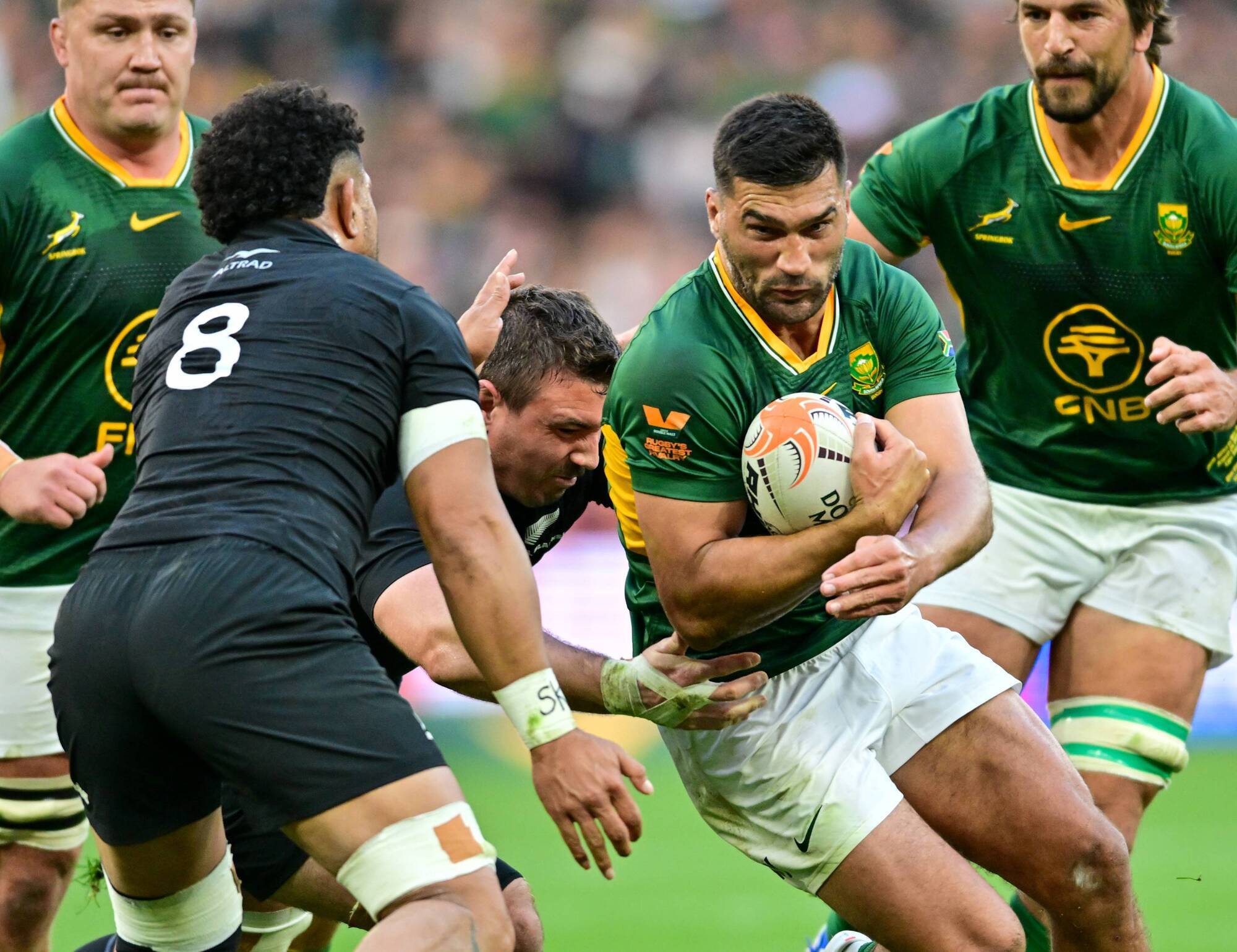
Damian de Allende of South Africa. Pic: Ashley Vlotman/Gallo Images/Getty Images
Wed, 07 Oct, 2026 - 04:52
Donal Lenihan
ONLY one place to start this opening column of a rugby season — and, no, that’s not Munster for a change. There will be plenty of ebbs and flows on that topic anyway over the coming months.
From an international perspective, the season is set to be dominated by the journey to next year’s World Cup in Australia. With that in mind, the focus for me over the recent fallow months was firmly set on New Zealand’s fascinating tour to South Africa.
This amounted to a step back in time. An eight-game sojourn, labelled by the marketers as ‘rugby’s greatest rivalry’. It lived up to expectations from start to finish.
As preparation for the World Cup goes, the series immediately offered rugby’s top two nations a seismic advantage.
Given the intensity of the undertaking, newly appointed All Black head coach Dave Rennie was afforded the opportunity of bringing a party of 44 players to South Africa.
What a perfect launchpad for him to get to know a wide cohort of young emerging players on the periphery of international rugby, and to work intensely on a new game plan incorporating a much-tweaked attacking style from his immediate predecessor Scott Robertson.
Despite his incredible success with the Crusaders — seven Super Rugby titles in his seven seasons on board — Robertson was ruthlessly dismissed by the New Zealand board 18 months out from the global tournament.
While the tour games against the four URC sides — the Stormers, Bulls, Sharks, and Lions — proved somewhat of a mixed bag in terms of the quality of opposition, it was the mouthwatering four-test series that not only captured the imagination but offered glimpses for the best of the rest on the international stage on how to go about beating the reigning world champions.
Despite losing the series 2-1 on South African soil, New Zealand out-pointed their hosts 78-83, scoring 13 tries to eight in the process.
Throughout the campaign, New Zealand played a brilliant attacking brand of rugby, most notably when winning the opening test 16-33 at Ellis Park, delivering five outstanding tries on the night.
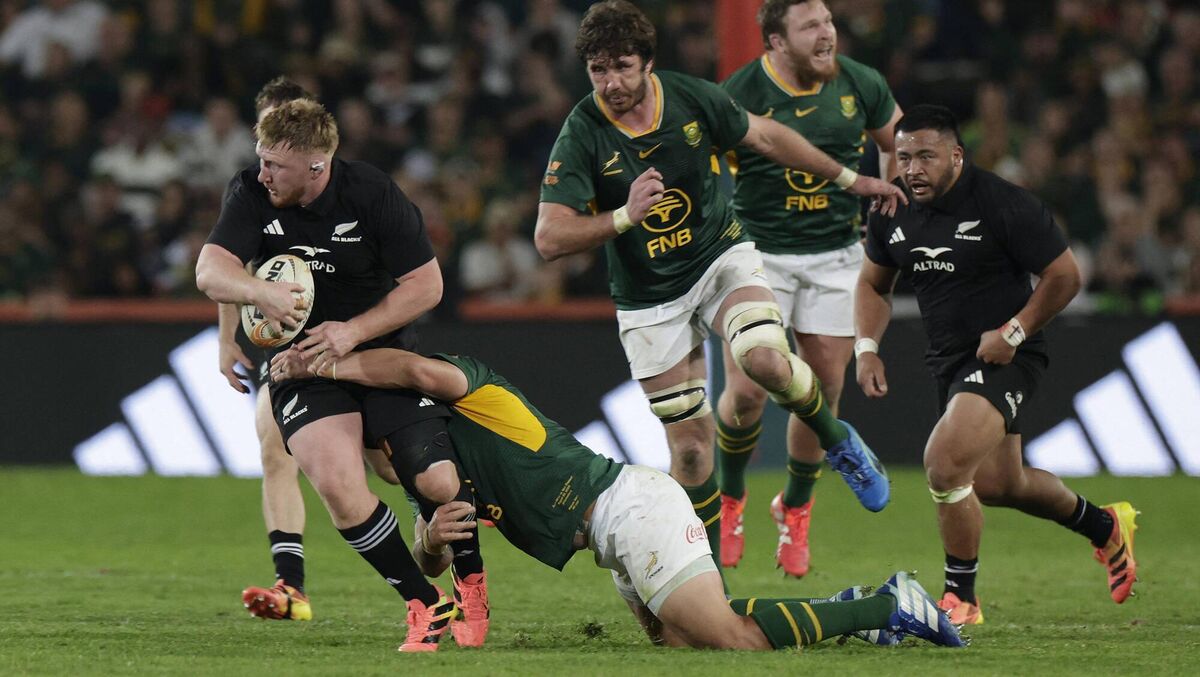
New Zealand's prop Fletcher Newell is tackled during the Rugby's Greatest Rivalry international rugby union match between South Africa and New Zealand at Ellis Park. Pic: Gianluigi Guercia / AFP via Getty Images
That opening win guaranteed the series would go all the way to the final test to be staged in Baltimore in the US.
That said, I think everyone appreciated it was the outcome of the three tests in South Africa that mattered most, with the trek to the US primarily amounting to a money-making sideshow for both unions.
With that in mind, and the series tied at 1-1 entering the crucial third test in front of 85,976 fans at the FNB Stadium in Soweto, venue of the 2010 soccer World Cup final, the clash had a ‘winner takes all’ feel to it.
South Africa delivered in a 29-24 cracker that carried all the weight and pressure attached to a World Cup final.
By the time the fourth test in Baltimore rolled around, New Zealand had no more to give.
Physically battered and down several key players, including inspirational captain Ardie Savea — who scored two tries before dislocating his shoulder after the 31st minute in the third test — the All Blacks were outplayed, even in an attacking sense, by a Springbok side that got better and better as the series unfolded.
While South Africa were the ultimate victors of a brilliantly entertaining series, Rennie’s men returned home with a far greater understanding of where they currently stand and, of more importance, the potential for genuine growth within their ranks.
Rennie will be very disappointed to have lost the final three tests, but I suspect this tour will have accelerated his understanding of the talent at his disposal, especially from an attacking sense, but also of the shortcomings that need to be addressed.
What enabled the All Blacks to outplay their hosts on the attacking front was the presence of three superb playmakers, spread right across their back line, in new out-half Ruben Love; the excellent Jordie Barrett, whose range and accuracy of passing and kicking was fundamental to exploiting the space available in the wider channels; and versatile full-back Damian McKenzie.
As a result, New Zealand succeeded in beating the famed Springbok blitz defence with such regularity that it enabled them to score 17 tries across the four tests. That was phenomenal.
In order to maximise that evolving potential with ball in hand, Rennie also knows that, when it comes to competing on equal terms with this South African side, major set-piece improvements around the scrum, lineout, and maul defence are required. Join the queue.
ON TOO many occasions, the All Blacks were unable to cope with the incredible power of the South African scrum, their explosive maul, and ability to disrupt the visitors’ line-out.
Without a functioning set piece, it’s very difficult to compete, as Ireland also found out to their cost at the Aviva Stadium last year.
The scary bit about the Springboks is they too have shown clear signs of evolution. For a team that has won back-to-back World Cups, that’s a tribute to the inspirational powers and tactical mindset of Rassie Erasmus after eight seasons at the helm.
It demonstrated that, despite having so many seasoned campaigners on board, especially the most-capped Springbok of all time in legendary second row Eben Etzebeth, their squad still retain the hunger required to become even better.
The series also showed that, in addition to their dominance up front against all comers, the Springboks are not a one-trick pony. Far from it. The first-choice back three of Damian Willemse; Cheslin Kolbe, who has also morphed into a first-class place kicker; and Kurt-Lee Arendse not only excel when it comes to the aerial battle, but are electric in attack from transition play.
Add to that trio the emerging 6ft 4in winger Ethan Hooker, who is also imperious in the air and offers another option in midfield, and the fast-developing Sacha Feinberg-Mngomezulu when switched from out half to full back. If your kicking game is even slightly off against them, you are going to be in trouble.
Over the course of the last few months, Erasmus has exposed 46 players to international rugby.
He took this to the extreme when making 13 changes to the side that started against New Zealand in Baltimore for their most recent outing against an ever-improving Australian side at the Optus Stadium in Perth — and paid the price with a 42-38 defeat in a crazy test match.
Ever the innovator, and with his team struggling, Erasmus introduced his entire eight-man bench in one go on 48 minutes. In spite of that, the Wallabies remained in control, holding what appeared to be an unassailable lead of 25 points with 15 minutes to go.
Such was the physicality brought to bear by the Springboks, Australia conceded four yellow cards. I’ve never seen anything like it as Italian referee Andrea Piardi, under enough pressure as it was before having to communicate with the TMO by telephone, had the audience of 55,000 in a state of frenzy.
Despite being down to 11 players at one stage, Australia hung on to win a humdinger that may yet prove momentous on their path towards their opening World Cup game at the same venue almost a year to the day. In the doldrums for far too long, the Wallabies are on an upward trajectory.
With so much information to digest after that seismic series against the All Blacks and, on the back of being on the receiving end of that bulldozing Springbok scrum last season, I can’t wait to see how the Irish coaches look to adapt their game when the two sides clash once again in the Nations Championship in Dublin on November 21.