Subscriber

Donal Lenihan: Six Nations injuries force Andy Farrell to rethink Ireland’s depth and loyalty
Injuries, emerging talent and selection risk collide as Ireland, France and England shape a defining Six Nations championship.
Donal Lenihan: Six Nations injuries force Andy Farrell to rethink Ireland’s depth and loyalty

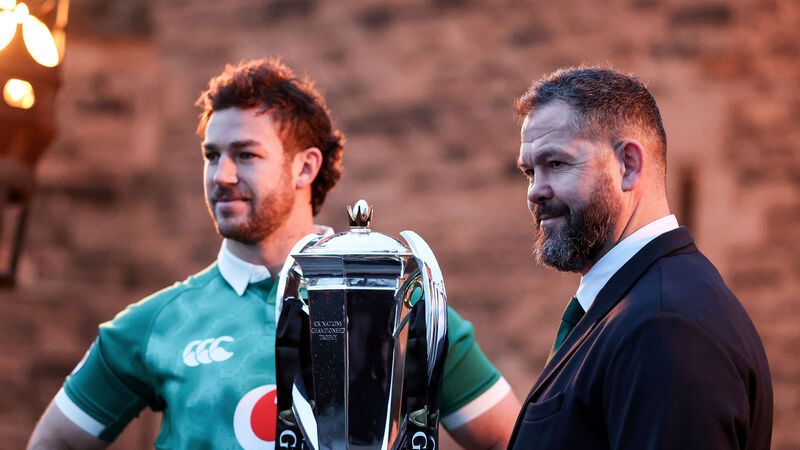
Ireland's Caelan Doris and Head Coach Andy Farrell pictured beside the Six Nations trophy. Pic: Gary Carr/Inpho

As the fallout from Munster’s failure to make the knockout phase of Champions Cup rugby continues, the arrival of another potentially mouthwatering Six Nations campaign could not be better timed.

The Irish squad decamped to training camp in Portugal on Monday with the narrative centered on a deepening injury list that may prove a major hindrance in the short term but with potential long-term benefits if it adds to Ireland’s depth chart.

Promising 20-year-old Connacht loose head prop Billy Bohan is an example of that. Just being involved with the Irish squad in Portugal will afford him an insight into what’s required to take the step up to the next level. In total, there’s 16 players in the Irish squad on fewer than 10 caps.

Sometimes a coach's hand has to be twisted before committing to embracing change. Alterations were already on the cards at loose head with Andrew Porter and Paddy McCarthy ruled out of the opening games of Six Nations action.

7138620

Given Ireland’s well documented scrum problems against South Africa last time out, the sight of Jack Boyle dealing with the sizeable threat posed by the Bayonne front five in Leinster’s recent Champions Cup pool clash at the Stade Jean-Dauger could not have been better timed.

On the back of his impressive performance that day, he was penciled in to start against the French but he too is now ruled out of the championship after sustaining a nasty Achilles tendon injury against Connacht.

Andy Farrell has always been a coach who embraces chaos but this latest setback could have serious ramifications given France would have already earmarked Ireland’s scrum as a potential weakness.

The fact giant French tight head Uini Atonio was forced out of La Rochelle’s game against Clermont Auvergne on Sunday night and has already been replaced in the French squad offers some respite for whoever Farrell selects at loose head for the opening game.

Farrell is nothing if not resilient. Given the loyalty and team-first attitude he’s embedded in the Irish squad over the years it’s only natural for him to have a tendency to stick with the tried and trusted.

He’s been loyal to players that have consistently performed for Ireland on the biggest stages worldwide. That trait will be tested over the next two months as current evidence on the provincial stage suggests that form and fitness may be against a number of regulars, including James Lowe and Bundee Aki.

The notable names excluded from Farrell’s squad, the likes of Porter, McCarthy, Robbie Henshaw, Mack Hansen and Jimmy O'Brien were due exclusively to injury. He can now add Boyle to that worrying list. Contrast that with his opposite number Fabien Galthie.

He’s chosen a broader 42-man squad including 12 uncapped players, nine of whom are backs. Eyebrows were raised when amongst those excluded were Damien Penaud, France’s leading try scorer of all time, along with two proven leaders and recent captains in No 8 Gregory Aldritt and centre Gael Fickou.

Galthie is spoilt for choice. He got away with making highly questionable calls last November like omitting Bordeaux Begles playmaking No 10 Matthieu Jalibert. In the past he’s even selected Toulouse full back Thomas Ramos ahead of Jalibert at out half when Romain Ntamack was unavailable, as he is for the game against Ireland.

So, who will he select in pivotal role this time. Jalibert is in the form of his life. His club are a top seed in the Champions Cup, having won it last season, with Jalibert front and central to the outstanding brand of rugby they are playing. Yet, it’s not set in stone that he’ll start against Ireland.

Right now, I suspect Farrell would be happier if Jalibert doesn’t start especially as, on current form, the majority of the French back line may be laden with Bordeaux players even in the absence of Penaud. The pressure is on Galthie given it’s four years since France won a Grand Slam.

Perhaps that’s why he’s included such a strong cohort of young players, many of whom starred at U20 level for the French in recent seasons. The highly competitive Top 14 is producing a strong seam of emerging talent waiting to press their claims for inclusion in advance of the 2027 World Cup.

There’s huge excitement around the emergence of several back three players such as twice capped Pau winger Théo Attissogbe, uncapped Toulon flyer Gaël Dréan and Olympic Sevens gold medalist Aaron Grandidier Nkanang.

Bear in mind also that another recent French U20, La Rochelle centre Simeli Daunivucu who wreaked havoc against Leinster in Dublin, would almost certainly have been included but for injury. That emerging talent is putting pressure on the more established French starters. Galthie is clearly sending a message.

With the final game of the championship set for a 9pm kick off at the Stade de France, the broadcasters have set their hopes on that game between France and England deciding the outcome of the tournament. Form would suggest as much but the unpredictability of sport is what makes it so attractive.

So what about England? They enter the campaign on the back of winning 11 tests in a row. Steve Borthwick’s men haven’t lost since the opening game of last season's Six Nations against Ireland in Dublin and are heavily fancied to push France all the way.

Their 33-19 demolition of New Zealand last November ultimately cost All Black coach Scott Robertson his job. Borthwick has borrowed heavily from the Rassie Erasmus playbook, packing his bench with explosive forwards, including a front row of Ellis Genge, Luke Cowan-Dickie and Will Stuart that many view as England’s strongest scrummaging unit.

In recent games, he’s also held another duo of British and Irish Lions in back rows Tom Curry and new golden boy Henry Pollock in reserve enabling England to finish strongly in all their autumn tests.

Italy, as evidenced by their impressive 26-19 win over Australia in November, have made serious strides under Gonzalo Quesada but, at a minimum, Ireland will need to have bagged a decent performance in Paris and a win over the Italians in Dublin before visiting Twickenham.

The fact those three games will be played on successive weekends for the first time in Six Nations history adds a further impediment with injuries guaranteed to exact a toll. Sadly Welsh rugby is in complete disarray meaning anything other than a convincing Irish win at the Aviva Stadium in round four would be disastrous.

Therefore much will be decided before Scotland arrive in Dublin for Ireland’s final game of the campaign. What happens against France and England will dictate just how relevant that encounter with Gregor Townsend‘s men will prove. Time will take care of that.

Connacht

A final word too on Connacht. Last Saturday in Galway marked a momentous day for the province. The opening of the impressive new Dexcom Stand and adjacent high performance facilities, almost 23 years to the day Connacht players and supporters marched on Lansdowne Road to keep professional rugby in the province alive, was significant in so many ways.

Hats off to CEO Willie Ruane and his professional board for their vision in driving this project. It must have been an emotional day for so many Connacht stalwarts who marched that day in Dublin when Cian Prendergast led his team out against Leinster. The music, light show and pageantry only added even further to an already emotional occasion.

I’m confident the appointment of Stuart Lancaster will pay dividends in the long term if he’s allowed develop his plan over the next three years. With strong leadership from the top of the organisation, anything is possible. Sincere congratulations to all involved.

More in this section