John Fogarty: Tech-heavy World Cup casts shadow over GAA officials
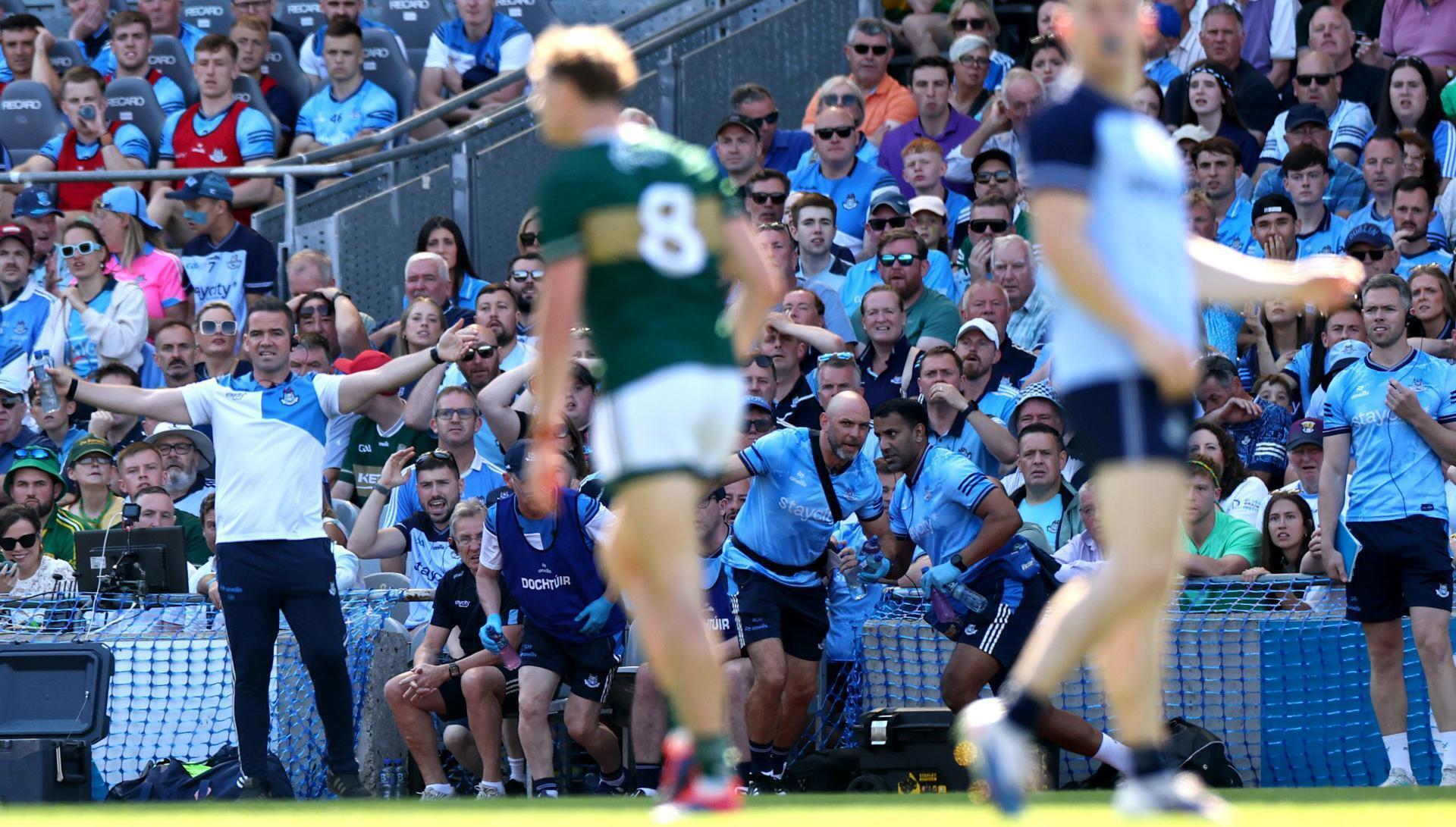
Dublin’s manager Ger Brennan on the line at Croke Park on Sunday. Pic: INPHO/James Crombie
Sixty years later, Gaelic football had its Geoff Hurst moment on Sunday. Dublin thought it was over (the goal-line). It isn’t now.
Unlike the Azerbaijani linesman Tofiq Bahramov who verified the England striker’s second of three goals that July afternoon in Wembley, Brendan Cawley’s linesmen weren’t tens of yards away from the whitewash. The two of them, one of them a club referee, were well placed to see it and determined it hadn’t crossed it.
Replays are inconclusive. Anyone who can categorically say the ball fully crossed the goal-line must have 20/10 vision. Likewise, anyone who claims it most certainly didn’t. When in doubt, the key thing is to do nothing.
The penalty decision against Peadar Ó Cofaigh-Byrne was on the harsh side but Dublin’s case against the Seán O’Brien goal was the strongest. There was nothing subjective or obscure about that.
To the airwaves, GAA followers took on Monday. “LiveLine” crackled with frustration about the decisions. Nickie Quaid’s double foul on Peter Duggan was revisited. The quality of umpiring was criticised. The need for a video assistant referee (VAR) was emphasised.
Away from the radio, in two counties outside the capital, sympathy was in short supply for Dublin. Galway shed no tears after they felt calls went against them in their All-Ireland quarter-final defeat to Ger Brennan’s side.
In Kerry, most conversations on Sunday and Monday referenced prior “misdemeanours” committed against them in defeats to Dublin. Remember Kevin McManamon’s double hop and Brennan’s tackle on Declan O’Sullivan in 2011, we were told. Remember Diarmuid Connolly’s hit on Peter Crowley before Connolly’s insurance score in ’16. Remember, Stephen Cluxton coming off his line for Paul Geaney’s penalty three years later. Remember, remember. What has gone around had come around in some of their eyes.
But that non-square ball goal coming so soon after Diarmuid O’Connor was blessed to win a late 45 that Paudie Clifford converted in the edgy win over Tyrone at the same Davin Stand End can’t be too easily dismissed. Coming as it did on that All-Ireland SFC quarter-final weekend where there were other contested decisions and 12 months after Noel McGrath’s point that was a wide, the margin for human error is wearing thin.
Coming as they do when a World Cup with all its technological trappings is being played across the Atlantic, the errors that have been made are perceived in a dimmer light.
The smart, chargeable Adidas Trionda football used in the US, Canada and Mexico took six years of research and development. Featuring a chip to provide video assistant referees with precise data on the movement of the ball, it cost millions.
Its creators were probably patting themselves on a job well done when the AI technology in the ball revealed that in a last 32 game earlier this month it had brushed off the head of Croatia’s Igor Matanovic before reaching Mario Palisic who was offside. Therefore, Josko Gvardiol’s equalising goal was ruled out and Portugal progressed.
Likewise, the chip was key to Sweden’s Mattias Svanberg scoring with his first touch against Tunisia, the quickest World Cup goal ever by a substitute. It was initially ruled out for offside but the review found Alexander Isak had made the slightest touch on the ball and as a result Svanberg wasn’t offside. Also against Tunisia, the chip denied Japan a goal as it was found the ball did not completely clear the goal-line.
On Saturday, VAR denied Norway a goal after Erling Haaland was found to have pushed Elliot Anderson. Mind you, the organisers would probably like to forget Norway’s strong claim that the Spidercam cable contributed to England’s equalising goal in Miami on Saturday’s quarter-final.
Adidas reportedly pay FIFA around €88 million a year to be a top tier partner. The Trionda, priced at €150, sells like hot cakes. FIFA will take in over €5 billion in revenue for this World Cup.
The GAA’s gate receipts for last year’s All-Ireland senior football championship and Tailteann Cup came to just over €22m. FIFA’s compensation to clubs for their players during the tournament is roughly 10 times that amount.
When it comes to talking turkey, FIFA gobble and the GAA nibble. But every four years, when two competitions run parallel, the lines of reality blur. What is expected of an amateur organisation becomes completely disproportionate. The conflation is, to be fair, unfair.
There is no question GAA officials are making mistakes. There is no question that the person charged with communicating HawkEye’s findings with the referee could be more than just a messenger.
Some have become referees – example, David Gough. Some were referees – example, Dickie Murphy. Away from the hustle and bustle of the action, they could quickly review a decision if it is officially challenged by a team or management and under strict conditions.
HawkEye could be extended to goal-lines but most of the bad calls in recent weeks would have been avoided with another look.
john.fogarty@examiner.ie
His achievements speak for themselves but one of the most endearing acts of Ciarán Kilkenny’s time as Dublin senior footballer was his online coaching engagement with children during the pandemic.
While the likes of former Mayo footballer David Brady used that surreal time positively to reach out to the older generation, Kilkenny put together a series of videos over nine weeks, which was heaven-sent for aspiring footballers.
"I would have uploaded it online on Twitter and Instagram and then throughout the whole day until 10 or 11pm I'd be getting engagement from the kids, seeing how they were getting on with their skills and seeing where they can improve,” he recalled later that year.
“And to see their improvement over the nine weeks, even a lot of them sent messages before they went back to the club saying they had improved on their left or right side, was really fulfilling for me.”
His retirement statement on Monday had shades of the one he released to confirm he was jettisoning an AFL career to play his first love. “When I turned down the opportunity to play professional sport in Australia, it was because I knew that representing my club and county would always mean more to me.” For a historian of the organisation as much as its sports and a true believer in meitheal, you sense if Dublin hadn’t seen such riches, he could have lived with being poor to paraphrase Tim Booth. As competitive and talented as he is.
There will be chatter about Kilkenny giving hurling a year but it’s unlikely. Sources close to the Dublin camp say his ability to be available for every championship game this year was a feat in itself.
After 87 championship appearances, eight All-Irelands and six All-Stars, he leaves the stage as a class act in more ways than one.
Colm Lyons’ six weeks without a game had us wondering when was the last time a referee assigned to take charge of an All-Ireland senior hurling final after such an extended gap to their previous engagement.
The shortest was two weeks for Fergal Horgan when he was the man in the middle for the 2020 and ‘21 All-Ireland finals as he was for a semi-final each year. Last season, Liam Gordon was in quarter-final action four weeks before the final as was Johnny Murphy in 2024, John Keenan in ’23, Lyons himself in ’22 and James Owens in ’15 and ’19 and Horgan in ’17.
Owens also refereed a semi-final and final in 2018 but the general pattern going back to Brian Gavin and Barry Kelly’s time has been quarter-final followed by final.
Time-wise, Lyons’ break is the longest since Kelly in 2008 when he officiated the Kilkenny-Waterford final seven weeks after his previous appointment, a Galway-Tipperary qualifier.
In terms of the championship, you have to go back one more year when Diarmuid Kirwan was given the biggest role of the season a full 12 weeks after his previous and only other championship game, the first of the Limerick-Tipperary Munster semi-final trilogy.
This is Lyons’ second All-Ireland final. He is one of the most proven operators but having not done an elite game in so long it won’t be surprising if he is a mite rusty to start off with on Sunday.
CONNECT WITH US TODAY



Be the first to know the latest news and updates