Christy O’Connor: What is a goalscoring opportunity?
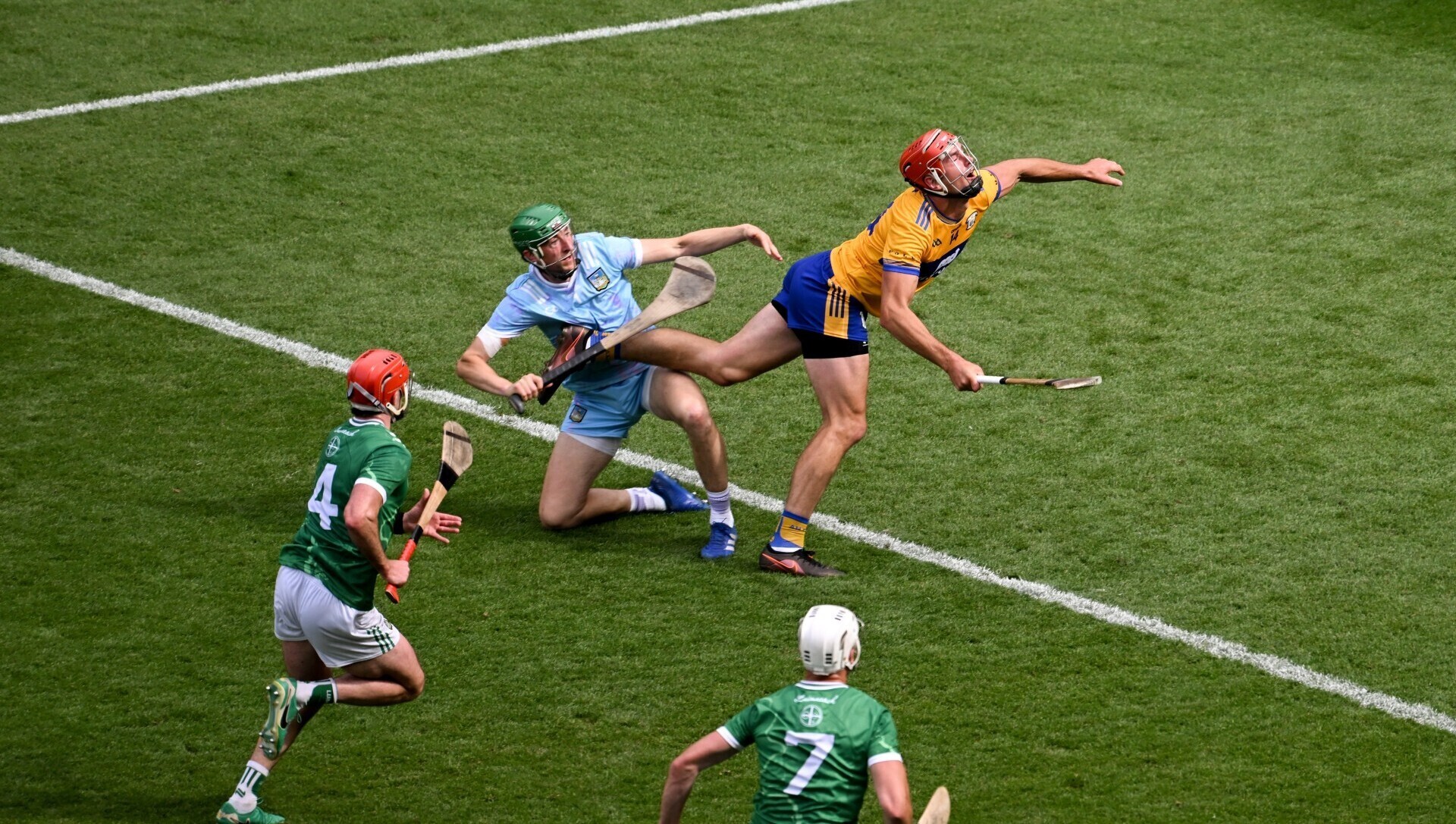
Limerick goalkeeper Nickie Quaid fouls Peter Duggan of Clare. Pic: Daire Brennan/Sportsfile
A photograph can never paint the full picture, especially an action shot, but Tom O’Hanlon’s snap of Nickie Quaid pulling down Peter Duggan on Sunday was the most vivid illustration of the exact moment of contact. And the picture spoke a thousand words.
Quaid has his hands wrapped around and inside Duggan’s faceguard, albeit only momentarily, but it was still enough – along with Quaid making contact with his outstretched leg – to haul Duggan down.
The ball ended up in the net as Barry Nash accidentally kicked the sliotar over the line. If referee Thomas Walsh had allowed the goal, it couldn’t have been a black card and penalty as Duggan wouldn’t have been denied a goalscoring opportunity.
When it wasn’t, the natural assumption was that it was a black card and a penalty.

Walsh told Quaid that, while it was an intentional foul, and a penalty, it was only a yellow card as Duggan wasn’t in possession of the ball.
A black card is issued when a defending player pulls down, trips or carelessly uses the hurley on an attacking opponent to deny a goalscoring opportunity.
However, a goalscoring opportunity centres around a couple of factors, outlined in the rule book under ‘Important Terms and Definitions’; the player must possess, or be in control of the ball, within the small ‘D’, or inside the 20m line in a central area.
But what then is a goalscoring opportunity? What happens if a player is hauled down while trying to solo the ball? Or flick it over a defending player, as Duggan did?
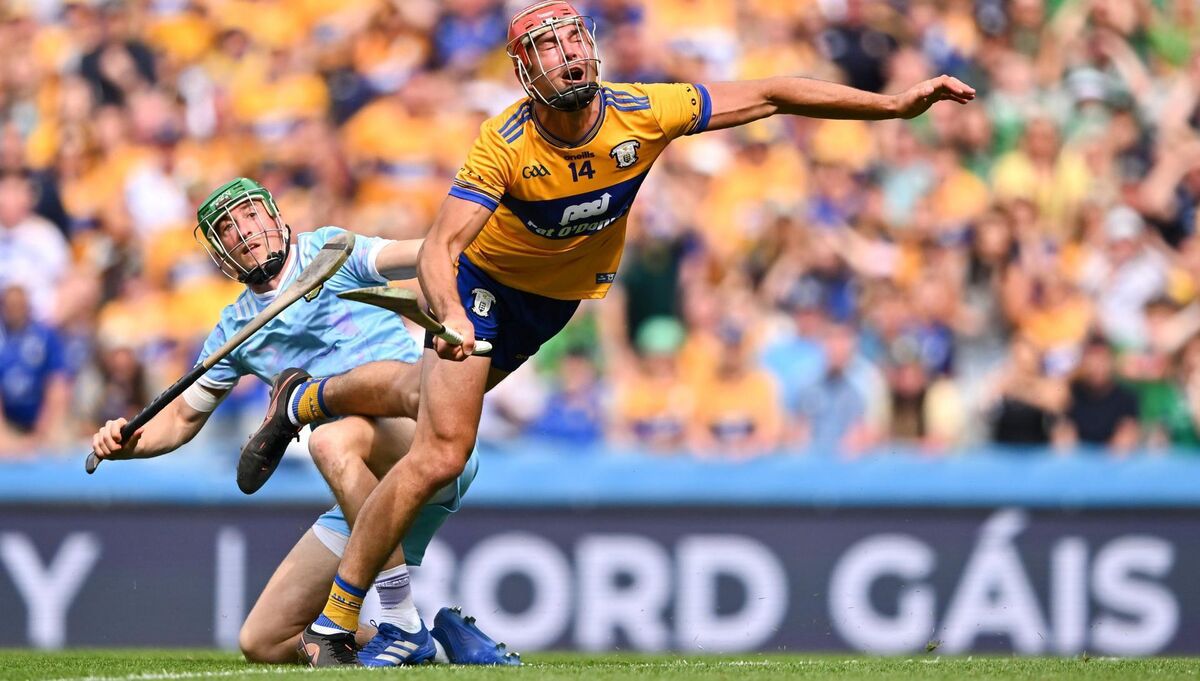
The referee has to take a subjective perspective to decide if there was an opportunity to score a goal when the infraction was committed. And there clearly was.
Read More
When Waterford’s Mark Fitzgerald was black-carded for a foul on Cork’s Brian Hayes in Walsh Park in May, Fitzgerald did pull Hayes to the ground while the sliotar was dropping but Hayes didn’t have possession of the ball.
It wasn’t even a latent pull-down from Fitzgerald as both players grappling, which is what often happens in that situation. A pull-down is a penalty and a black card but only if it is a clear goalscoring opportunity. And it wasn’t in that instance. But it wason Sunday.
The purpose of the rule is to discourage cynicism in goal-scoring situations. Quaid’s split-second reaction reduced the capacity for Walsh to term it premeditation. The technical detail of what exactly constitutes “clear goalscoring opportunities” is loaded with grey areas around the topic of cynical play.
The biggest issue is the thin scope of detail around fouls included in the rule, the central component of which is based around pulling down an opponent.
Yet there are numerous different ways in which modern players are coached to commit fouls in goalscoring scenarios so as to ensure they don’t fall into the black card category. Referees were clearly prepared to err on the side of implementation, but Walsh choose to err on the side of caution.
He could argue that Quaid’s foul did not meet the objective criteria for that punishment, but the rule is a mess when the ‘terms and definitions’ doesn’t always allow the rule to deliver the correct outcome of what the black card was intended to deliver – prevent cynical play in a goalscoring situation.
And it was the decisive decision in the game.
Was it really that bad for Cork? Was it as much of a horror show as last year’s All-Ireland final?
In the 64th minute on Saturday, Shane Barrett forced Darach Fahy into a brilliant save when a goal would have reduced the margin to three points and finally given Cork the oxygen they were craving.
Would a goal then really have made any difference either? Galway nearly had a goal from Jason Rabbitte within seconds of Fahy’s save. Galway had an answer to every question Cork posed. So was this as bad as last year?
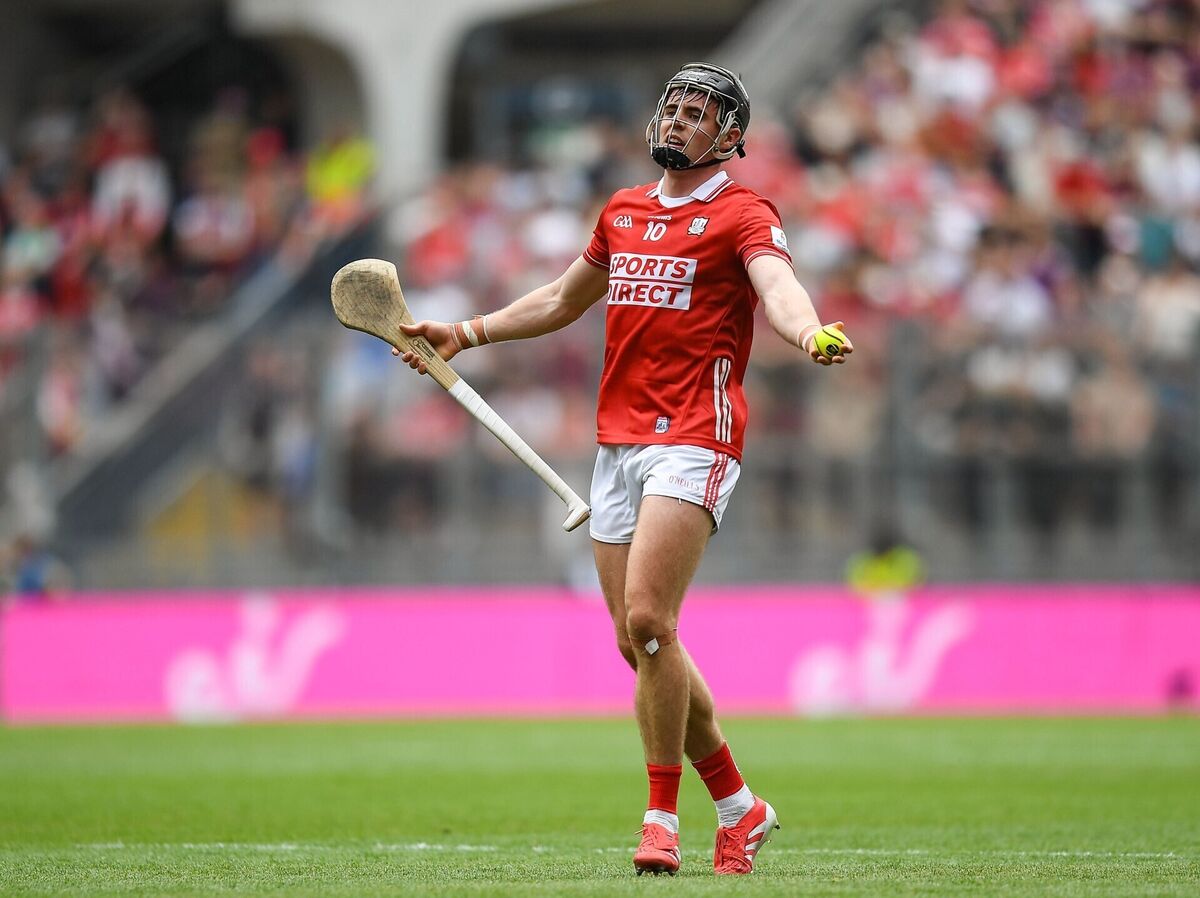
Yes. If last year’s second half was considered a freak, Saturday confirmed it was a pattern.
This collapse had the same haunting echo from 12 months ago. Cork only had one more shot in the second half (13) compared to the dozen they got off after the break against Tipp last July. Cork did score three more points this time around but that’s only adding minor nuance to another horror-show.
No matter how deep you dig, the reality is even more miserable for Cork and more impressive for Galway.
Micheál Donoghue’s side absorbed every punch Cork threw and responded with an even heavier barrage, burning Cork alive in a forest fire of aggression and intensity.
Galway took over around the middle in the third quarter, drowning Cork in waves of manic intensity, gorging on turnovers as they went.
Having pushed up on Cork’s short puckout and forcing Patrick Collins to go long, Cork were walloped on their long puckout in that third quarter, securing only two of nine Collins’ restarts in that period when Galway smothered Cork beneath a tsunami of scores.
The composure and precision of Galway’s link-up play and running game was outstanding but so was their game-management.
After using Jason Rabbitte as a long-ball option in the first half, when Rabbitte scored 0-2, was fouled for 0-3 and had another assist, Galway were content to avoid Rabbitte in the third quarter and shoot from distance, with Galway getting off 15 shots in that period.
The writing was already silently on the wall at half-time because Galway were getting off plenty of shots.
Galway didn’t panic or change anything at the break - because they didn’t need to.
Getting out ahead early further enabled them to get more bodies back deeper and ramp up their running game. They kept hustling Cork out of possession, repeatedly punishing them on the scoreboard with that possession; Galway sourced 1-16 off turnovers.
After the pain of last July, Cork never thought they’d see a day like that again. But seeing it so soon made it feel even more painful.
Early in the second half of Sunday’s All-Ireland minor final, Tyrone looked to be cruising to successive All-Ireland titles.
And then suddenly, they weren’t as Cork found a way back, drawing level with four minutes remaining before a late goal from Eoghan Aherne nudged Cork over the line.
It was Cork’s first title at this grade in seven years but they also stopped Tyrone from achieving more than just back-to-back titles; they also halted Ulster’s bid to win four All-Ireland titles in succession for the first time.
That had only been achieved twice before by a province, by Leinster (whose sides won six-in-a-row) between 1954-’59 and Munster (whose teams also won six-in-a-row) between 2014-‘2019, with Kerry winning five of those titles in succession.
Ulster's grip at this level in the first part of this decade was reflected by more than just All-Ireland titles; the 2023 final was contested by Derry and Monaghan; Derry retained their title in 2024 by overcoming Armagh in the decider.
Prior to Sunday, Ulster teams had won three successive All-Ireland titles before across just two periods; Tyrone (1947, 1948), Armagh (1949); Tyrone (2008, 2010), Armagh (2009).
Ulster though, came nowhere near to making it four-in-a-row in the following years; in 1950, Antrim were annihilated by Kerry in an All-Ireland semi-final; in 2011, Cavan (Ulster champions) were beaten by Galway in an All-Ireland quarter-final, while Armagh (runners-up) were turned over by Roscommon at the same stage.
Tyrone went closer than any of those teams in trying to secure a first four-in-a-row for the province. But they just came up short.
A collection of the latest sports news, reports and analysis from Cork.
CONNECT WITH US TODAY



Be the first to know the latest news and updates