Maurice Brosnan's Football Observations: What would Dublin be happy for Clifford to score?
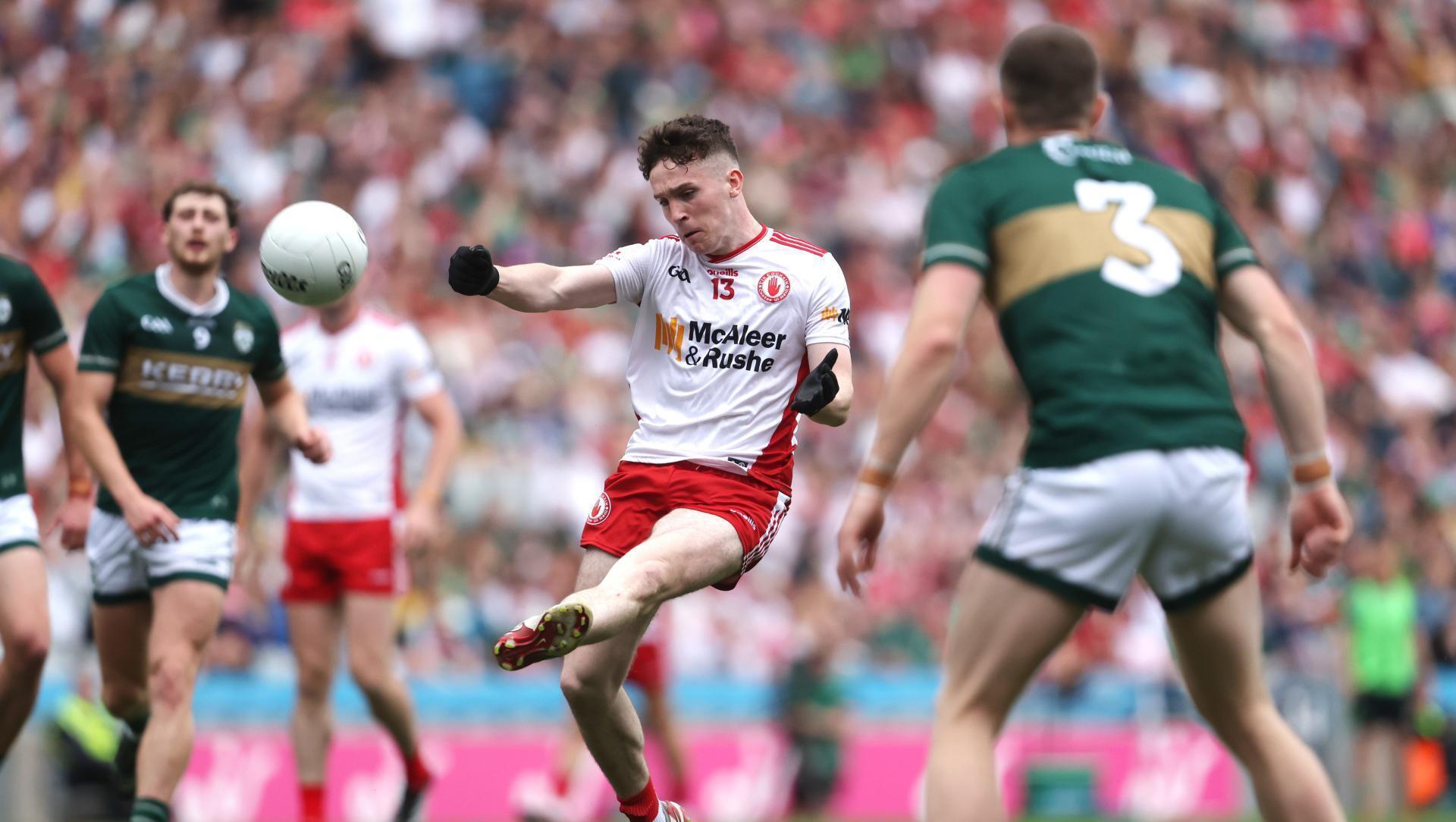
Tyrone Eoin McElholm shoots against Kerry. Pic: ©INPHO/Bryan Keane
At first glance, it was the sort of innocuous moment that scarcely deserves mention in the intro to a column. In the second half of the thrilling quarter-final between Kerry and Tyrone, Eoin McElholm was in possession around the middle, soloing.
That play was not particularly consequential in the context of Kerry’s eventual victory. It didn’t even end in a score. Still, the gifted prospect was doing something that is exceptionally difficult to execute. As he controlled possession, he kept his head aloft while repeatedly soloing the ball, scanning. He never looked down at his foot or the ball; his eyes were fixed on the space in front of him.
The Tyrone corner forward kicked three points in Croke Park on Saturday and could have had a decisive goal if his rifled effort had been a fraction below the woodwork rather than a touch too high. Yet that solo and scan spoke to the remarkable level of play littered across the four games. The list of highlight moments is extraordinary.
We make this point partly as a response to those predictable beings who default to the “well, actually,” routine. That thing that you think is good is actually not as good as you think it is. There is a proud tradition in the GAA of columnists and commentators thriving on such whining: tactics, teams, the format, the calendar, the quality; it's not actually that great, really. Make sure to return next week for our column on how handpassing is ruining civilisation.
What we have at the minute is a suitable platform for creativity and class to shine. These capabilities were always there, but why would McElholm scan inside when the opposition had 15 players behind the ball? Now there is wondrous opportunity. It led to some remarkable passages.
Here is our quick-fire list of ten deadly plays.
A handpass to himself, a two-pointer into the Hill, and a soaring kickout catch. All on your first outing in Croke Park. A bonus point for going for goal at the death.
David Clifford’s chip for his first point, Conn Kilpatrick’s dink onto a kickout break while charging up the sideline and best of all, Sam Mulroy’s unfathomable lift to tee up Ciaran Byrne’s final point on Sunday. You know what they say: always handpass to yourself and never bend your back.
One for the Keel clubhouse wall. On that, might it be time we started crediting videographers for their outstanding work in capturing these moments of brilliance last weekend? The GAA deserve enormous credit for introducing the pitchside camera operators. That clip of Evans’ full-length dive, which captures the athleticism and reach in all its glory, was captured by the outstanding Mark Forde. He is a 21-year-old student who spotted a gap in the market for an American sports-style sideline footage and alternative angles. His craft was honed with Offaly’s U20 hurlers and he’s now working wonders for the GAA. We praise photographers for iconic shots. The same should apply to videographers.
The NBA’s Cleveland Cavaliers have a team tradition where a custom gold chain is awarded in the locker room to the player who displays the most grit and intensity during a win. It is the ‘Junkyard Dog Chain.’ Kerry and Tyrone could hand out one each. on breaks resulted in two frees and three points at the Hill 16 end. to impact kickouts, or his Superman dive to flick the ball towards Sean O’Brien before Dylan Geaney’s two-pointer, are the sort of plays that are cherished inside a dressing room.
ability to take off on a scorching run is ideally suited to Croke Park. He created their goal and broke a stubborn Louth press with that trademark burst from inside his own half. If they had opted to set up some set plays to release him more, they would have won the game. The human Flash.
for all three of his points, especially the one on the hooter. That is the sort of emotion the game needs.
win in the dying moments. Clutch.
into the Hill. A sensational footballer who harshly missed out on an All-Star last year due to patience wearing thin with the wider group.
It was a complete two-way impact. Every element we like about Gaelic football was captured by his display. Do you like scores? Do you like kick-passing? Do you like tackles? Do you like winning breaking ball? Scully did it all.
Some defences, like Dublin, do not rely on matchups. There is a collective goal that supersedes any individual tagger. Others, like Tyrone, rely on them heavily. In the entire quarter-final last weekend, they managed to get five out of six matchups correct. It was a phenomenal return. It still wasn’t enough.
At the very start, Joey Clarke was on Dylan Geaney, Niall Devlin was on Paul Geaney, Cormac Quinn was on David Clifford, Peter Teague was on Joe O’Connor, Kieran McGeary was on Diarmuid O’Connor and Michael McKernan took Paudie Clifford.
Teague gave O’Connor his fill of it. McGeary had a height disadvantage yet still competed admirably on the other side, including during that comical moment when they both came crashing down while holding the same ball. McGeary finished with 0-5 in assists and scored 0-2.
Paudie Clifford had 35 possessions, one turnover, 0-3 in assists and scored 0-5, including 0-3 from play. But McKernan had a significant impact going the other way as well, and it is an unfair ask to completely cancel out the number 11.
After 20 minutes, Dylan Geaney had five possessions. Three were handpasses backwards in the one play; the other two were kicks inside. One ended in a turnover and the other was a wide. He never went past or shook off Joey Clarke. Then the tenacious corner-back had to head down the tunnel for a temporary sub.
Geaney thundered into the game while he was off, scoring two points. Clarke returned but struggled to extinguish a then raging fire.
At that point, David Clifford had already registered 1-3. This was the only matchup that Malachy O’Rourke would have been seriously concerned about. Kerry missed four of their first five shots from play. Tyrone were ahead before the goal, but the three-time Footballer of the Year’s influence is such that he was single-handedly dictating the terms.
Niall Devlin swapped across and produced the greatest man-marking job ever seen on Clifford in the new-rules era. Clifford scored two points from five shots from then on. Both were fisted efforts (Kerry fisted four points, Tyrone none).
His full-length dive to block Clifford’s first two-point attempt resulted in the ball dropping short. It was all about footwork and concentration from the Coalisland native. He was dealing with a man who is currently unstoppable in the truest sense of the word. No one has a template to combat him. Keeping him scoreless is a fantasy.
It is a fascinating question for Dublin. What would they be happy for Clifford to score in the semi-final? Five points from play? More?
At the same time, how Clifford navigated that attention was a further demonstration of how this genius is evolving. In the 2023 All-Ireland, he kept forcing shots under close attention.
Devlin repeatedly showed him to the sideline and his right foot, but never wavered from his task. Clifford knew that. So when his brother ran a loop in that corner, he waited patiently. Both defenders descended on the number 13, understandably.
Clifford teed up Paudie with a floated handpass. That brief lapse created enough space for him to race in and fist over.
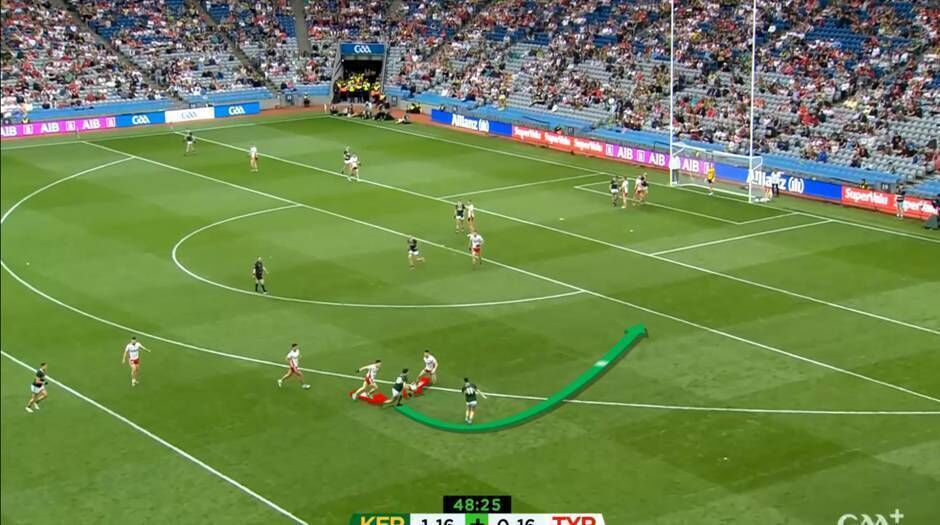
All across the board, the Kingdom are littered with players who know their role. During that stretch of inaccuracy in the first half, Jack O’Connor didn’t need Gavin White to stride forward and attempt a hero point. Instead, the wing-back took off, breached the Tyrone defence and teed up David Clifford for a goal chance.
White had 29 possessions, won three kickouts and assisted 1-5. Graham O’Sullivan’s surging runs down Clifford’s channel created his first three points as he finished with four assists. O’Shea won or broke eight kickouts to a team-mate. Jason Foley struggled at times with his direct opponent, but his four possessions included two kickout wins. The entire system is in service to the team. They are not just individual stars; this is a collective force.
That is what Cork were sorely lacking as they squandered so many opportunities on Saturday. They had 34 shots to Mayo’s 28. From a kickout perspective, they retained 68% while holding Mayo to 48% with a highly effective 4-4-3 press. This is quickly becoming the blueprint for teams looking to combat opposition kickouts zonally.
Cork’s attack was dire on Saturday. Martin McNally earned plaudits for allowing plenty of physicality, but Mayo had twice as many scoreable frees because they attacked with more punch and purpose. A key metric tracked by some teams is scores per ten phases, essentially measuring attacking efficiency. Cork’s was 4.2 (Mayo’s was 6.4, while Kerry and Tyrone were above 7.) The first thing John Cleary referenced post-match was their conversion. “We weren’t good in front of goal today,” he said. The real challenge now is to determine why and how to solve it. They turned to the bench for more finishers, but what they truly needed was a player to punch a hole and tee up a simple score.
For the final question of Sunday’s press conference, Pádraic Joyce was asked if he believes this Galway group can go again given their latest missed opportunity.
“I have seven years done here now and I’ve two more to do,” he said immediately in his answer. He was not asked about his own future but felt the need to address it. After that, he listed their recent record: two All-Ireland final defeats and two quarter-final defeats in the last five years.
“They just have to come back again. The football is there in the county. They will always be there or thereabouts.”
Joyce’s comment about next season was noteworthy, yet it is far from a guarantee that he will return for 2027. After the intense speculation that surrounded last winter, perhaps it was simply a bid to put the inevitable talk and questions to bed while he makes up his own mind. Across the board in the county, there is uncertainty about what he will do.
If the vibes were bad at the start of the season after a disappointing exit to Meath in 2025 (and rest assured, they were), this mood is even worse. Local radio is filled with questions about kickouts, late collapses, substitution calls on the sideline and a perceived fear of losing. The online reaction is relentless.
Last winter would have been a tough one for players and management. There was a point where a cohort genuinely believed that Joyce was going to depart. There are legitimate questions to answer now. Is the county legend the best man to lead them next season? If so, what needs to change?
On the first question, the answer is still yes. Joyce guided Galway through a transitioning generation, won four Connacht titles in a row and evolved over the course of his reign. Despite not winning a new U20 Connacht title since 2020, they have identified unpolished talent and turned it into diamonds. John Maher and Cein D’Arcy are two prime examples of that development.
There are football issues that have been long-standing and need to be addressed, in particular around their kickout strategy and in-game adjustments. Is the substitution policy best serving the team? The long list of first-half replacements can appear harsh, while recent absences were felt last Sunday. What would they have given for a Cathal Sweeney, Johnny Heaney or Peter Cooke off the bench?
A longstanding frustration, shared by some people within the setup, is how often team news leaks before games. The news of Seán Kelly’s injury was widely known long before throw-in. This is a consistent issue around the current team. Kerry suffered no such problem in the case of Brian Ó Beaglaoich.
Transforming setup and the makeup of the backroom team would be a significant ask for this Galway group. It is complicated by the fact that current chairperson Paul Bellew’s term is at an end this December and, should Joyce go, there is no standout candidate inside the county. A managerial search externally would be fraught with difficulty.
This will be a defining off-season for Joyce and the panel. The last Galway retirement was Gary O’Donnell in 2021. It is hard to imagine that trend will continue for much longer. They are at a critical point where a talented crop could drift away. The pressure is on everyone involved to get this decision right.
Last weekend, both Dublin and Cork utilised similar zonal presses to good effect. It is effectively a 4-4-3, with their best fielders out around the middle to contest long kickouts. For Cork, that was Ian Maguire, Paul Walsh and Colm O’Callaghan.
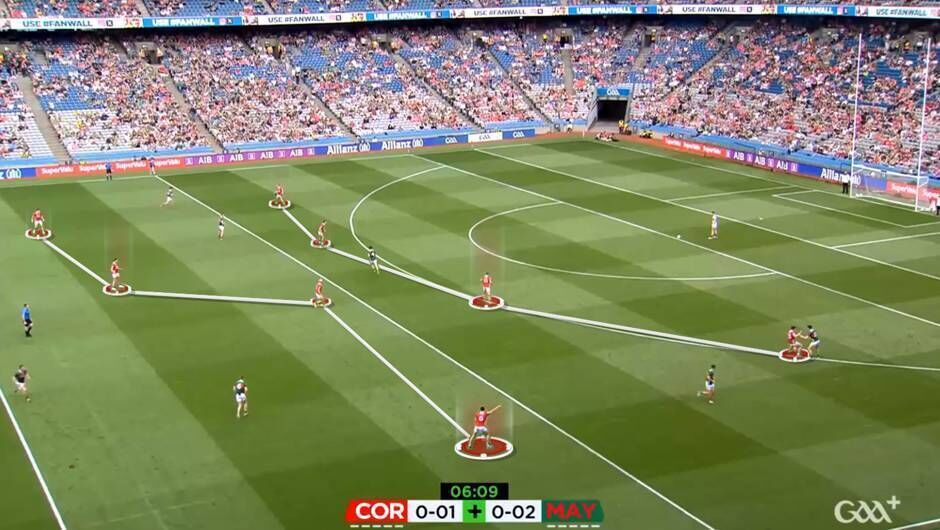
The success of this press should prompt opposition coaches to delve deeper into alternative ways of countering it.
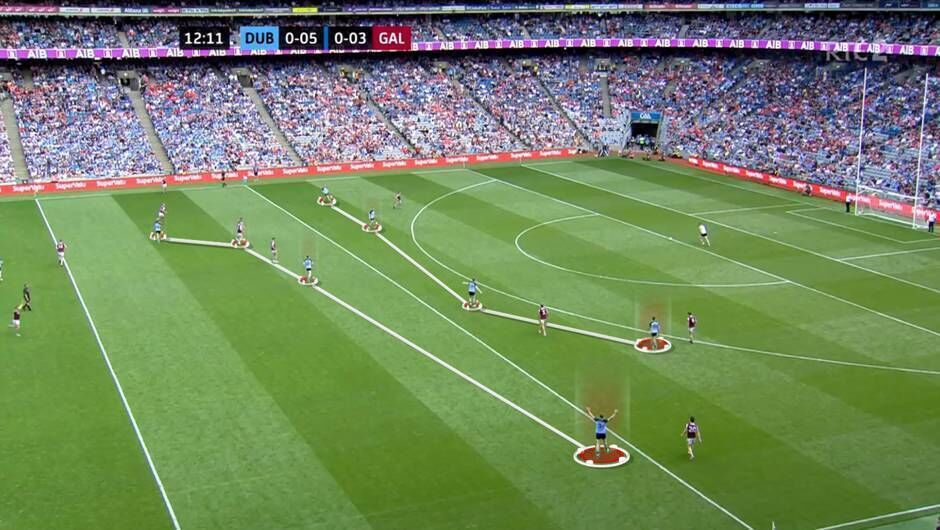
Naturally, the most obvious way to combat a zonal press is through overloads. If they have four on the arc, send five and hit the free man. For that to work, there must be bravery on both sides. A goalkeeper willing to hit it and a receiver demanding the ball in that tight window.
Evan Comerford had some success with a clever mid-range kick to the wing-back slot, right on the sideline where it wasn’t covered by the zone.
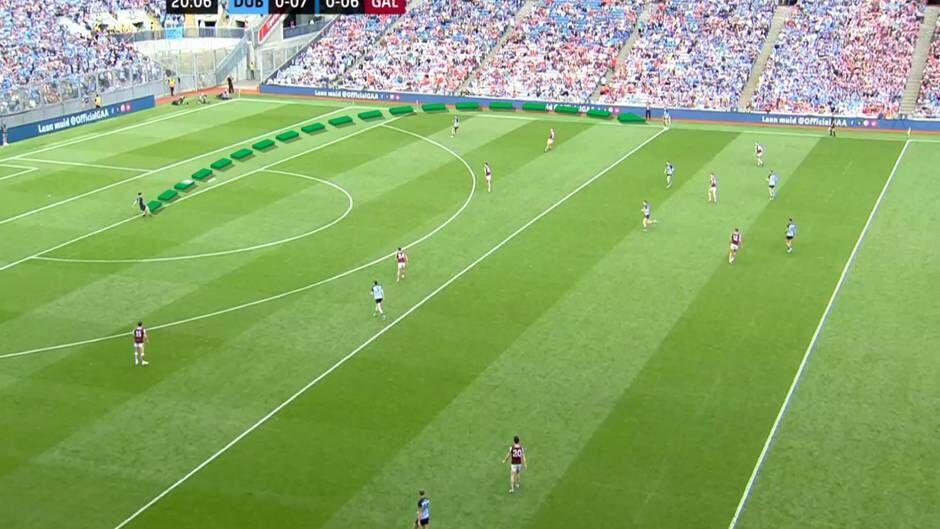
Other goalkeepers, like Niall McDonnell or Blaine Hughes, would thread passing lanes through the front four, but it’s a difficult kick for most.
How Kerry screen and utilise blocks on both sides of the kickout is a great example of the drawbacks of man-to-man. Flyers like Gavin White and Jason Foley can get free or they can use their size in the middle third, with one blocker paving the way for a jumper to attack the ball. The zonal press will increasingly become a weapon of choice. The next innovation is how to break it.
Ready player one. You are Tyrone and two points down. Kerry concede a free with 68:42 on the clock. Do you take the one or go back out and try work a two?
A major factor was the fact that Kerry were enjoying such dominance on their own kickout. A contrary consideration is the lack of two-pointers from play into the Hill 16 end. Was Darren McCurry right to kick the one-point free or should they have tried to work another effort from outside the arc?
With 38 minutes played, referee Sean Hurson offered Monaghan a Sunday choice. Stephen O’Hanlon was fouled twice, once outside the arc and then, as the advantage developed, once inside the arc. Hurson pointed at both spots and Monaghan immediately opted to go back out for the two-point attempt.
They could have accepted the second foul, just as Galway could have had a penalty for the John Maher incident that occurred while they had advantage in the second half. Joyce asked a journalist afterwards whether it looked like their captain had been fouled from the vantage point of Level 7. His understanding of the incident was that David Gough deemed it was not a foul, so they went back for the two-point free.
As an aside, it is a thankless task to be an inter-county referee, but the trend of forwards pinning the arm of defenders is becoming ridiculous.
Usually before undertaking this exercise, we like to make the point that the All-Stars are too often dominated by standout showings in the All-Ireland semi-finals and final. The problem this year is that a host of players are extremely close in the race and have another opportunity to strengthen their case in an All-Ireland semi-final or final. Nevertheless, we persist:
The competition for number one has never been fiercer. Shane Murphy has hardly put a foot wrong for Kerry. Louth’s Niall McDonnell has been excellent, what of the magnificent reel of saves by Mayo’s new kid Jack Livingstone? We haven’t even mentioned Tyrone’s Niall Morgan or Roscommon’s Conor Carroll. But Beggan. He started the championship by scoring five points against Cavan. His heroics against Derry were immense. His kickouts wobbled occasionally in the Ulster final, yet he still scored another two-pointer and was terrific against Mayo. We suspect Murphy will eventually edge this race, he has had three top tier performances this year against Cork, Armagh and Tyrone.
: Conor Dillon (Westmeath), Niall Devlin (Tyrone), Enda Hession (Mayo).
Mark McHugh moving Conor Dillon, who wore number 12, onto Jordan Morris at the start of the Leinster Championship was a masterstroke. Niall Devlin has kept Darragh McMullan to a point, Diarmuid Murtagh to three scores (two ones and a two), Kobe McDonald to two scores (a two and a one) and David Clifford to two scores. Enda Hession is the heartbeat of this Mayo outfit.
A nod to Monaghan’s Dylan Byrne, Galway’s Liam Silke, Dublin’s Davy Byrne and Cork’s Daniel O’Mahony.
Matthew Whitaker (Westmeath), Dara McDonnell (Louth), Craig Lennon (Louth).
Charlie McMorrow and Mike Breen will go very close. Tiernan Kelly and Ronan Daly also deserve a nomination at this stage.
Mark O’Shea (Kerry), Conn Kilpatrick (Tyrone).
The runaway favourites right now. Jarly Óg Burns, Peadar Ó Cofaigh Byrne, Jack Carney and John Maher are all in the race.
Niall Scully (Dublin), Con O’Callaghan (Dublin), Stephen O’Hanlon (Monaghan).
Dara Heneghan is incredibly unfortunate after two sensational showings against Roscommon and Galway, as well as a cracking goal against Tyrone. Mayo’s Ryan O’Donoghue can play himself into this conversation with a semi-final performance.
David Clifford (Kerry), Oisin Conaty (Armagh), Dylan Geaney (Kerry).
Westmeath’s Brandon Kelly scored a remarkable 4-22 from play and is a serious contender. As is Dublin’s Paddy Small. Mayo (Kobe McDonald and Darragh Beirne) and Louth (Sam Mulroy and Ciarán Downey) will have a say yet.
CONNECT WITH US TODAY



Be the first to know the latest news and updates