Maurice Brosnan on football: What’s the one thing defenders have that forwards haven’t?
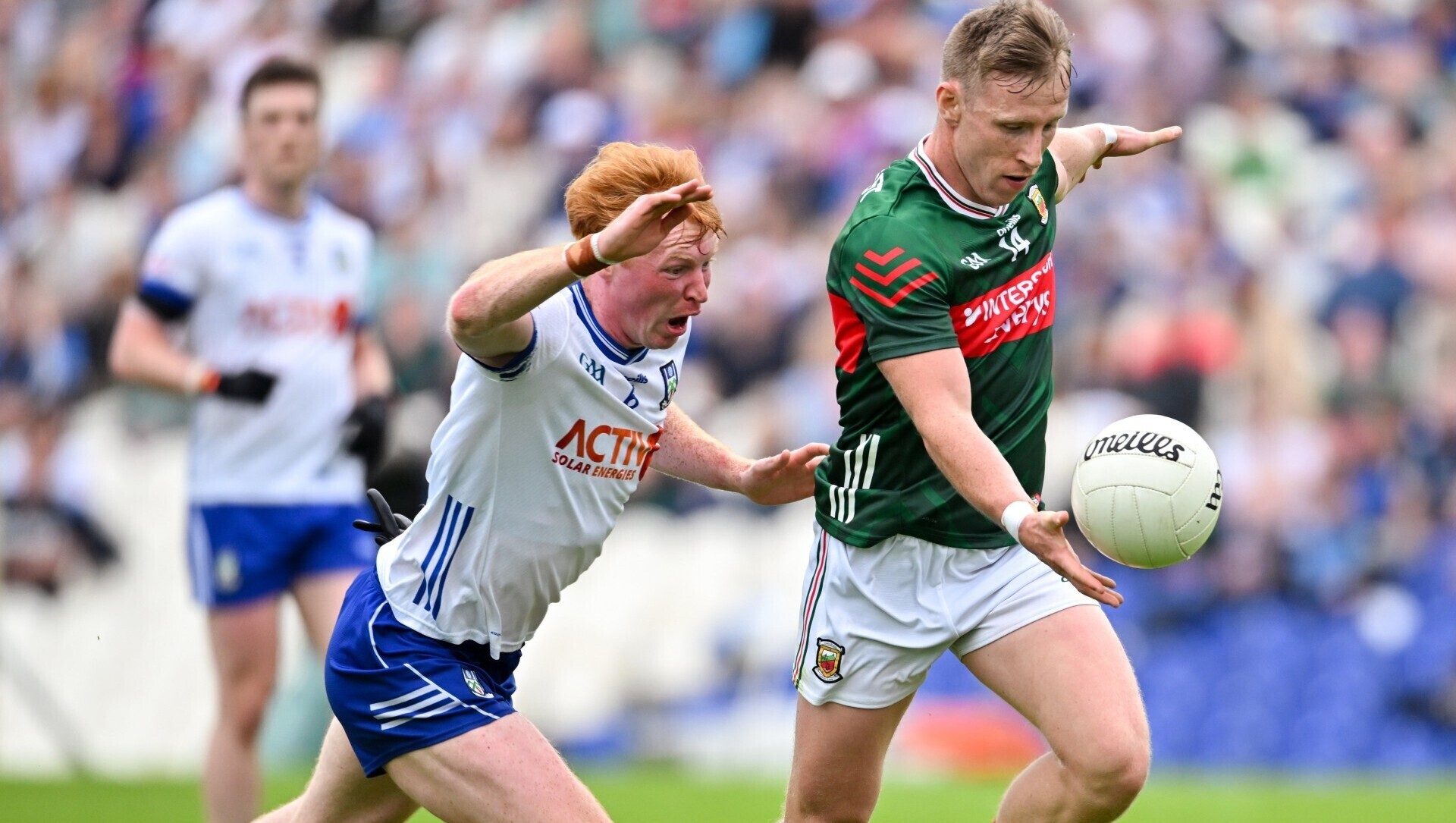
BATTLEGROUND: Ryan O'Donoghue of Mayo in action against Ryan O'Toole of Monaghan. Pic: Philip Fitzpatrick/Sportsfile
“What the game is supposed to be now, everybody wants you to score. Nobody wants you to defend. Whether you like it or not, that is the game you have to play,” Kieran McGeeney, speaking after the Ulster final.
In the coaching education world, outside voices are a much-sought after commodity. Everyone wants to know what is happening on the other side of the fence.
For the same reason, certain proud constituencies make an effort to ensure that when county coaches are presenting, only local disciples are in their midst.
The wonderful resource that is Dublin GAA coaching opts for a different route.
Three years ago, they ran a superb workshop that included current Armagh coach Conleth Gilligan, recorded in full for anyone who wants to benefit from it.

The focus of his presentation was individual and group defending. At one point, he turned to the assembled attendees and asked them a simple question.
“Tell me what defenders generally have that forwards don’t?”
After some gallows humour about being the byproduct of the frustration of failing as a forward and how no one dreams of being a corner-back, they settled for the answer: Aggression. It is a strength. It is a weakness.
“They are more aggressive. Every defender thinks they are a hammer. Which means, everything they see is a nail and they want to hit it. You see it, straightaway as soon as they get in, they want to nail it. Instead of going, every four steps, I will wait. When he makes his move, I will make my move.”
Read More
The fundamental problem for many in the old game was that aggression wasn’t sufficiently rewarded due to the perpetual grey area around the tackle.
McGeeney himself left the GAA’s Standing Committee on Playing Rules in 2019 due to what he perceived to be a reluctance to discuss and address the mechanics of the tackle.
This is a primary reason that the blanket defence came into being. The safety of possession one gained meant it was too difficult to win back the ball, so teams opted to clog up the scoring zone instead.
Despite the perception around that version of the game, too many structural advantages were stacked in the forwards’ favour.
The offensive mark, a chronic inability to police steps, a nebulous tackle, all conspired to dilute the version of defending we were once accustomed to.
There is a serious point to his suggestion that defending is impossible in the new rules.
It is a legitimate criticism of the current order, another reminder that enforcing steps and a more robust tackle could enhance the game even more, but it is also a belief he could never articulate within the dressing room.
They must treat it like a vital part of the sport to be understood technically and tactically. They clearly do.
The artistry of individual defending is something we enjoy more now. Yet quantifying that is notoriously tricky. Often, defending is only analysed through a negative prism, what not to do. Positive clips tend to be attacking play and negative ones defensive lapses.
As well as that, the mythology is alluring. Last week, former Dublin footballer Philly McMahon’s comments about his approach to combating David Clifford went down badly in certain Kingdom quarters.
“In my last season, I remember contacting Dessie and saying, stick me on Clifford. He is going to be a player we have to lock down, I want to lock him down,” he told the
“I said to myself, I’ll throw a few verbals here. Just to see would he bite and he did. I knew then, he doesn’t necessarily need the fastest player marking him or tightest player marking him, he just needs someone to be taking him off his focus.”
McMahon is an engaging pundit and the gig is ultimately about entertainment as much as it is enlightenment. However, the story doesn’t necessarily track with reality.
Clifford played Dublin twice under Dessie Farrell. In 2020, he scored 1-3, 1-1 from play and that clutch free at the death to secure a draw and that game-recognises-game handshake from Dean Rock.
In 2021, Clifford scored 1-6, the goal coming from a penalty at the end to force another draw. McMahon did not start. He did come on in the final ten minutes to foul Stephen O’Brien and concede that penalty.
It is hard to say that this psychological approach is the way to shackle Clifford or any of the game’s current top forwards. The question lingers, what is?
Here are eight observations from the Gaelic football championship. (We have swapped hurling and football around this week to align with the schedule).
As pundit Conor McManus discussed Ryan O’Donoghue’s Man of the Match award, he made the point that Ryan O’Toole may have been bemused by the fact that his man won it.
For O’Donoghue, that ding-dong contest is a part of the game that he relishes.
“That is what you want to play football for,” he said outside the victorious dressing room.
“One-on-one, especially as an inside forward. That one versus one battle, me versus you. It brings me back to my boxing days.”
O’Donoghue finished with eight points, four from play. Did he comprehensively best this matchup? Well, it is complicated.
Firstly, the speed and all-action nature of Gaelic football now means it takes multiple rewatches to truly untangle such contests.
O’Donoghue was successful with three shots (one of them a two-pointer). He also missed three, including one blocked down by O’Toole.
The Mayo number 14 was turned over three times as well. Four points, three turnovers and three misses. Would O’Toole have taken that return if offered it at the start of the day?
At the same time, O’Donoghue had 35 possessions. He assisted four scores, including winning the late free.
Such ambiguity accompanies every matchup. Kobe McDonald scored a remarkable 1-4, including a tricolour of scores — a one, two and three from play — in the first half.
Yet Dylan Byrne did a good job on him. The tigerish corner-back took over the task of tracking Oisin Conaty in the second half of the Ulster final and kept him scoreless.
For McDonald’s two-pointer, Byrne had to track Diarmuid Duffy’s free run, leaving Ryan McAnespie to pick him up. Byrne was beaten in the air for the goal, although Darragh Beirne should not have been able to race up the endline so easily beforehand.
On the other side of the ledger, McDonald was turned over three times and kicked one wide. The tightrope defenders currently walk means that every possession is laced with this sort of tension.
Stephen Coen was picked to negate the attacking influence of Conor McCarthy from wing-back. His first blocked shot was textbook one-on-one defending from Coen, with excellent footwork and body positioning driving McCarthy back into traffic.
That moment scarcely registered in real time. This is the game now.
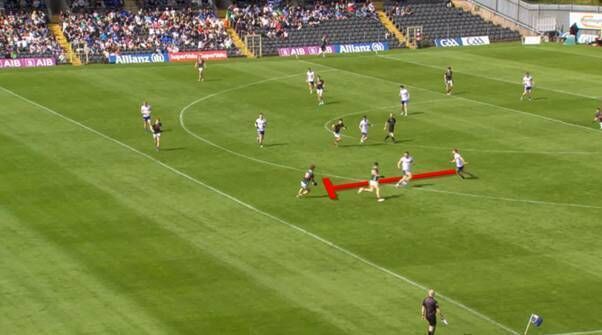
Early in the first half, Gabriel Bannigan’s frustration was evident. The Monaghan boss strode forward onto the pitch and bellowed repeatedly: “Get out! Push out! Push out!”
The home side had obviously discussed Mayo’s two-point threat before the game. It has been a theme of the season. And yet Mayo were able to kick six two-pointers from eight attempts. Monaghan finished with four from eight. That combined with the return from shots on goal, one from one for Mayo versus two from eight, explains how a team can lose a game despite winning on expected score by 11 points.
It was clear from the throw-in. Karl Gallagher was defending inside the arc with his marker, Jack Carney, lurking beyond it. By the time he realised what was happening, it was already too late.
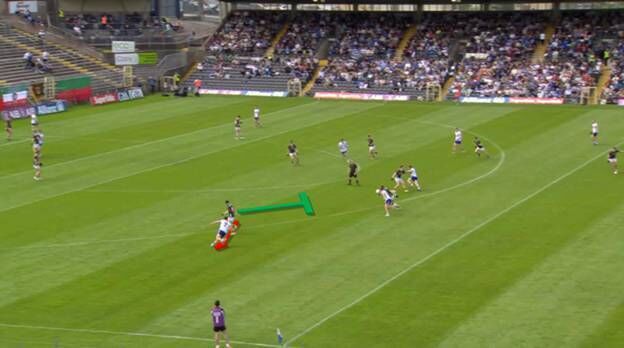
As for Mayo, turnovers did not overly hurt them in the end. Monaghan scored 1-3 from that source. The greater issue was their inability to defend kickouts when Monaghan secured possession. From 19 won kickouts, Monaghan generated 18 shots and 13 points.
What exactly was going wrong? Take Conor McCarthy’s first-half point. Rory Beggan clips a short kickout to McCarthy, unmarked on the arc. Monaghan work the ball up the field, where Mayo meet them man-to-man.
As Monaghan gathered outside the 45, Mayo pushed out to engage them. McCarthy found himself attacking Conor Loftus and drove into the space. Sam Callinan could have broken from his man and applied pressure, but he remained faithful to his task. That allowed McCarthy to clip over.
It was revealing to hear Derry boss Ciaran Meenagh highlight the fact that they were able to win 60 per cent of their own kickouts on Saturday. Both Monaghan and Mayo were higher. However, against Armagh, that is a significant feat.
Their kickout press is a thing of beauty when viewed up close. They take into consideration the opposition’s tendencies and hammer them. It was curious to watch Andrew Murnin line up beside Shane McGuigan so frequently, until it became clear why.
Shea McGuckin, a right-footed goalkeeper, had a pod on his left side as a “safe” option. If he wanted to go there, it meant going on top of the aerial monster that is Murnin. They pushed the likes of Oisin Conaty and Cian McConville into the front of their press, where their speed could eliminate short options. Every detail is considered.
Speaking of a smart team, the way Tiernan Kelly went for goal while playing advantage is another revealing insight into how Armagh think about the game.
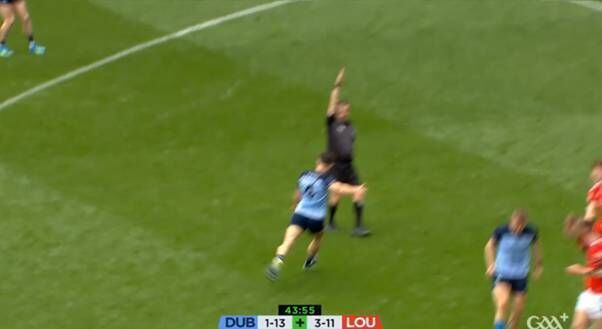
On Sunday, Dublin were awarded advantage inside the arc in the second half after a foul on Sean Bugler. Rather than work the ball back outside for two or attack the goal, Davy Byrne immediately tried to tap over. He missed and they came back for the free.
Kelly saw the same situation through a different lens.
Increasingly, teams do not respect width in the same way they once did. On Sunday as Cavan tried to be patient in attack against the wind, Westmeath were able to stay compact in defence.
They did this by ignoring the Cavan attacker on the non-ball side wing. That allowed Charlie Drumm to stay central and clog up the space.
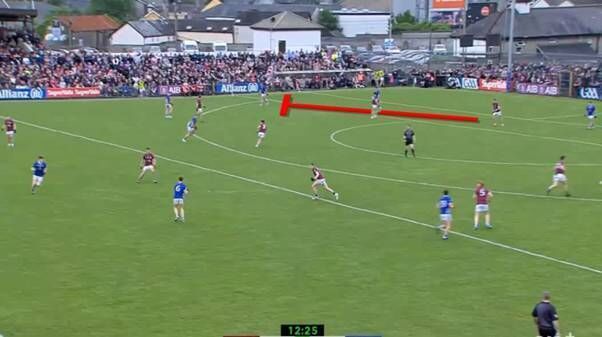
As pointed out by GAA+ co-commentator Shane McEntee, what Cavan needed during that spell was depth. They scored four points from play in the opening half. That said, they showed remarkable spirit after that with four from nine two-point attempts helping them force extra-time.
It was happening right in front of him. Westmeath boss Mark McHugh watched Emmanuel Shehu dart in from the left wing and skip away from Ronan Wallace for Cavan’s opening score.
The wing-forward was then fouled for Paddy Lynch’s two-point free and notched a second soon after. McHugh had to turn to his pocket knife.
Enter, Conor Dillon. Wearing 12, Dillon man-marked Jordan Morris during their Meath win. McHugh needed him to fight a fire again. Just before half-time, he showed Shehu towards the sideline, forcing him to have to make a play with his left. Instead he over-carried.
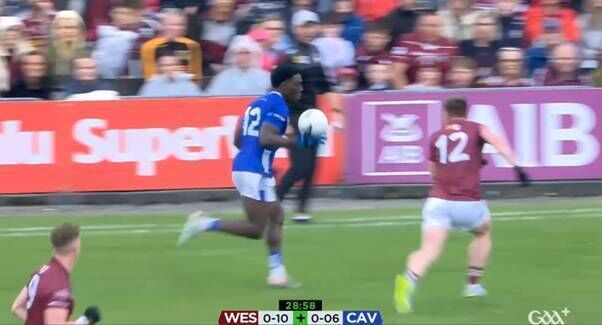
At the other end, Dillon scored two points. All-Star form.
After their issues in the Leinster final, Dublin opted to start Hugh O’Sullivan in goals instead of Evan Comerford. In the end, they retained 62 per cent of their kickouts while winning three of four short.
O’Sullivan was not flawless. His failure to deal decisively with Conor Grimes’ short shot for James Maguire’s second goal was noticeable. From the resulting kickout, Dublin went to the wing, where they were outnumbered five versus three.
That led to Ciaran Byrne’s brilliant score into the Hill.
At the same time, to point the finger at any individual is to draw the wrong lesson. Just like the Leinster final, Dublin’s movement for short options was unconvincing.
Davy Byrne should have provided his goalkeeper with more protection for that third goal. The issue is with the system as much as it is with the man between the posts.
Cork will travel to face Donegal in Ballybofey in the winners’ side of the All-Ireland SFC Round 2. However, even though they knew they were playing Kerry, Donegal would not have witnessed Cork live this year.
While other Jim McGuinness comments post that Killarney triumph made waves, he was also asked during that press conference about the ‘advantage’ of knowing their opponent before the provincial finals.
“We didn’t see Kerry in the Munster final,” he said.
“We trained on the Sunday and we didn’t go to the Munster final. You have a behind the goal view, both sides of the pitch (with a) sideline view. You see everything you need on video. We didn’t come to Kerry.
“That is a media thing. People think there is a massive advantage. You come to a game, you can only watch so much anyway. You watch what is going on here but there is a hundred things going on.
“If you want to analyse a game, you have to sit with the video to look behind the goal, beside (it), what is going on there, how do we deal with him. You watch the game seven, eight, nine, ten times before you actually understand, this is what they are about and this is what we need to do. There is no massive advantage of being at the game to be honest with you.”
CONNECT WITH US TODAY



Be the first to know the latest news and updates