Maurice Brosnan: Four big questions for Kerry and Donegal if they meet again
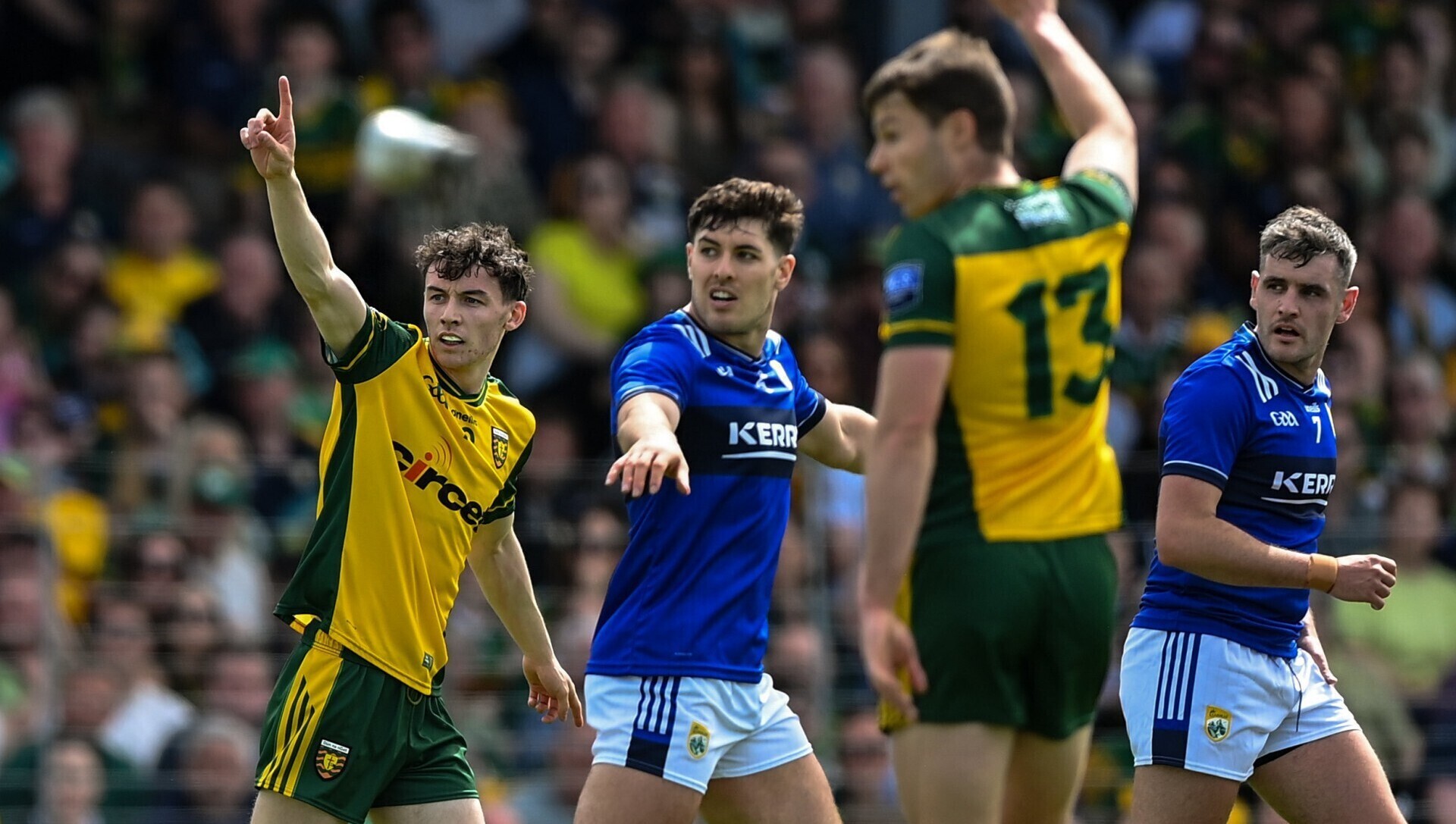
One of the best elements of the Donegal and Kerry rivalry is how they are forced to adapt and evolve. They make each other better. Pic: Stephen McCarthy/Sportsfile
For the Limerick hurlers, the reward after a successful round-robin was just them in a circle with pizza, a boombox and a few cold ones. Talk, toast, tan. No quarter given to intruders.
It has become a regular ritual to see them come out and gather in the middle of their home field after Munster championship triumphs. On Sunday, they secured their place in an eighth consecutive provincial decider. Several players availed of the ice baths beside their dressing room before the entire panel came out as the delivery drivers arrived with copious pizza.
It was then that a disorientated Tipperary fan emerged from the wilderness, shuffling along towards the group. His intent looked more harmless than hostile, but he was a trespasser nevertheless. He had long overstayed his welcome.
Before he could advance into the circle, he was cut off. Psychologist Caroline Currid saw him coming from a mile away. Deny delay, dispossess. The county kitman came in behind to double-up in a combination that would make Paul Kinnerk proud. A gentle arm across the back and a point towards the nearest exit followed. You don’t have to go home but you can’t stay here.
Limerick are particularly adept at this boundary stuff. It is striking how they care for the group and meticulously service them. To watch John Kiely ask for the result in Cork, process its implications and then discuss it was a lesson in psychological awareness.
He delivered a masterclass while spelling out how they are framing this challenge and are ready to confront it. This is a man who understands precisely how all the pieces matter and how post-game media in particular is a golden chance to broadcast a message already embedded internally.
On Saturday in Killarney, both managers were asked whether they were worried about further repercussions from the half-time melee that saw Michéal Burns sent off and Evan Looney yellow-carded. It was more individualised towards Jim McGuinness, given the camera footage of his involvement.
The straightforward way out was to reiterate his concern for his player and how referee Sean Hurson handled it. Instead, emotion overrode pragmatism and he bit back.
Such looseness can cause issues for managers. They pour endless hours into the gig, working towards what is in the best interests of their county. It has to be the ultimate priority. Their words can be powerful or harmful.
Carlow manager Joe Murphy gave a brilliant interview after their first trophy in Croke Park in 82 years, but it became ammunition in the Leinster championship, with Wicklow boss Oisín McConville using it as motivation.
After the Division 4 league final, Murphy spoke about outside influences and their need for a homegrown ticket. It should be said that the former Naas boss made the point specific to Carlow right now.
“I’m not knocking, there have been great men that have trained and managed Carlow in the past and around the country at the moment that are not natives of the county that are training.” There is evidently a huge amount of frustration with how previous manager Shane Curran handled his exit and how it was depicted in places. Perhaps it would have been better to come out and deal specifically with that.
Murphy’s side are one of just four counties who are out of the championship now. Last weekend, Leitrim knocked them out on a 0-22 to 1-13 scoreline.
Leitrim, managed by former Carlow coach Steven Poacher, made note of Murphy’s comments in the aftermath of that Wicklow loss. In particular, the slight about their Division 4 opposition in 2027.
“At the end of the day, Wicklow are going to Leitrim and Waterford next year. We are not,” Murphy told the Carlow Nationalist.
The Leitrim camp were aggrieved at that. This is the edge of media engagement. Almost all managers see its value and how it can steel their county, when used to galvanise their county. If it becomes about individual vanity or self-preservation, the group can suffer.
Here are eight observations from the Gaelic football championship.
Thankfully, Gaelic football has another heavyweight rivalry. These two straight up don’t like each other. One of the best elements of recent showdowns is how they are forced to adapt and evolve. They make each other better.
It is far from a guarantee that they meet again. If they do, here are four questions both managements will need to answer.
The main concern for Donegal at half-time would have been both kickouts. Kerry won eight out of 10 of their own; Donegal won just eight out of 16. Of course, there is more to a kickout than a goalkeeper, but Gavin Mulreany was penalised once for taking too long over a restart and put another straight over the sideline. They effectively had only three set options with a wind at their backs: short, the mid-range right sideline, or long to the pod on the left.
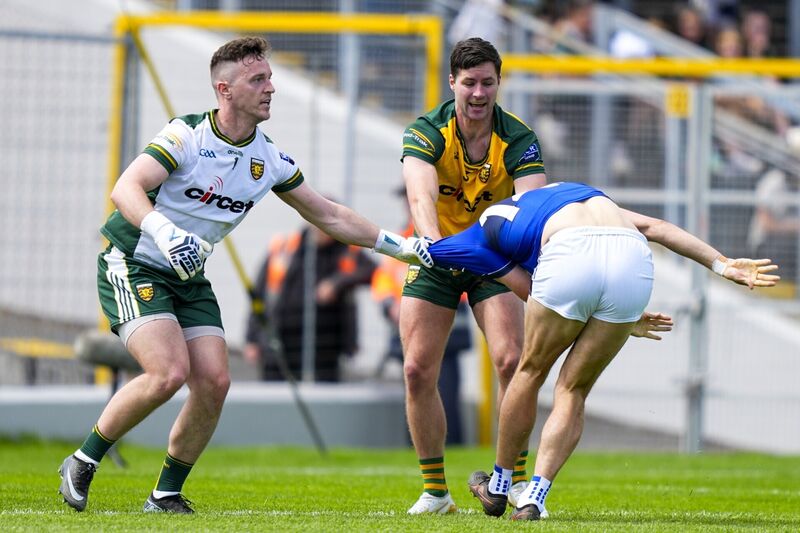
Kerry’s animation in their press, the body positioning of everyone on the field, including selector Kieran Donaghy on the sideline, was immense. Mulreany has impressed since stepping in for the injured Shaun Patton. Saturday was the first real sign of struggle since Donegal couldn’t win a kickout at the end of the Tyrone defeat last year.
In this column at the start of the year, we wrote about how Kerry defended deep and compact in the 2025 decider. They did so because Donegal didn’t carry into contact or shoot from outside. Now that has changed and so must they. Donegal kicked three two-pointers from three attempts in the first half.
Every heavyweight bout needs a compelling one-on-one component. Paudie Clifford versus Finbarr Roarty was it.
Firstly, Clifford is not fully fit. Even still, Roarty was detailed to track his every move and the former Young Footballer of the Year was welded to him. Elsewhere, Brendan McCole took David Clifford.
Max Campbell also started in a late change. In the league final, he man-marked Sean O’Shea. After an All-Ireland final where they only man-marked one primary threat, will Donegal now tag three?
Twenty-eight shots to 22. Expected score: Kerry 19 points, Donegal 17 points.
The Kingdom’s finishing was poor on Saturday. As Donegal defended with 10 markers and one player freed up to sweep, Kerry tried to find the free man with probing kick-passes on the angle. In order to fully execute that, their shooters need to be two-footed. On several occasions, Kerry did get in, but were unable to take the score with their non-dominant foot. Sean O’Shea and Paul Geaney, who can kick two-pointers with both feet, would be transformative for their attack.
Donegal showed why a red card is such a consequential penalty now in Gaelic football and how to best utilise the extra man. It was telling, then, that in the next game, Meath gave such a graphic demonstration of what not to do in attack and defence.
Their attacking flaws after Colm O’Callaghan’s red card have been well discussed by now. As well as kicking three wides in a row, Meath conceded numerous turnovers to fan the flames of Cork’s comeback.
Out of possession, how teams make the most of that numerical advantage is just as important. Twice in the final quarter, Cork were able to get a short kickout away. They scored points from both possessions. Cork kicked a total of six two-pointers from nine attempts. The final one came during that crucial period. It was a 10-on-11 scenario with Meath marking every Cork attacker and James Conlon left free.
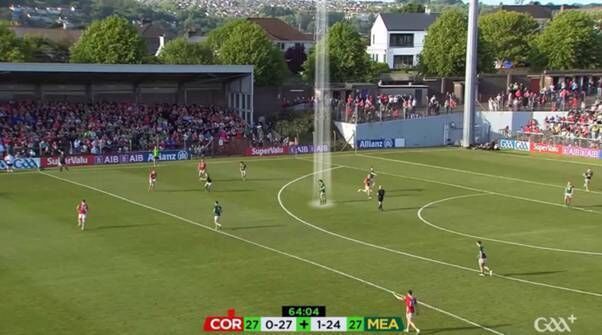
The plus-one stayed deep inside the arc as Steven Sherlock gathered the ball. It was clear where the danger was, yet Meath couldn’t recognise it. John Cleary’s outfit were full value for the victory in a game where they had more shots, a higher expected score and the same number of possession phases despite a harsh sending-off.
In the end, Meath were fortunate they were playing a team reduced to 14, as otherwise, the margin of deficit would have been greater.
Sometimes the scoreboard lies. For Cork, at half-time the primary challenge would have been convincing themselves that despite the eight-point deficit, they were actually playing well.
At the turnaround, there were two issues. The first was forcing it. Cork led by two when they went for goal; Mark Cronin went for goal and hit the post. From that rebound, Meath went up the field and kicked a two-pointer. They were one down when Luke Fahy went for goal. Again, the ball did not go dead. Again, Meath broke, and Eoghan Freyne kicked a two-pointer.
The second issue was their kickout. Meath scored a remarkable 1-9 off it. They were being bested in centrefield while Patrick Doyle tried to go short twice and was picked off.
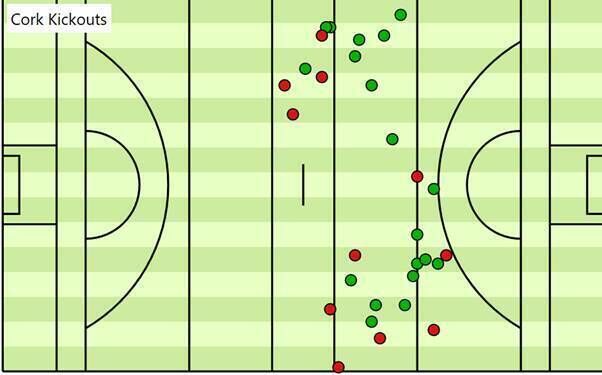
To their credit, they persevered. Doyle managed to successfully get five short kickouts away. His short restart to Sean Meehan with 44 minutes played was audaciously brave. The home side worked the ball up the field and eventually, Sherlock snapped that glorious effort from outside the arc to give them the lead.
We have a referee problem. Far too often, they are standing in the way on 11v11 attacks. Currently, the referee handbook states they “should move parallel to the play giving a side-on view.” This leads to them standing at the top of the arc, where teams are trying to create space.
Pushing them outside the 45-metre line may make it difficult to adjudicate attacking marks. Given how rare they are, would that be such a bad thing?
Roscommon short kickouts in the Connacht final: 12/13. Roscommon short kickouts on Sunday: 10/11.
Neither team pressed it well. The Connacht champions scored 2-11 from their own kickout on Sunday. Tyrone won’t face the same criticism because they were on the right side of a one-score game rather than the wrong one.
Conor Carroll’s ability to clip away to his left-hand side, favourable for a right-footed keeper, is striking. Roscommon eventually targeted Ethan Jordan in this pocket and went right after him.
That said, Carroll did slip up once. Against Galway, his botched short kickout ended in a point, although there was a goal on. Against Tyrone, Mattie Donnelly punished it mercilessly.
Speaking of which, Galway have evidently refined their press since the Connacht final. RTÉ co-commentator Eamonn Fitzmaurice referenced their drills during the warm-up, while they occasionally pressed with two inside forwards just inside the arc, denying a short option.
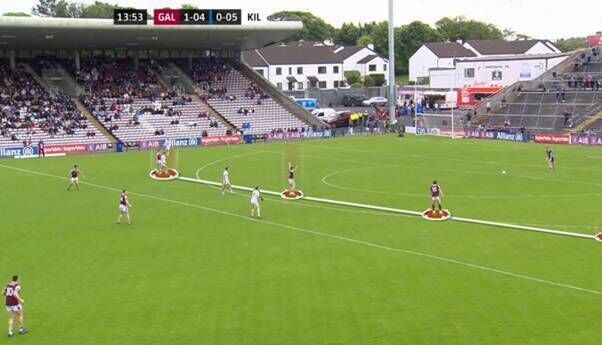
Engineering a press can be tricky. Some players are better at pressing than others. In a bid to overcome that, a coach might move individuals into the centre or the opposite wing. If a goalkeeper is right-footed, you move the worst presser to his right side, where he would have to rotate his entire body to go short and is more readable.
In theory, that is a good plan. In reality, that shooter might be left-footed and naturally gravitate to the right corner anyway. As a result, he either has a lengthy sprint back across on every kickout or ends up pressing from there.
Kildare ended with 68% retention and conceded seven short kickouts. Work done for Pádraic Joyce’s side, more to do.
He now has a tally of 52 shots from play for a return of 41 points (including 2-5-25) and he was Galway’s leading assister in the league, with a total of 3-14. After winning an All-Star in 2024 and being unfortunate to miss out last year, Robert Finnerty has gone to another level.
It remains bewildering why broadcasters continue to miss key moments in games for the sake of inconsequential replays. Enda Smith’s outstanding second-half goal last weekend stemmed from a kickout win and long delivery, but none of that buildup was captured. Shane Cunnane’s contribution was only appreciated by those who witnessed it live.
COMETH THE HOUR, COMETH ENDA SMITH!🚀
— GAA+ (@GAAPlusOfficial) May 24, 2026
The Roscommon captain shows all his experience and class to rattle the net, game well and truly on now! #ROSVTYR
Match clips courtesy of @AIB_GAA pic.twitter.com/cuaKxUP0qu
Nevertheless, the production for Saturday’s clash in Killarney was impressive. Those sweeping drone shots of the stunning scene were terrific. Down the line, the GAA’s in-house broadcaster could utilise that camera as an improved behind-the-goal view for movement and structure. It would be a stellar addition to their already excellent midweek analysis show.
CONNECT WITH US TODAY



Be the first to know the latest news and updates