Maurice Brosnan: Level of analysis work at elite-level GAA is extraordinary
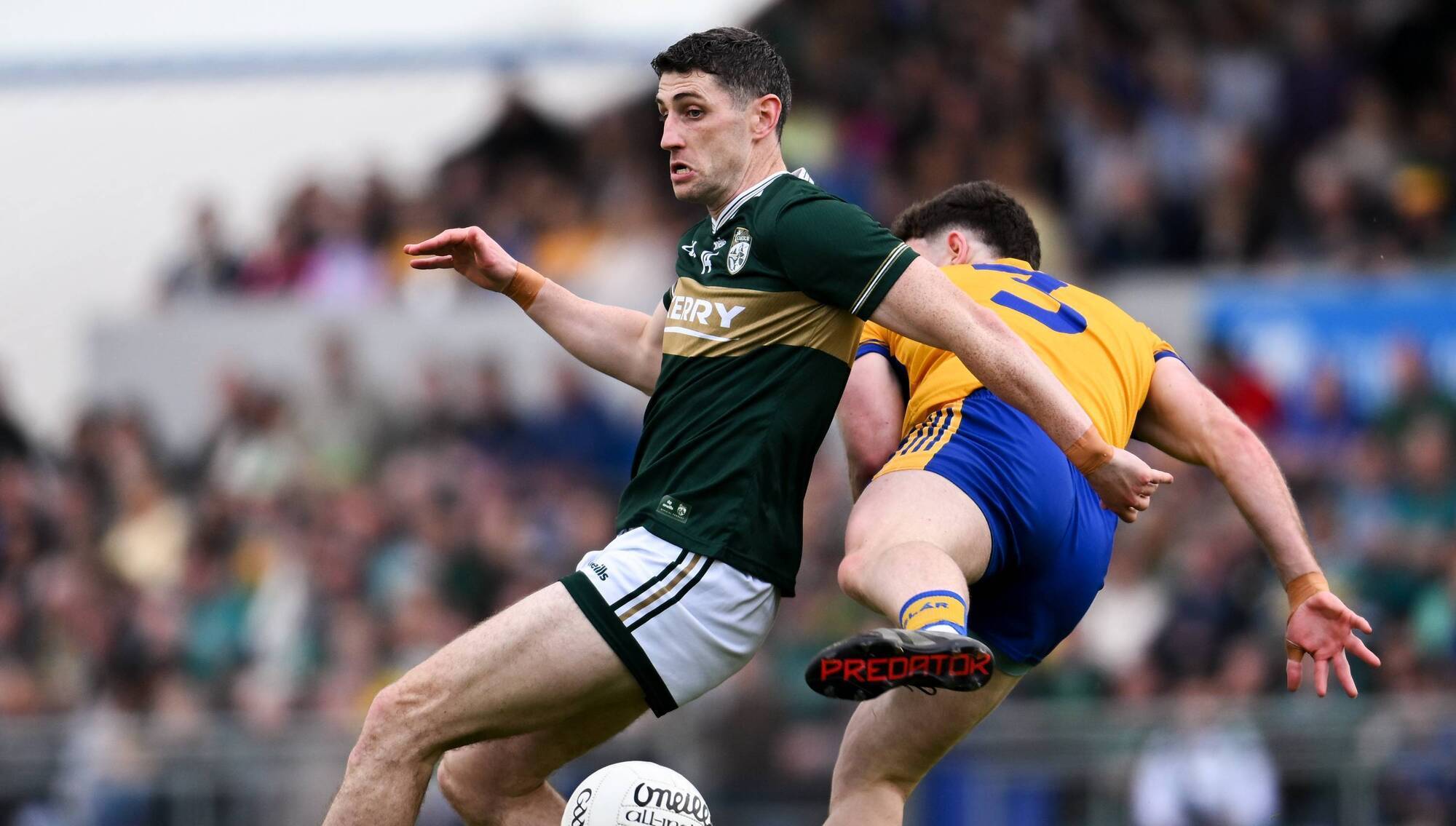
Clare clearly put considerable thought into their plan for Kerry, including having Ronan Lannigan mark Paul Geaney. Lannigan kept the Kerry captain scoreless. Pic: Paul Phelan/Sportsfile
One of the prevailing fears, both within and outside the Football Review Committee when they were redesigning the shape of the game, was what it would do to the underdogs. In the new game, was it still possible for them to compete?
So much of the change that had occurred in Gaelic football over the previous century was driven from this very position. This is the engine of most innovation in sport: the starting position is an acceptance that they can’t compete on conventional terms.
The Golden State Warriors knew they couldn’t outmuscle teams in a size and post-heavy NBA landscape. Instead, they pivoted to a high-volume game of pace and three-point shooting. In soccer, José Mourinho opted for an ultra-organised defensive structure and targeted counterattacks rather than take on European giants at their own game. Gaelic football’s blanket defence was a bid for lesser sides to compete with traditional powerhouses.
Would that become less likely in the new world? That was a legitimate concern. And yet, when the Games Intelligence Unit finally published their final report from the 2025 season, the numbers were encouraging.
Read More
The maximum winning margin was 25, lower than the equivalent figure for the two previous seasons. The average winning margin was six, the exact same total as the previous three seasons.
Now, all the usual caveats about it being early days and requiring a bigger sample size apply. For all of the seismic shocks and close calls we have witnessed in recent weeks, there have been one-sided affairs too. Mayo and Roscommon enjoyed comfortable opening rounds. Westmeath hammered Longford by 21, Cork swept aside Tipperary last weekend.
Still, the manner of some of these results has been remarkable too. Division 4 Leitrim came within five points of Galway; Division 3 champions Down comprehensively defeated Division 1 champions Donegal; Division 3 Westmeath were full value for their win over Division 2 champions Meath; Division 4 Wicklow ran Dublin, recently relegated from Division 1, to two points.
Roscommon would baulk at any portrayal of them as underdogs against Connacht rivals Mayo, but add in the context that they were without several St Brigid’s stars, the suspension of Daire Cregg, the seismic loss of experience that the dressing room absorbed over the winter, and they were rightly priced as outsiders. They then rocked into Castlebar’s wide-open pitch and conquered it.
All of this calls for a closer look. What is it that allows these teams to compete? Are there any indicators for how teams can defy the odds later this summer?
Here are eight observations from the Gaelic football championship.
“We came with a gameplan we thought could trouble Meath. We didn’t have a big pile of time to study them during the week with the short turnaround, but we stayed in Cusack Park until nearly 12 o’clock on Thursday night to make sure everyone was clear."
- Mark McHugh, Westmeath.
“The commitment they gave me for four weeks. They have put their lives on hold, we’ve been together 10 days in a row studying Donegal, making sure we had every i’s dotted and t’s uncrossed.”
- Conor Laverty, Down.
“I watched Galway last year in Park Esler in Newry, I watched the way Down took them apart on the kick-out and I thought that was the area we could get at. We have done, honestly, the guts of 25-30 hours of video work on this group, on this Galway team.”
- Steven Poacher, Leitrim.
The level of analysis work being done currently at elite-level GAA is extraordinary and constant and teetering on a line between exhaustive and unsustainable. It shows in all kinds of ways and elements of the game when it is right. When it isn’t, the gap is obvious too.
A cursory review of Kerry’s 2025 campaign would have set the template for what it takes to compete with the All-Ireland champions. Primarily: keep them to 23 points or fewer.
Cork kept them to that total during normal time in the Munster semi-final. Meath kept them beneath it when they beat them. Tyrone kept them to the same, coming closer to the Kingdom than both of their Ulster rivals did in Croke Park. The obvious and primary way of doing so is to starve a stacked forward line of supply (more on that later) but matchups matter too.
Clare clearly put considerable thought into this plan. The squad and management stood together in the middle of the field for the national anthem. They then headed for their pre-planned positions.
Alan Sweeney, named at corner-back, went to the wing. Captain Cillian Rouine stayed at six to take Paudie Clifford. Ikem Ugwueru, named at centre forward, went back to take David Clifford. The in-form Ronan Lannigan was tasked with marking Paul Geaney. He kept him scoreless.
Leaving aside the on-going discussion about screens and how they impacted Ugwueru, the Éire Óg man did so much right. He won the first ball that was kicked into Clifford before missing with his subsequent handpass. Kerry were fortunate to be given a two-point free from the resulting tackle.
In total, Clifford scored 1-7, 1-3 from play. The goal was a shot that dropped short and wasn’t dealt with. A short attempt and three points from play is as good as any man-marker can hope for against the three-time Footballer of the Year. The killer for Clare was that both goals came from short shots.
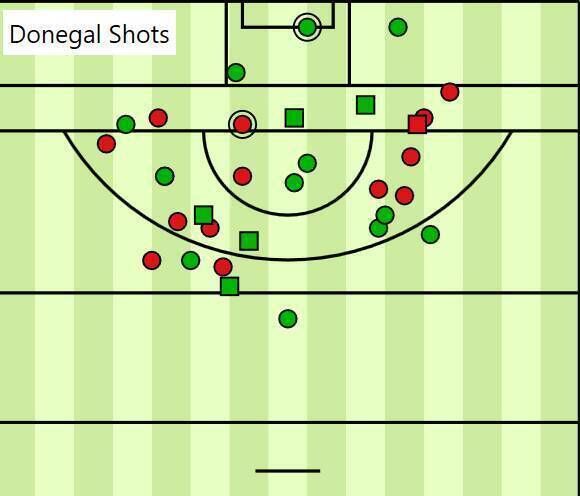
This level of prep reveals itself in subtle ways. Another example was how Down and Roscommon defenders consistently showed their opponents onto their weaker sides and anticipated their shooting tendencies.
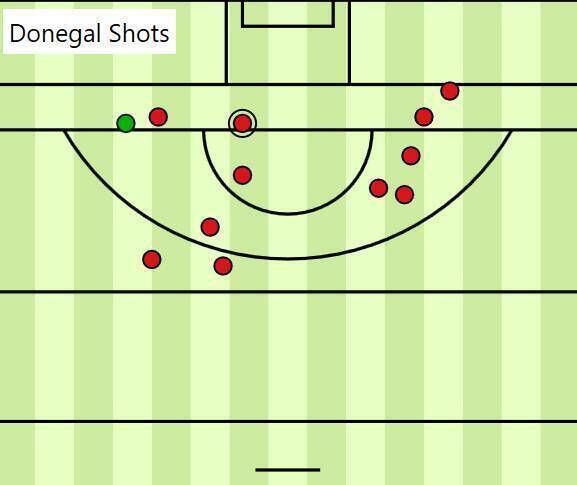
Down knew that Donegal were likely to hit 30 shots or more, so endeavoured to ensure almost half of them were taken under high pressure. It meant staying deep and clogging the scoring zone. Donegal were able to kick four out of six two-pointers. However, they were only 57% on single-point attempts.
The only goal came from a Conor O’Donnell short shot.
Leitrim substitution Kieran Clancy was introduced to a ferociously tight game with 53 minutes played. The first thing he did was make his way over to Shane Walsh and repeatedly push the Galway forward, over and over.
It was abundantly clear that Steven Poacher’s side had set themselves for an ambush in Carrick-on-Shannon. A crucial component in that is Karl Mullen’s famous phrase. This requires controlled aggression. The challenge for any team in similar conditions is finding that balance between ferocity and headless.
A minute after coming on, Clancy was shown a yellow card. Another minute later, he held up Walsh as he broke down the stand side. He let Walsh know about it as the ball was moved back outside until referee Niall Cullen pointed over towards him in warning.
In the same phase, Walsh regained possession and went at him. Clancy bought the dummy solo and dove desperately in an attempted block down. The ball was popped inside for a simple score.
That was one of three assists from Walsh, who also scored three points including a free that he won himself. The other free came from a Conor Quinn shoulder on Damien Comer after the Galway forward had already lost the ball.
Despite a spirited performance and a superb kickout press after Conor Flaherty’s black card, these lapses let the game get away from Leitrim. In the aftermath of winning a penalty, Fergal McLoughlin bounced up to bellow a roar of celebration in the goalkeeper’s face.
The momentum of Flaherty’s black card was undone by one for Mark Diffley soon after. Of course, all teams understand that over-zealous celebrations or tackles can backfire. They want to bring bite but not lose control. They also accept the consequences that can come anyway.
Robert Finnerty and Conor Reynolds enjoyed a full-blooded battle on the edge of the square. When Finnerty eventually broke free and slotted over a two-pointer, his first instinct was to point at Reynolds and make it clear who was supposed to be marking him.
Westmeath celebrated turnovers against Meath like they were scores. Dublin’s Páidí White received a celebratory shove after conceding a penalty against Wicklow. Teams have to bring that edge. It has to be channelled properly, too.
When Down’s 26-man panel was released last week, it featured some noticeable inclusions. Liam Kerr, who took last year out, was back and named to start. Ross Carr, recently returned from Australia, was in the 26. Caolan Mooney was not included in the panel.
Last month, former AFL player Mooney reversed his decision to retire from Down duty. Mooney was included on the standby list with Ryan Magill. While Donegal did what most do and submitted a four-man standby panel, Down submitted just two.
Before throw-in, they both came into the 26. Mooney started. He scored a sensational point before half-time and had 0-3 in assists. Lining out a player who missed the league and endured significant injury trouble previously was a risk, but it paid off. Daniel Guinness’ decision to go for goal from range was bold. Their first point came after the outstanding Ronan Burns elected to drive his kickout directly on top of Donegal goalkeeper Gavin Mulreany, who had joined the press. It had the hallmarks of that famous day in 2024 when McGuinness and Donegal went after sweeper-keeper Odhrán Lynch. Down won the break, gambled on the far side and worked a shot.
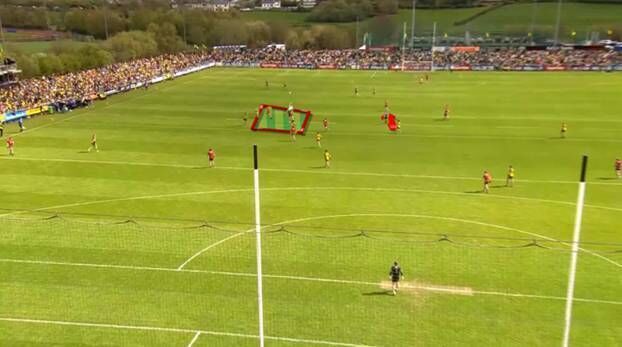
Roscommon boss Mark Dowd made the bold call to release his St Brigid’s stars to play for their club. “No matter what happened today, there was always going to be other games coming down the track; they are now in a better position for that,” he said afterwards.
Like all bets, it looks inspired when you go and win.
For a man who has bounced back from significant setbacks, it was almost cruel to watch Robbie Hennelly pick up a piece of grass and toss it aside after a wayward short kickout was picked off by Roscommon for a goal. Players have their own triggers to reset and go again, from throwing grass to Bernard Brogan clicking his fingers.
But senior inter-county football is a merciless place. Weaknesses are hunted like prey. Roscommon would have noticed Hennelly was not using a kicking tee for his kickouts. That had a clear impact on the trajectory of his strikes and the distance he could generate. Despite playing with the breeze, only one of 12 first-half kickouts reached the opposition’s half.
That lack of distance allows a team to be more aggressive with their press. For the first kickout of the second half (which Hennelly impressively managed to find Jack Carney), every single Roscommon player outside of the full-back line was in Mayo’s half.
At the other side, Roscommon goalkeeper Conor Carroll consistently threatened to go over the top. His kickout to Enda Smith for their second goal landed close to the opposition’s 45.
The fact that Down knew about Michael Langan’s injury allowed them to put a plan in place for whoever would replace him as Odhrán Murdock’s marker. They found a way to make sure Murdock could run at Caolán McGonagle one-on-one, while drifting off the Donegal man at the other end to cover space. That eventually cost them when Murdock competed for a dropping ball instead of taking care of his man, McGonagle, for the goal.
That’s the other side of the gamble. For Down, there was more reward than risk.
First-half: Galway kickout 63%, Leitrim 60%. Second-half: Galway 44%, Leitrim 50%.
Possession remains nine-tenths of the law. The best way to stop a dangerous opponent is to starve them of the ball. By battling hard in the kickout war, Leitrim were able to ensure there was a five-phase difference in phases (team possessions), 37 to 32.
The difference in approach to each goalkeeper was telling. In the first half, they only put three on the arc to ensure they could stay set at the back. In the second half, with Flaherty off the field, they adjusted and went man-to-man.
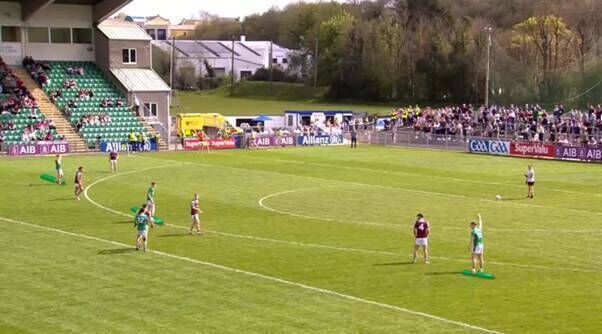
The first task is getting hands on the ball, the second is making the most of it. In this regard, Down were clinical. 39 phases for 34 shots (including short shots regathered, it was 36 shots). They won 17 kickouts for 15 shots for a 14 point return (1-1-9). They won six opposition kickouts for six shots for a six point return (1-0-3).
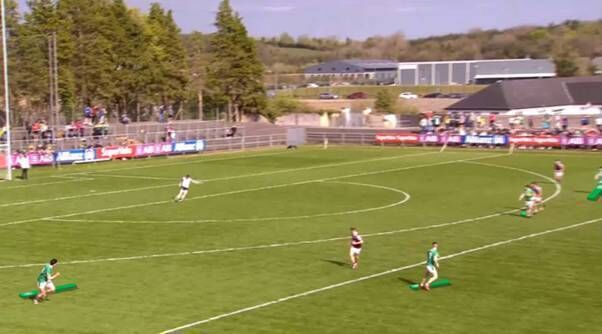
Ride the dip
For the shock to land, there is a requirement for the opposition to be below par. That could be a marginal dip (Donegal) or a considerable one (Mayo).
On Sunday in Letterkenny, Donegal missed 11 of their first 14 shots. Galway missed seven of their first 11. The problem for Leitrim was that they were just as inaccurate at the other end. Barry McNulty’s eighth effort was a terrific two-point free, but he had missed seven attempts at the posts before that.
This is where Fermanagh went wrong on Saturday. They score first and won Ethan Rafferty’s kickout only to kick it wide. They won the next kickout and kicked it wide. They won the next kickout and kicked it away to Aaron McKay. That led to a Darragh McMullan two-pointer. They won their own kickout but dropped it short and Jarly Og Burns scored at the other end. From the next kickout, they won it only to foul in the process. A failure to hand the ball back saw it brought forward for a two-point free. Conor Turbitt nailed it.
Leitrim’s penalty came from a shot by the terrific Tom Prior that hit the post and bounced favourably. They missed the penalty too but managed to bundle in the rebound.
When Donegal scored a goal with two minutes left that would have made the margin four points, it was ruled out as Shea Malone was deemed to have carried the ball over the endline.
A good thing for GAA+ too, who somehow managed to miss the entire play before that goal. The broadcast went from a replay of Down’s third goal to Malone holding the ball near the endline without any explanation of how that happened.
I'd actually organise to stay down here tonight and go to Castlebar tomorrow and see that game tomorrow and plot our way to Connacht title,” said Leitrim’s Poacher.
“Jack Kelly said to me after the match ‘you've got us believing again’, that's what we want, we want to get them believing because without belief, you have nothing.”
That was a challenge for Down as well. “I had said to them on Thursday night that ‘I don’t think you are just fully with me in the belief yet, but before Sunday morning, you are going to believe in the way that this management team believes in you,’” said Conor Laverty post-match.
“I said at half-time, ‘Do you fully believe me now? Do you fully believe what this management team believes?’ And you could see it bouncing in their eyes.”
CONNECT WITH US TODAY



Be the first to know the latest news and updates