Eight observations from the National Football League: A need for the six, Mayo miss and Rossies rise
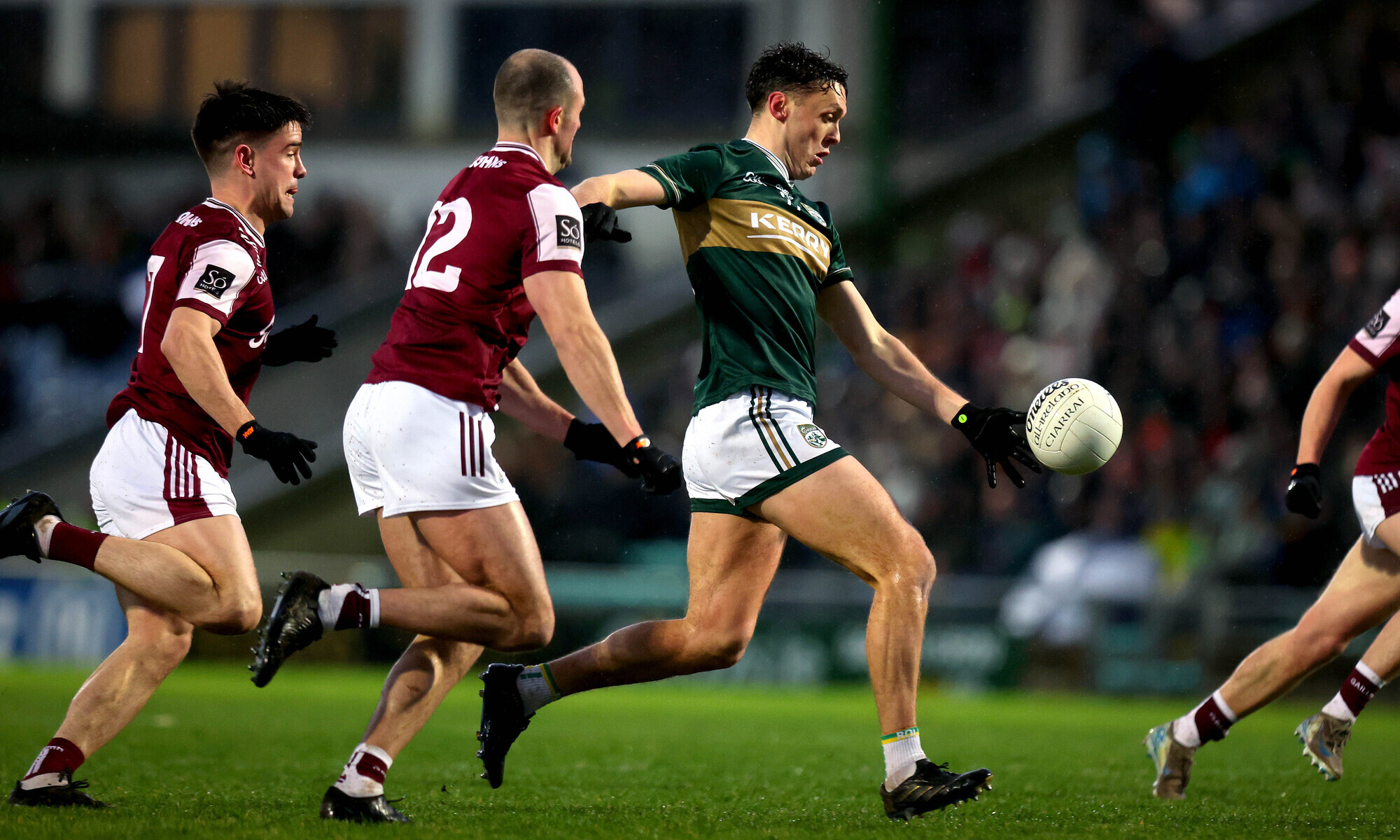
A NEED FOR THE SIX: Kerry’s David Clifford and Sean Kelly, Galway's number six. Pic: ©INPHO/Ryan Byrne.
Some call it good practice. For others it borders on tyranny. In the anatomy of the match report, the fundamental axis is the lineup.
The sanctum of the press box has often been disturbed by endless positional debates about where a certain player is actually stationed. In the traditional format of a match report, journalists are usually expected to list the 1–15 in the order in which they played.
Innovative coaches pay no heed to the challenge of this exercise when they tore up the traditional grid in favour of the fluid positional blur that is modern Gaelic football.
This is no cry for sympathy, but it can be tricky to monitor 30 different positions while also taking note of every score and incident, all the while trying to get some coherent copy ready for an on-the-whistle report. We are martyrs, really.
Take last Saturday’s meeting between Galway and Kerry, for example.

Seán Fitzgerald and Dylan McHugh were named at full-back and centre-back but both were replaced before the start. As they warmed up on the field, starting wing-back Liam Silke went down and also had to be replaced.
It left Pádraic Joyce and Dave Morris in a bind. Johnny McGrath is a relentless man-marker who kept David Clifford to two points from play in last year’s league encounter, but the Fossa forward was able to rack up a remarkable seven assists and still operate as a devastating focal point.
They were without influential defender Silke. Do they opt for McGrath, one of their emerging prospects, or tear Seán Kelly out of the heart of the defence to man the square?
In the end, Kelly started on Clifford. Corner-forward Fionn McDonagh came out to compete for the throw-in before taking his place inside. McGrath marked Seán O’Shea.
Ryan Roche was one of the late changes but the Killannin clubman was never likely to operate in the back six and didn’t.
Captain John Maher wore 12 yet is essentially deployed as a midfielder. Finnian Ó Laoi (typically a forward) came on for Brian Cogger (typically a defender) after 28 minutes.
Kelly moved back out to centre-back for the second half with Jack Hernon taking over on David Clifford.
Where do you line them out? Kelly spent more time out the field than inside but undeniably started on Clifford. Was Johnny McGrath Galway’s starting centre-back? Are we better to ignore the positional fiction completely and list the team as they are named, make a best-guess stab at it while acknowledging the room for error, or discard the traditional 1–15 completely?
How do teams frame it? It is increasingly common to hear them reference a three-up, three-back and “middle eight.”
The futility of even attempting to list players in the old format has been a source of debate for a decade now. Here is the central issue: What is the alternative? Like the annual All-Star debate, it is not enough to say the system is wrong. You must present a considered alternative.
To which, we now turn to you. Suggestions/solutions/bright ideas to
Granted, the game has completely changed. Nevertheless, some positions still matter. A goalkeeper, obviously.
There is still a requirement for a lethal inside forward. When it comes to centre-back, there is a need but a void in so many teams.
The six isn’t a glorified position. Of the 18 players nominated for 2025 All-Stars, only one can claim to have truly operated in that role: Micheál Breen. Finnbarr Roarty lined out in the position but no one would claim he actually played there.
It was a similar story in 2024 as Aidan Forker took the spot. However, the importance of a proper centre-back has only intensified in the new rules.
As one-on-one duels returned and high pressing increases, the ability to read the play and recognise when to press out on a marker and when to drop off to cover the centre is paramount.
Who is the best six in the country currently? It is a question unlikely to prompt a consensus answer. It should be said, there are some players who operate in that space:
Seán Kelly (Galway), Tiernan Kelly (Armagh), Caolán McGonagle (Donegal), Seán Coffey (Meath), Ikem Ugweru (Clare) and Breen are all expected to provide that sort of cover for their sides.
It was noticeable in Tralee last weekend that as Galway were chasing the game in the second half with the breeze at their backs, they moved Kelly back to centre-back.
When Kerry overloaded inside the 21 in a tactic now widely deployed, Joyce’s side marked with a man less. Put simply, when Kerry put five inside, Galway covered it with four. If it was six, they went with five.
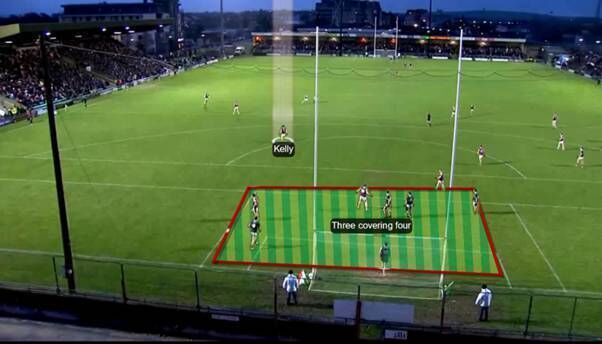
Left on the outside every time was Kelly. His task was to read the play out the pitch and identify when to drop back and when to step up. This is an extremely difficult ask. Galway evidently felt it was worth prioritising the collective defensive shape over the individual match-up of Kelly on David Clifford.
To learn that takes time. Another issue with the centre-back role is that the likes of Mayo, Dublin, Cork and Tyrone often change it.
“Part of it, if you ask the question of who is the six, you struggle to find someone who will wear six often enough,” said Paul Galvin on this week’s Examiner podcast.
“Someone who wears it a lot and he mainly plays there is Coffey. He is in that mould. There is a whole load of inconsistency. I struggle with it, I shake my head at times.
"I check teams, because I played there, I check for half-backs and half-forwards. You see a whole new half-back line. It is very hard to win games if you aren’t settled in those lines.”
Once, it was all about defending teams creating a “plus one” in their own half. The term was much maligned but the principle was simple: free up a defender from marking responsibilities to cover space and, ideally, double up on an attacker.
Thanks to the ban on the backpass to the goalkeeper, pressing in the opposition’s half has a greater tactical reward. On Saturday, Galway returned to a pressing trap they previously adopted against Mayo in 2025. Effectively, it was a plus one in the opposition’s half.
Take Finnian Ó Laoi’s second-half point. It started with a Shane McGrath shot that dropped short. Immediately, Galway’s forwards stepped up and cut the line. They each raced to mark a free man while Ó Laoi left his wing to condense the space. Had Kerry been able to switch the ball across the pitch or work it to the free man, Galway were wide open.
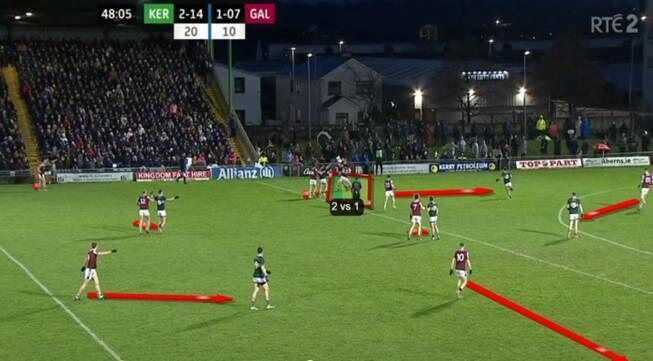
They couldn’t. They were trapped. Ó Laoi and Oisín Mac Donnacha worked together to force Cillian Trant to overcarry.
From the resulting solo and go, Ó Laoi collected possession and scored. In total Galway turned Kerry over six times in their half.
The question for the summer is whether it is possible to do the same when the likes of Gavin White, Tom O’Sullivan and Brian Ó Beaglaoich return.
Midway through the first half in Croke Park last Saturday, Brian Howard was fouled approximately halfway between the arc and the small D. Referee Brendan Griffin put up his hand to signal advantage and Howard immediately took a shot. It drifted wide. Con O’Callaghan kicked the resulting free.
Other teams have already realised the opportunity that the new advantage rule affords. For example, when Louth found themselves in a similar situation against Meath in the same ground, they worked the ball back outside the arc for Paul Mathews to have a go. He slotted it.
Credit must go to referee Brendan Griffin for applying advantage properly in that position. It was something O’Callaghan seemed to take issue with when Dublin weren’t afforded similar in their opening round fixture against Donegal.
A crucial score in Limerick’s victory over Wexford came from the same source. An extremely well-coached side, as soon as the referee’s arm was raised to indicate advantage, the roar of “two!” could be heard from the sideline. James Naughton circled back outside the arc to produce the orange flag.
An brat oráiste faighte go slachtmhar ag James Naughton 🎯
— Spórt TG4 (@SportTG4) February 16, 2026
Tune in for highlights of @LimerickCLG versus @OfficialWexGAA
🗓️ Anocht/Tonight
⏰ 20:00
🏐 GAA 2026 🥎@GAA_2026 #GAA pic.twitter.com/hbyaz1ZRil
No team had as many shots per game in the 2025 Sam Maguire series as Monaghan. They averaged almost 37. That return seems like a strength, until it isn’t.
Manager Gabriel Bannigan was left bitterly disappointed with their poor finishing against Dublin in Croke Park. This is a theme. They saw similar wastefulness inflicted upon them in the second half against Donegal in last year’s quarter-final at the same ground.
On Saturday, they scored four points from their first seven shots. They then went on a run of 11 successive efforts, scoring just two (for a three-point return, Dessie Ward landed a two-pointer).
It started with Stephen O’Hanlon’s missed goal chance. They then dropped an effort from outside the arc short, hit the post twice and missed two goal chances.
Like their 2025 exit, it was a period crying out for a fisted point or a simple score to settle them. In the end, Micheál Bannigan scored two points from eight attempts. Stephen O’Hanlon missed two and didn’t score. A policy of peppering the posts is all well and good, but the next evolution is understanding game state and recognising when it is time to keep the scoreboard ticking over.
Speaking of familiar issues, Donegal 27 shots, Mayo 28. Donegal expected score 19 points, Mayo 20. The final score: Donegal 1-19, Mayo 0-14.
“I haven’t got the stats on that, to be honest,” said Andy Moran post-match. “But it was the amount of shots. If you have six shots and you hit three of them, that is 50%. That’s not good. Six shots isn’t enough, do you know what I’m saying? Whatever amount of shots we had, we just didn’t have enough. I don’t think we had a shot for the first 10 minutes.
“Listen, that comes down to a tiny bit of my coaching and Pady’s coaching and we’ll go and work on that next week.”
Four black cards after nine seconds was always going to result in a chaotic opening period between Louth and Meath. After a scuffle, All-Star Meath defender Seán Rafferty and his colleague Brian O'Halloran were sent to the line along with Sam Mulroy and Ciarán Downey.
Prior to the excellent work of the Football Review Committee, 13-a-side was a popular new rule suggestion. The first 10 minutes on Saturday night were remarkable. There were 13 phases, nine shots, five turnovers and several fast breaks into open space. Meath led 0–3 to 0–2 by the time the four players returned to the field.
If anything, the game was better from that point on. The space and speed of attacks was interesting, but the lack of contact, after such an explosive opening, reminded us of Robbie Brennan’s initially scathing assessment of the rules 11 months ago.
“Outdoor basketball with a breeze.”
The fact that Roscommon were able to secure two wins from their first three league games without the St Brigid’s contingent is a remarkable achievement. Mark Dowd deserves enormous credit for affording the Connacht champions a proper break while steering his county to the verge of securing top-tier status.
Brian Stack and Eddie Nolan are currently injured but the remaining club players returned to training last weekend. The panel grows stronger ahead of a trip to Galway this weekend.
Interestingly, the team that overcame Armagh on Sunday had five players from the Pádraig Pearses club on the field: Caelim Meogh, Ronan Daly, Conor Ryan, Paul Carey and Eoin Colleran. The club recently recruited Alan Flynn as a coach, who managed and coached the Galway U21 All-Ireland winning teams in 2011 and 2013. He has also coached Clare, Kildare and Offaly in recent years.
It is worth remembering that Pearses brought Brigid’s to a replay in last year’s county decider. For all the talk of the arduous route All-Ireland champions Dingle face in getting out of their county, Brigid’s task is by no means simple.
Earlier this year, a Walsh Cup quarter-final between Westmeath and Kilkenny made headlines after Kilkenny refused to play on St Loman’s artificial surface. The club’s grass pitch was not made available.
Speaking to Midlands 103 after their loss to Down last weekend, football manager Mark McHugh was evidently frustrated at their preparation for the fixture.
“They came at us very quickly. When you are finished, cold and wet, everything seems like the end of the world. We didn’t do enough tonight. We started the game… our whole first half was just way off what we are used to. We weren’t doing the right things. We made a lot of silly handling errors.
“I’m not using it as an excuse at all, but we didn’t have a grass field this week. We could not get one. The clubs would not give it to us. I felt that hampered us a wee bit. The first half, the boys weren’t used to the wetness and the muck. It took us a while to get going.”
CONNECT WITH US TODAY



Be the first to know the latest news and updates