Eight hurling championship observations: Did Cork and Limerick play better against the wind?

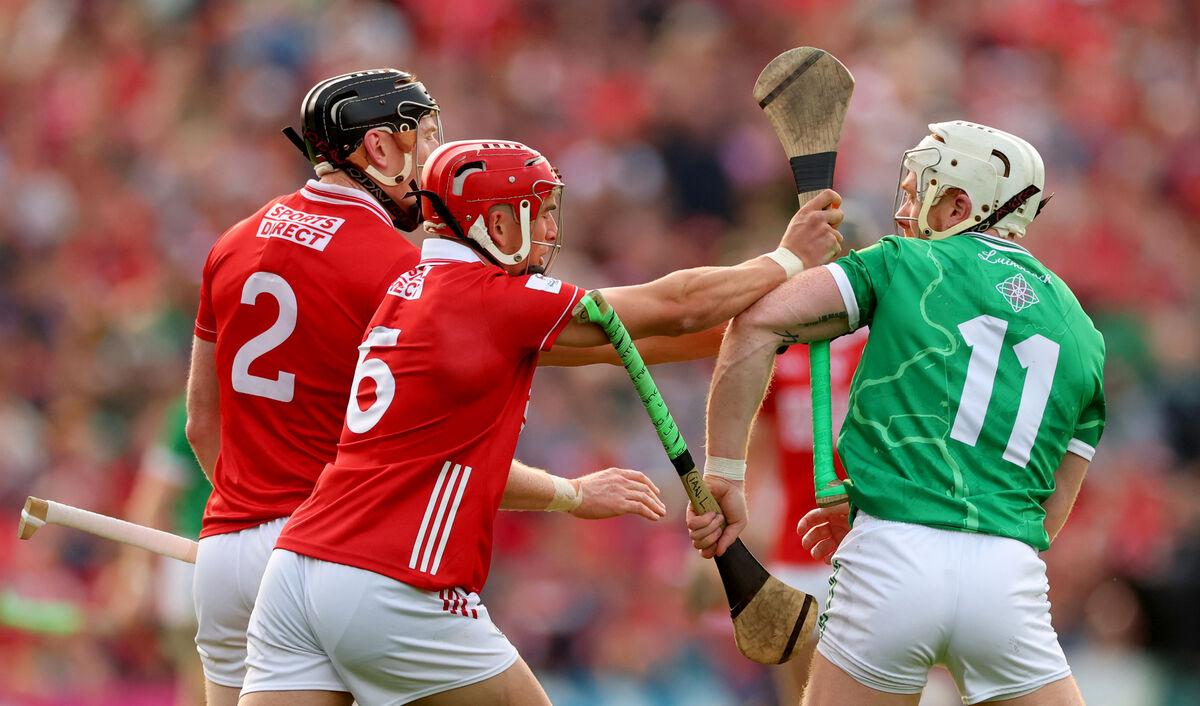
GONE WITH THE WIND: Cork’s Brian Hayes and Limerick's Dan Morrissey challenge for the ball. Pic: ©INPHO/James Crombie
In the official programmes for the two 2024 All-Ireland finals, ten experts were asked for their pre-match prediction: five football and five hurling. Nine of them called it wrong.
It is the kind of statistic that illustrates how difficult pre-match predictions really are. The game before the game is just as treacherous. Clare and Armagh were both marginal underdogs for the decider, but only one expert opted to back one of them. (Christy O’Connor – Clare, for anyone wondering.) Rest assured, this writer offered equally inaccurate forecasts within these pages too.
Last Saturday’s Munster final rendered almost every pre-match analysis obsolete. It was full of glitches in the script. That made the drama. It was a day to expect the unexpected everywhere you looked.
There was sound logic behind every Limerick backing before last weekend, just as there was last July for the deciders. Cork returning to the scene of a 16-point hammering while unable to start their best defender of the season so far, their captain and the leading candidate to replace him. Limerick with eight All-Stars and 31 All-Ireland medals on the bench alone. Imagine.

All that separated a correct call from so many wrong ones was the bounce of a ball in the final minute, one mishit penalty being saved and another sneaking in. Al Pacino’s ‘inches.’ In truth, this is where the sport is at right now.
Teams competing at the elite end of the championship are all capable of beating each other on any given day. It makes the certainty we cling to before throw-in look precarious. This new reality is a wonder for the GAA. The more blockbuster encounters that are impossible to call, the more wrong predictions, the better.
Cork know where they were at coming into the Gaelic Grounds and they know where they are at heading back down the M20. When Tim O’Mahony emerged from a triumphant dressing room, he declared Limerick still the team to beat. Pat Ryan was indifferent to the idea that they now need to quell the hype.
“We won by penalties against a brilliant Limerick team. This is just one thing. We move onto the All-Ireland series semi-finals. We know we are a really good team, you saw what we were like when we weren’t at it three or four weeks ago. It’s all to play for.”
As for everyone else, the gap between what we think we know and what unfolds is not to be criticised, it should be celebrated. Pre-match predictions should be hard. That’s the whole point. Sport, at its best, refuses to comply.
Robert Downey had to be sure. Even with the flags stretched to taut above both terraces, he picked up a piece of grass and tested the breeze once more. Having won the toss, he elected to go with it.
While it would have been interesting to see what way Limerick elected to play if they had won the toss, what unfolded was compelling in its own right.
Did both teams play better against the wind? At the end of the first quarter, both sides had the exact same number of shots. By the 21st minute, Limerick were ahead.
Adam English (twice) and Gearóid Hegarty had terrific goal chances, with Patrick Collins called into action twice. Limerick had more shots in the first half against the breeze than they did in the second half with it.
In extra-time, Limerick scored one point from play with the wind and had four ambitious efforts drift wide. In the second ten-minute period, Shane O’Brien, Peter Casey and Cathal O’Neill all scored well-worked points.
As captured on the celebratory videos of Cork’s dressing room, their tactics board had a four-man half-forward line to swarm Kyle Hayes. That was far more noticeable in the second half than the first, where the centre-back started impressively.
For John Kiely, that first half is likely to be a huge focus of their review. They were exceptional on their puckout, retaining more than Cork, and had opportunities to break through the centre. Only Adam English was capable of consistently making that run. They struggled at times with Cork’s pace in the second half.
All of this is relevant should there be a third meeting in Croke Park. With the wind, Cork tend to go long and carry less. That won’t be as influential a factor in an All-Ireland final. HQ will offer them an environment conducive to run consistently.
Limerick now know they need to match that.
As a unit, both half-forward lines made their mark on the game. The raw numbers show their influence in attack: Diarmuid Healy 0-3 scored, 0-1 assisted. Shane Barrett 1-3 scored, 0-2 assisted. Seamus Harnedy, 0-2 scored, 0-6 assisted.
Gearóid Hegarty 0-2 scored, 0-2 assisted. Cian Lynch 0 scored, 1-4 assisted. Tom Morrissey 0-2 scored, 0-5 assisted.
Where Limerick were bested was their defensive contribution. For the first time since the 2019 All-Ireland semi-final, their starting half-back line failed to score from play in championship. None of their starting back six scored from play.
Diarmaid Byrnes had his hands full with Harnedy throughout. Their full-back line had time on the ball, but the players they wanted in possession in that position was Barry Nash, who was navigating a crowded section of the pitch.
In a game of edges and influence, Limerick’s grip started to slip.
Typically, Cork’s hurley carrier enters the field immediately after the first play. That was the case again last Saturday.
Tim O’Mahony and Darragh Fitzgibbon both opted to use a different stick or the purposes of throw-in trashing. They preserve their primary hurley.
The designated carrier came to the attention of referee Thomas Walsh in the second half.
With 54 minutes played, Damien Cahalane was marking David Reidy in the middle of the pitch. Peter Casey came on in a similar role and Cahalane started to track him. A minute later, Adam English went down with an injury.
The member of Cork’s backroom team raced into the full-back line during that break in play. They wanted Eoin Downey to swap across to Casey, with Cahalane moving closer to the square on Shane O’Brien. Walsh issued a yellow card for that infringement. It was worth it.
Timing that intervention can be tricky. In the Leinster final, Conor Whelan snapped his stick in half at the start of the second half.
As Billy Ryan broke out with possession, the Galway hurley carrier was caught coming back against the play. His only reprimand seemed to be a stern warning from the nearby linesman.
Since retiring in 2020, two-time All-Star Anthony Nash immersed himself in coaching. In 2022, the South Liberties side he played with and coached made it to their first Limerick senior semi-final since 1985.
The former goalkeeper was involved in two Fitzgibbon Cup triumphs with UL and Cork’s U20 All-Ireland in 2023. Last week, London claimed an unlikely Christy Ring triumph with Nash on the sideline to earn a spot in the 2026 Joe McDonagh Cup.
"He's been brilliant and has worked really hard on the structure of the team, puckouts, that kind of side of it,” said manager Neil Rogers, while stressing Nash was not the goalkeeping coach, with Alan Tobin in charge of that.
“He is very good at taking lads one on one in training as well, just giving them nuggets of information. His experience is huge and he’s a huge character.”
In early 2023, a bombshell statement from Roscommon GAA revealed that Clare native Francis O’Halloran was stepping down as manager a day after their Division 3A defeat against Louth. The statement also spelled out why.
“The commitment and efforts shown by the management team have not been matched in recent times by the playing members of the panel despite our best efforts.”
Galway native Seamus Qualter returned for a second spell before another Clare man, Kevin Sammon, took charge. Last month, an outstanding injury-time score by Brendan Mulry shocked Mayo to secure the Nicky Rackard Cup.
It was a remarkable sendoff for Mulry, who was due to depart for Australia in the aftermath of the Croke Park outing. His brother Conor was the team’s joint-captain. Speaking to the Official GAA social media post-match, the skipper issued his own sign-off.
“Look, it is famous. Standing in Croke Park with your brother who scored the winning score. Our backs were against the wall with five minutes to go. We have had managements come down from Clare in the past to tell us we weren’t good enough and our commitment wasn’t good enough.
“It just goes to show you, any team will do it on any given day.”
Despite being outshot 17 to 24, at half-time in Croke Park Kildare would have been content. They had been the better side for much of the half and were level at the turnaround.
Ben Conroy’s follow-up to Paddy Purcell’s darting run directly from the throw-in would have forced lesser sides to tighten up. Instead, they cut loose.
No team can guarantee no goal concessions. They all set it as a target, but perfection is rarely attainable. Sports psychologists can stress the need to aim for ‘a clean sheet’ rather than set an ambition like ‘no goals.’
What happens if things don’t go according to plan? How do you avoid an overwhelming sense of panic?
The underdogs response was to hit three consecutive points. Cathal Dunne’s sensational double save denied a goal yet they it came while they had advantage and allowed a stopover free.
Kildare lost five of the next six puckouts, one of them being their own, but forced Laois into countless turnovers to claw it back. David Qualter drilled two big placed balls. Laois didn’t score another point from play for the next 15 minutes.
Big teams have to dig in on big days. On Sunday, Kildare proved they belong.
Was it a mental or tactical issue? “Neither I would say,” said Galway defender Fintan Burke of their flat Leinster final performance.
“I don’t know what exact word I would use. After 25 minutes, we were a point up. I wouldn’t say it was a mental issue. You can’t have a mental issue in the middle of a game really. Tactically… It wasn’t mental and it wasn’t tactical.
“It was probably just our on-field decision-making. Our decision were just poor. At times when we needed to carry the ball an extra 20 yards and give the lads inside a better chance, we didn’t. At times when he needed to let it in, we didn’t. We just made the wrong decision on the field.”
Kilkenny’s decision to concede puckouts and force Galway to work it through the lines worked empathically. Galway scored six points from 16 short restarts and were destroyed on turnovers throughout.
Micheál Donoghue has made moves to address an obvious ball-winning issue. Bright prospect Rory Burke, an U20, came in for a surprise start in the latter stages of the league.
Jason Rabbitte - the son of former senior star, Joe – reportedly impressed in the air during training earlier this year and was added to the matchday panel for the home tie versus Wexford. For now, it’s too soon to expect them to shoulder this burden.
None of this is new. Intercounty management is an exercise it maximising all available resources. Much of the coaching ticket that led the county to a first Liam MacCarthy Cup in 29 years in 2017 is back in place.
Francis Forde and Noel Larkin are with Tipperary All-Ireland winner Eamon O'Shea on the line. Highly-regarded analyst David Morris, who is also a member of the football ticket, was in the stats box.
Despite not winning All-Stars, two of the most vital players in that 2017 team were Jonathan Glynn and Joseph Cooney. Galway currently lack similar personnel to plug the puckout gaps.
They urgently need a game-changer or to drastically improve at playing the short game. Until then, the same cracks will keep costing them.
In the history of the Leinster round-robin, Kilkenny have never scored as many goals as this. Martin Keoghan and TJ Reid combined to make it 18 goals in six games. Last year, it was 11.
Derek Lyng’s outfit hit 3-18 from play in Croke Park with 10 different scorers. That came without their best forward in Eoin Cody. Despite the big blow that was Tom Phelan ruled out for the season, their depth is developing. David Blanchfield, Shane Murphy and Cody will all be determined to start in the semi-final.
On Sunday, they only scored two points from 12 short puckouts. That weak spot failed to undermine them. It was a more serious issue in the 2024 semi-final against Clare.
Have they demonstrated sufficient ability to mix it up and sustain a high-level challenge? Is their form a sign of progression or a reflection of the provincial field?
On July 6, we’ll find out.
CONNECT WITH US TODAY



Be the first to know the latest news and updates