Jack Anderson: Politics and sport always mix but don't compare them
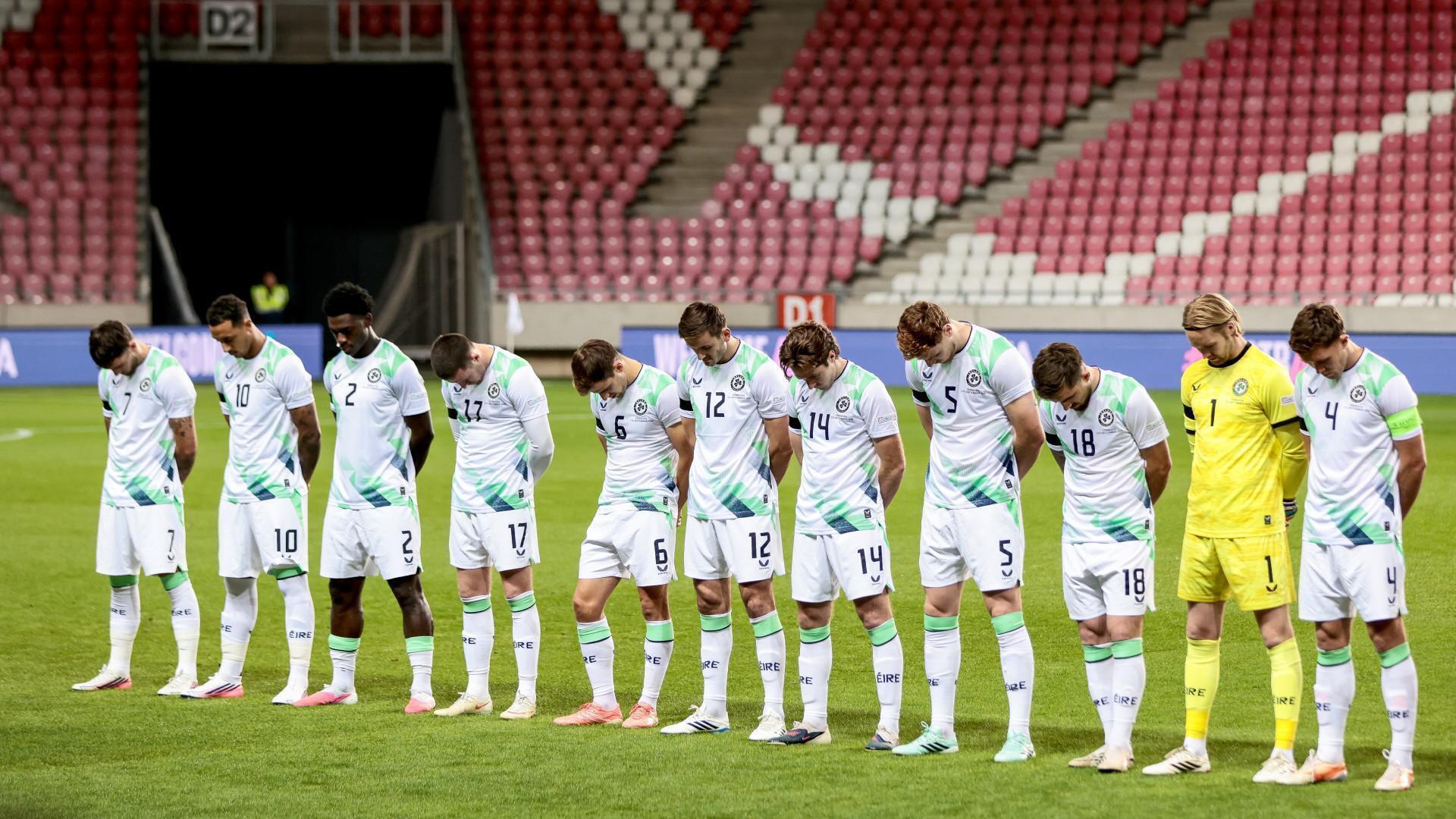
The Ireland team during the Israel national anthem. Pic: ©INPHO
To paraphrase Macbeth, nothing becomes this week in Irish football like the leaving of it. Tomorrow, Ireland will, for the first time, play a home game at an away venue. Sunday’s game in Serbia will be surreal. What odds a soporific 0-0 to end a tumultuous week?
There is no need here to replay the arguments on whether the Israel games ought to have been played, better a recap on some of the lessons learned.
The first is that that old canard of sport and politics not mixing should be dismissed as the myth it’s always been. Even the future direction of the other big sports story of the week – that involving Manchester City – has an underlying political dimension. There are long-standing, close connections between Britain and the UAE, epitomised by the fact that the Man City chair has diplomatic immunity in the UK.
While there has been a lot of media speculation this week as to whether City might (in addition to sporting sanctions) face HMRC investigation or even criminal investigation for fraudulent accounting, expect City’s punishment to be left to football alone. A fine, transfer restrictions, millions in compensation to other clubs, and playing away at Vicarage Road next year, is likely to be the height of it, for now.
Back to the Israel games and Heimir Hallgrímsson’s press conference before the first one featured a bizarre line of questioning ranging from Ireland playing football against Nazi Germany, to the Emir of Qatar and the use of the term genocide.
For the record, Ireland did play Germany three times in the Nazi era: first in Dortmund in 1935; then beating them in Dalymount 90 years ago this month; and in May 1939 playing them in Bremen in the last German international before World War II.
Read More
At that game, the Irish team gave the Nazi salute. As an aside, the first away friendly that the then West Germany played after WWII was 75 years ago this month in Dublin.
The manner in which the Nazis used sport – epitomised by the 1936 Olympics in Berlin – as propaganda and, much more malevolently, the horror and iniquity of what they did to the Jewish population of Europe echoes still. And yet, placing that historical spotlight on Hallgrímsson at a press conference for a football match nine decades later seemed so incongruous. And yet, there we were.
One could argue that the FAI should not have put Hallgrímsson in that position and that’s the second lesson from the week; whither the FAI?
If the underlying key driver in of all of this - the extreme (and continuing) depravations being inflicted upon the Palestinian people – wasn’t so serious, you could say that at times the week took on a Saipan-ish flavour, especially at the Oireachtas hearing.
Who said what and when to Gavin Bazunu prior to the first Israel game; why was a second player vote called; what would the FAI have done (hypothetically) if the players had voted not to go ahead with the first game; all become part of an unsatisfactory, scurried hearing that probably should have been postponed to another time – thankfully a serious safeguarding issue in the women’s game, raised by Senator Evanne Ní Chuilinn, will be returned to.
Gavin Bazunu took a principled stand. The players voted by a majority to play. The FAI through Paul Cooke implied that, while happy to consult the players, their duty was to the game as a whole and that the consequences for Irish football if the fixtures were not fulfilled would result in financial and reputational damage beyond the loss of six points.
As I argued last week, I doubt UEFA would have penalised Ireland beyond the mandatory loss of points. Indeed, throughout the week UEFA has taken a softly, softly approach. We did hear at one stage that Hallgrímsson might face investigation for his use of the term genocide. But nothing came of that. Similarly, the protests at the Austria game on Thursday in Dublin are unlikely to attract any meaningful sanction by UEFA beyond a reprimand about security at the Aviva.
There was a suggestion that in Hungary Israeli fans directed racial abuse at Adam Idah, but UEFA stated that as the Irish complaint had not followed protocol – apparently in alerting the referee the word racism must be used – there the matter had to end. Interestingly, UEFA’s own guidelines appear not to demand such precision and merely state that, “When the referee becomes aware…of racist behaviour (especially racist chants, insults and screams, banners, etc.) and the racist behaviour is of a strong magnitude and intensity” the referee can temporarily stop the game and invoke UEFA’s anti-racism protocol.
The FAI is still investigating video footage of the incident, and rightly so. And to be fair to UEFA, when properly engaged, its anti-racism protocol can be used to good effect. The Israeli FA has strongly denied the accusations and counter-allege that Gaza-related comments were made to its players.
There is some irony in that last point because it brings us right back to when these fixtures were announced, and the FAI’s view that it should not have to play Israel in UEFA competitions in the first place.
In November, the FAI approved a motion to call on UEFA to ban Israel from European club and international competitions on two grounds. First, in violation of UEFA regulations and with discriminatory effect against Palestinians, the Israeli FA was not, “implementing and enforcing an effective anti-racism policy". And second, again contrary to UEFA regulations, the FAI contended that its Israeli counterpart was facilitating the “organisation of clubs in illegal settlements in the occupied West Bank without the consent of the Palestinian Football Association (PFA)”. The momentum behind that FAI motion has somewhat stalled since. Will it now be revived?
FIFA recently rejected a PFA complaint about the failure to sanction Israel over football clubs based in the West Bank. FIFA said it was constrained by the “unresolved and highly complex” legal status of the West Bank under international law. The PFA has since appealed FIFA’s decision to the Court of Arbitration for Sport (CAS) noting that the illegal nature of settlements on the West Bank has been clearly acknowledged by the UN and the International Court of Justice.
If UEFA dismisses the FAI’s motion on similar grounds, will the FAI also appeal to CAS or was the motion just symbolic?
Finally, hearing the reaction of the Israel players after the first game was interesting. It took some chutzpah from the Israeli captain to say that his country was ten times better than Ireland after shipping a 3-0 defeat, but that snarl aside, and much, much more seriously, it is clear there is a chasm between, on the one hand, the Irish view that what is being done to Gaza (its people, its infrastructure, its future) is grossly inhumane and callous; and, on the other, the Israeli stance that we are either ignorant of or do not want to understand the existentialist threat they face daily.
The week in review directs you back to Orwell’s celebrated quote that “serious sport has nothing to do with fair play. It is bound up with hatred, jealousy, boastfulness, disregard of all rules and sadistic pleasure in witnessing violence: in other words, it is war minus the shooting.” This week shows however that Orwell was wrong. Yes, sport and politics do mix. Yes, sporting rivalries can evolve into hatred. But no, the plaything that is sport should never, ever be compared to the pity of war.