Jack Anderson: The FAI’s decision to play Israel raises questions that go far beyond football
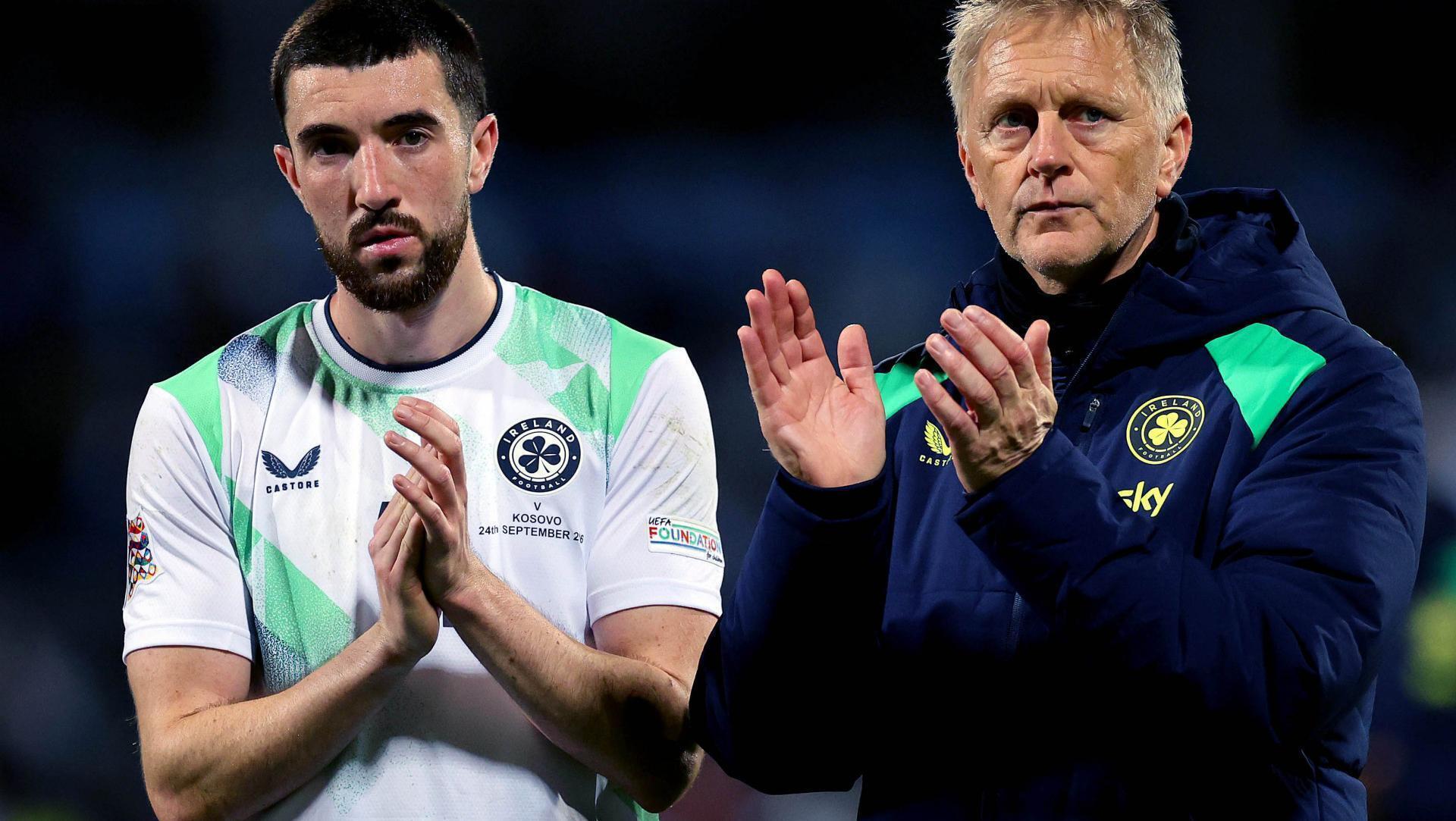
Ireland head coach Heimir Hallgrímsson, and Finn Azaz, after defeat in Kosovo. Pic: INPHO/Ryan Byrne
There was little need this week for an algorithm to place the Israel game to the fore of your social media feed. It was already there.
Although it’s “only” a game, the debate about Sunday’s match has much wider ethical, moral political connotations. It’s a fiction to think that international sport is politically neutral. Political friction is often the story of international sport, as Ireland’s opponents on Thursday night, Kosovo, can attest.
One small aspect of this whole affair has been the legal issues. There is nothing in international, Irish or sports law compelling the FAI to fulfill (or not) the upcoming fixture against Israel.
Hamas committed war crimes of unspeakable depravity on October 7, 2023 but as confirmed by the UN and other international organisations, the Palestinian people have since and long been the victims of multiple, disproportionate breaches of international law. There is an argument that on this basis the government could have requested the FAI not to play against Israel. But even though the FAI, as with other sports bodies, receives significant public funding, the government is limited in what it can mandate a private sports body to do.
And if the Irish government had intervened; the FAI would have been suspended by both Uefa and Fifa for breach of football’s “sporting autonomy” regulations. Football associations are obliged to manage their affairs independently with no undue influence. Uefa and Fifa are happy to take public money (to fund stadia etc) but otherwise fiercely resist political “interference”.
Irish government intervention would have led to the FAI’s suspension from world football, and the governance of Irish football would have been given to an external “normalisation” committee (think troika coming to Dublin in late 2010). Our participation at Euro 2028 would have been in doubt; conversely, Israel’s freedom to qualify for it would not.
Although it’s a moot point, as the government left the playing of the Israel game up to the FAI, intervention would have been self-defeating. Things will however get interesting if Israel qualifies for the Euro 2028 tournament.
A factor in the FAI Assembly’s decision to play (68% in favour) was legal advice. While there is nothing in law compelling the FAI to fulfill fixtures against Israel, there would have been consequences if they decided not to. A loss of 6 points and an array of financial losses might have accrued, ranging from relegation from the Nations League; to a fall in rankings and seedings; and the knock-on effect all this would have in terms of funding (vital to the precariously financed FAI). A tangible economic loss would have been the broadcasting monies that would have been withheld for not playing and, intangibly, the loss of goodwill within Uefa.
There are three points to say about that legal advice. The first is, for many, the price to be pai"d in terms of not fulfilling the fixtures (loss of points, money, goodwill etc) is nothing as compared to the suffering of the Palestinian people. The former is beside the point; the latter is the point. Goodwill maintained with Uefa is goodwill spent with Irish supporters.
Second, the legal advice was mainly about the financial consequences, some of which were contracted, such as the TV monies; other projected losses are speculative i.e., we might get relegated and that might affect our seeding and that might affect our chance of qualifying and that might affect our ability to fund the domestic game etc. Reframe of all of the above into one straightforward question: If the Republic had qualified for this year’s World Cup and the FAI was in a healthier financial position, would it be more likely that Ireland would have withdrawn from these games?
The FAI’s position is that while they sympathise hugely with the Palestinian people (and have obtained the blessing of its FA and have agitated with Uefa to have Israel removed and would prefer not to be drawn against them in the future etc etc) ultimately the FAI executive’s decision was based on what it sees as its organisational duty of care to ensure the association’s financial stability.
The third part of the legal advice is that the Republic would be deducted six points for not playing. That’s true; Article 26 of the Uefa Regulations of the Nations League mandates that in such a scenario the game is forfeited i.e., 3-0 against the forfeiting teams and the loss of 3 points. Moreover, Uefa may impose “any further disciplinary measures deemed appropriate on the association concerned, including disqualification from the competition” and require that compensation is paid to the other team.
Would it have made any difference to the FAI Assembly’s vote (even now?) if it had been explained that it is very unlikely that anything more that the mandatory forfeit penalty would be imposed? There is, as my colleague John Fallon has pointed out, Uefa precedent (teams refusing to play Belarus) for not going beyond a 3-point penalty. Also, the supreme court of sport (CAS) has, in similar cases where club teams have either refused to play or abandoned a game, warned against penalties being disproportionate.
The longest relevant suspension at CAS was imposed on Iran in judo (four years) but that was for systematically ordering its athletes either not to compete against Israelis or to deliberately lose to avoid them in tournament draws.
Would it have made any difference to FAI delegates (or even now?) if it was explained that Uefa would be hesitant to impose extra sanctions on Ireland (beyond points) for fear it might prompt an appeal, giving the FAI a forum to make its case. Uefa would likely feel uncomfortable having to defend politically sensitive matters at a tribunal e.g., why ban Russia for Ukraine but not Israel for Gaza etc. For similar reasons, don’t be surprised if Uefa does not meaningfully pursue Heimir Hallgrímsson for his “playing against genocide” remarks.
In short, the potential loss to the FAI (sporting, financial, political) of not taking part may not have been as dire as presented in July at its EGM but that’s probably no matter now as Sunday approaches.
Historically, there is little precedent in football as to what happens when a country refuses to play another for political reasons. There is one that has almost been forgotten. It doesn’t bear exact equivalence though it did begin almost exactly 53 years to the date of Sunday’s game.
On September 26, 1973, Chile drew 0-0 with the Soviet Union in Moscow in the first leg of the final qualifying stage for the 1974 World Cup. Two weeks earlier, the socialist government of Salvador Allende had been removed in a bloody coup led by General Augusto Pinochet. Pinochet’s junta detained, tortured and assassinated thousands, including at the Santiago national stadium. The return leg between the CCCP and Chile was scheduled for that very stadium on 21 November.
The Soviets requested a neutral venue. Fifa sent a delegation to Chile to check out the security situation and declared themselves satisfied. The Fifa General Secretary Helmut Kaser said. “If one should take into account each time the domestic conditions of a country, not organise a match where there are political detainees or where one mourns victims of a system, then tell me in which country one would safely organise a football match?” Fifa, politically neutral as ever.
The Soviets did not travel and were expelled. A ghost game took place with Chile scoring into an empty net. As the disappearances continued, including many footballers, Chile struggled to attract teams to play them in international friendlies as they prepared for the World Cup in West Germany. Only one country travelled to play them during that time.
They were even hosted at the whitewashed (to cover what?) national stadium; and that, of course, on 12 May 1974, was Ireland.