Paul Rouse: A young nation at play - what the 1926 census reveals about sport in the new Free State
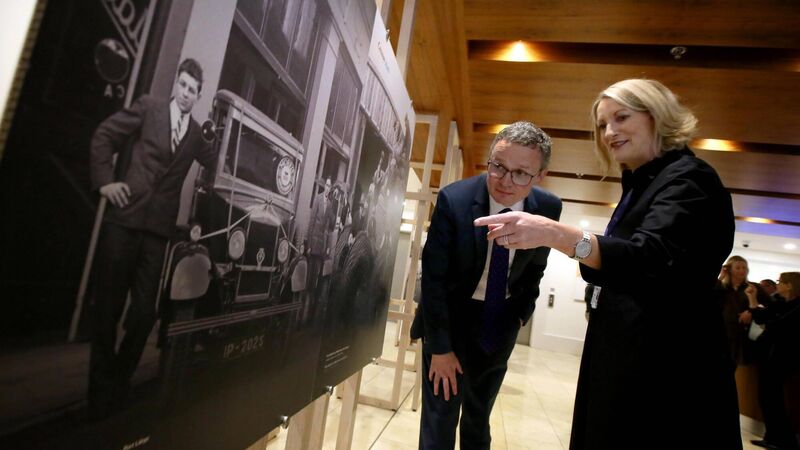
Looking at an image of Kelly's Garage on Catherine Street, Waterford are Minister for Culture Communications and Sport Patrick O’Donovan TD, and National Archives Director Orlaith McBride at the launch of a comprehensive public programme of events ahead of the centenary release of data from the 1926 Census. Pic: Mark Stedman

Later this month, on Saturday, 18 April 2026, the records of the 1926 census will be made public on the National Archives of Ireland website.
The release will offer an extraordinary insight into every family and community in Independent Ireland in the years immediately after the establishment of the Irish Free State and the partition of the island. There are returns from 700,000 homes. The scale and nature of the information contained will transform our knowledge of the lives of people from the middle of cities to the most remote of country areas.
Unlike in other countries – notably the United Kingdom – the Irish state is making the census available for free. This is a credit to every state institution who has supported this process.
Part of the story contained in the records is related to sport – and what emerges from the census is the diversity of sport that was on offer to people in 1926.
The raw facts of this are clear.
In the 1920s, hundreds of new clubs were established across numerous sports – including hockey, tennis, cycling, boxing, athletics and golf. For example, between 1924 and the outbreak of World War II, 71 new golf clubs were established.
In Gaelic games, too, there was substantial and sustained growth. Between 1924 and 1945, the number of GAA clubs doubled from 1,000 to reach more than 2,000.
In 1926, the All-Irelands went south. Cork – led by their captain Seán Og Murphy from Merchant Street in the city– won the All-Ireland hurling championship, while the football was won by Kerry, whose players included Con Brosnan and John Joe Sheehy who had fought on opposing sides in the Civil War.
You can see all their returns in the census.
The passion for sport was revealed also in the place of soccer in the Irish Free State. For some who had fought for Irish freedom, the notion that what they considered to be the game of the English soldiers should now prosper drew frenzied disgust.
The imagined Ireland of their struggle for freedom was supposed to cast off anything that was not native, but precisely the opposite happened. In the 1920s, a concerted effort was made by those who ran soccer to spread the game outside the cities. The Leinster Football Association noted how their ‘propaganda work’ in provincial towns had provoked interest to the point where soccer was proving ‘immensely popular’.
The returns of the best soccer players in the country are also there to be seen.
In 1926, sport was also being used to project the nation. Staging sporting events and sending out teams to play in international competition was a brilliant way to raise awareness of an independent Ireland.
Legislation was introduced in the Dåil in 1926 to allow for major motor races to take place in the Phoenix Park. Motorcycle and sidecar racing took place that year and then later in the decade 100,000 people attended a Grand Prix in the park.
The Army Equitation School was founded in 1926 and produced a showjumping team that travelled around Europe winning Nations’ Cup competitions.
Ireland was promoted as a venue for international sporting events and in 1928 the new Irish Free State sent a team to the Amsterdam Olympics. The star of the team was the hammer-thrower, Pat O’Callaghan, who became the first athlete from the Irish Free State to be crowned an Olympic champion.
Speaking at a homecoming in Kanturk, Co Cork, he said: ‘I am glad of my victory, not of the victory itself, but for the fact that the world has been shown that Ireland has a flag, that Ireland has a national anthem, and in fact that we have a nationality’.
This idea of a nationality was important.
The diversity of sport that was available, the growth of sports that were not ‘Gaelic’ created a problem for those who wished for a certain type of Ireland.
Back in 1920, Aodh de Blacam, a leading Sinn Féin arch propagandist, had imagined that the independent state to be made in Ireland would be ‘a medieval fragment in the modern world’. That is to say that he looked into the past for a vision of the future that was again revealing itself.
The 1926 census begins to answer the questions as to what had the Irish fought for freedom to achieve? What did independence mean beyond a changed flag and anthem?
The idea, or even hope, that popular culture in independent Ireland would be defined by Catholic and ‘Gaelic’ values clashed with the reality that the modern world did not permit of isolation. All-out resistance to global and modernising influences was impossible.
What emerged was a remarkable tapestry of experiences and influences.
Gaelic sport thrived, so did soccer and rugby. On top of that, cities and towns across Ireland had skittle alleys and shooting galleries, Turkish baths and swimming pools, and so much else that were recognisably part of the globalised world of the 1920s.
Words, images and ideas circulating in books, newspapers and other prints sold on stalls or available in libraries, reading rooms, and club and society houses, were drawn from across the world.
This facilitated cultural change in Ireland, not least through the stunts and thrilling feats of speed undertaken by men and women in newly-invented cars, motorcycles and airplanes. The continued growth of consumer culture, with developments in advertising and marketing, underline the desire for material wealth, the consumption of food and drink, and the rise of recreational shopping soaked in increasing American influence.
Powerful new media added more layers of globalising trends. Cinema was increasingly prominent and the arrival of radio was a landmark moment in the new state.
While new media facilitated new modes of recreation, older habits continued to thrive. Public houses were to be found on every significant street in urban Ireland. As well, they were the focal point of village life and were scattered across the countryside in numbers that were completely at odds with the country’s declining population. Alcohol consumption crossed divides of class and identity and geography. Its most spectacular impact could be seen in the country’s jails, where a significant percentage of the inmates had been convicted of alcohol-related crimes.
All of this – sport and play, cinema and drink, reading and writing – can be found in vivid detail in the 1926 census.