Donal Lenihan: Failings laid bare as Euro exit deepens Munster pain
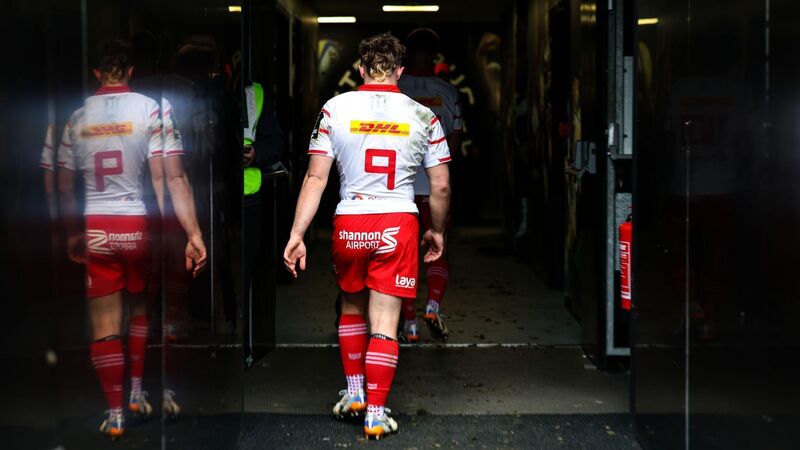
Munster's Craig Casey leaves the field at Sandy Park on Saturday. INPHO/Dan Sheridan

It’s now official. Munster rugby is in crisis mode. Saturday’s defeat to Exeter, their 10th in the last 14 games, not only sees Munster as the first Irish province to exit Champions/Challenge Cup rugby this season, but it places even further pressure on the side to finish in the top eight of the URC.
For an organisation already looking to direct a handful of staff towards the exit door, a failure to qualify for next season’s Champions Cup would be catastrophic.
Munster are fast running out of scapegoats.
For too long now, a succession of coaches in Rassie Erasmus, Jacques Nienaber, who admittedly left of their own accord, Johann van Graan, and the last man to deliver silverware in Graham Rowntree, provided the easy out for a Munster hierarchy chasing short-term fixes.
Erasmus and Nienaber subsequently combined to deliver back-to-back World Cups for the Springboks while Van Graan has been tearing up trees with Bath, having delivered a Gallagher Prem title along with Challenge Cup glory last season.
While a lot of attention will inevitably focus on Clayton Millan over the next few weeks, it’s high time that the organisation of the professional game in the province is subjected to a root-and-branch, independent review by the IRFU.
It’s been a pretty challenging period for anyone in Munster colours lacing up their boots these last few weeks.
Apart altogether from the highly competitive physical demands of playing against the top South African sides away from home in the URC, you had exhausting travel and climatic issues to deal with.
Couple that with flight disruptions and the extraordinary decision to announce a voluntary redundancy package when the Munster squad were based so far away from home.
Already under pressure, coping with a prolonged losing streak, a 45-0 defeat to the Sharks could not have ratcheted up the pressure any further.
Munster players have always been a proud and resilient bunch, thus no surprise when they responded in an even more testing environment against the Bulls, at altitude in Pretoria in temperatures of 30c, than they managed at sea level in Durban seven days earlier.
In a game Munster could well have won, to emerge with two bonus points at least represented some measure of consolation from a 34-31 defeat.
It’s difficult however to rely on pride and emotion alone to drive successive performances. Having to deal with a return journey from Johannesburg, an onward link from London to Shannon, followed a few days later with another flight for the Exeter game was always likely to take a toll.
The sense of responsibility that comes with pulling on a Munster jersey was heightened further by the realisation that some people within the organisation are on the brink of losing their jobs, an inevitable consequence of falling attendances and the failure to secure a knockout home fixture in the Champions Cup since 2022.
As one of just eight of the 24 participating teams to depart the Champions Cup after the pool stage this season, the lack of a home knockout fixture in either tournament for yet another year impacts the coffers once again this year.
It’s even more difficult to take given some clubs fielded vastly under-strength teams in a deliberate effort not to make the cut, while it’s also served to damage Munster’s hard-earned status and reputation on the wider rugby stage.
European rugby is part of Munster’s DNA since its inception 30 years ago, but in a tournament that’s clearly lost its allure for so many clubs who choose to prioritise their domestic leagues, getting rerouted to the Challenge Cup for only the second time in their proud history was never part of the plan.
Just four days after arriving home from their South African sojourn, Munster were tasked with boarding yet another flight for the trek to Exeter to face a Chiefs side currently sitting higher up the Gallagher Prem table than round of 16 qualifiers Bristol Bears and Saracens in the Champions Cup.
No surprise therefore when that duo were dispatched with ease by Toulouse and Bath over the weekend. Maybe it was just as well Munster didn’t advance to the Champions Cup. The experience could have been even worse than what transpired in Sandy Park. Quite honestly, on current form, that was a game I couldn’t see Munster winning.
Right now, Munster are not at that level and have become over-reliant on Tadhg Beirne, Craig Casey, Jack Crowley and Alex Nankivell when attempting to compete on equal terms with the top sides, both domestically and in the Champions Cup. When that quartet are injured or unavailable, the fall off in standard and competitiveness is seriously worrying.
That, more than anything, highlights the biggest problem McMillan has inherited. The sooner that reality dawns on those tasked with running the professional game in the province, the better.
At the top level, Toulouse and Bordeaux Begles are well ahead of them. Bath and Glasgow Warriors, an organisation very close to the Munster model but operating at a different level at present, will fancy their chances of upsetting the odds and challenge for Champions Cup honours over the next two months.
Leinster should be dining with them at the top table but, for a variety of reasons, have yet to produce a performance commensurate with the quality of players on board this season. Their starting team against Edinburgh last Sunday was made up of 14 Irish internationals, including 10 British and Irish Lions, and an 86-times capped All Black.
The bench had six more internationals, including two Lions. In addition, they were missing key frontline players in James Lowe, Garry Ringrose, James Ryan and RG Snyman. That level of proven quality is frightening. Yet, with 26 minutes to go, an Edinburgh side currently sitting 13th in the URC were leading by three points.
It was an extraordinary game from that perspective, with Leinster handing the Scots a succession of crazy tries, including three intercepts, that somehow kept an inferior opponent in the game far longer than they should have been.
While Munster have problems of an entirely different nature to navigate over the remainder of their URC campaign, so too have Leinster if they want to put to bed an incredible tendency to shoot themselves in the foot at the business end of the Champions Cup.
It helps Leinster’s cause this season that Toulouse, Bordeaux, and Bath are all on the opposite side of the draw, with the two French Top 14 giants meeting in a mouthwatering quarter-final at Bordeaux’s Chaban Delmas next Sunday. Make sure you don’t miss that one.
Unlike their Leinster, Connacht, and Ulster counterparts, Munster’s players and management have a weekend off and a bit of badly-needed breathing space to absorb the enormity of what has happened over the last few weeks. At least that offers a bit of time to plan their assault on the remaining URC games, away to Benetton and Connacht and against Ulster and the Lions at Thomond Park.
They’re not the only ones in the organisation tasked with reflecting on their performances. Off the field, Munster have got so many key decisions wrong, over a far longer time frame, that has contributed significantly to the deeply concerning position the province now finds itself in.
Unfortunately, that will take longer to rectify than the shortcomings McMillan faces right now. More on that to come.