Paul Rouse: What would it take for a boycott of the Trump World Cup?
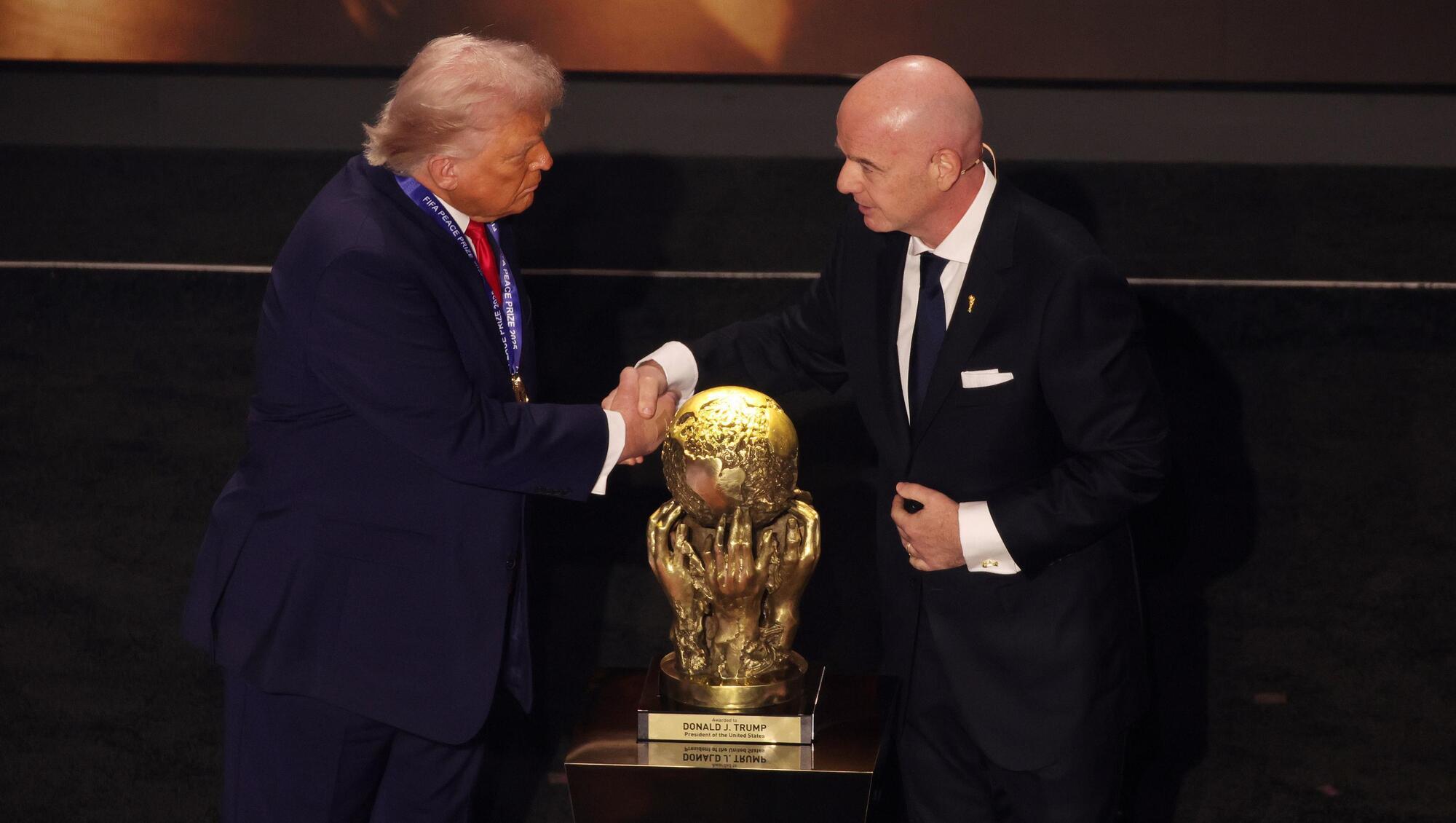
POLITICAL FOOTBALL: US President Donald Trump is presented with the inaugural FIFA Peace Prize award by FIFA President Gianni Infantino. Pic: Sam Corum/PA Wire.

What exactly would Donald Trump have to do before there is an organised boycott of the World Cup in America which is due to start next June?
Is there actually a tipping point at which associations or players or sponsors will say that this event cannot go on – or at least it cannot go on with us being a part of it?
Obviously, there can be no pretence that this is not Trump’s World Cup. He is already all over it.
Last July, when Chelsea beat Paris St Germain in the final of the World Club Championship, Trump was on stage to present the trophy afterwards and stood in the middle as the players cavorted around him. The Fox News report of this is available on YouTube and is a classic example of how politicians try to use sport and how that attempt is enabled by media.
This was followed, last August, by Gianni Infantino, who is the head of FIFA, bringing the World Cup trophy to the White House for a photo opportunity with Trump, who was wearing his red ‘Trump Was Right About Everything’ cap.
Then in December, Trump dominated the draw to split the 48 competing nations into groups. Trump was invited on stage and before the groups for the 2026 FIFA World Cup, he was presented with the FIFA Peace Prize. This prize was invented for Trump by Gianni Infantino, a lickspittle of epic proportions.
Through their history, international sporting organisations have sought to maintain the fiction that sport is just sport, or if it does have a wider function it is to bring peoples together, to smooth over differences, to help with modernization and other such rhetorical claims of the spurious variety.
This nonsense has been used as a shield by – for example – by the International Olympic Committee and FIFA whenever they come under pressure to act in the face of overwhelming evidence.
The most famous example of this is when the International Olympic Committee defied calls for a boycott of the 1936 Berlin Olympics. Those Olympics were planned as a propaganda platform for showcasing Germany as a strong, united and modern country.
Adolf Hitler had made plain by 1936 his plans for expanding the boundaries of Germany and had begun to rearm. He had also already embarked on brutal campaigns against Jews and Roma. There had been book burning, the murder of political opponents, the building of concentration camps for dissidents, and the creation of a dictatorship.
And yet the Olympic movement came to Germany.
In a brilliant introduction to a book he edited (with Arnd Krūger) on this subject, The Nazi Olympics: Sport, Politics, and Appeasement in the 1930s, William Murray noted the failure of the attempts to get countries around the world to boycott Berlin. He wrote: “The willingness of the rest of the world to play games with Germany in 1936 was an act of appeasement, even if the full evil of the regime was still to unfold.”
Four decades later, there were calls to boycott the brutal Argentinian military junta’s World Cup of 1978. The French sociologist and philosopher, Jean-Marie Brohm, who taught for many decades at the University of Montpellier, made a profound plea for such a boycott in a book he published beforehand entitled Sport: A Prison of Measured Time.
There is no need here to rehearse the appalling nature of the Argentinian government except to give one example from 1978, when south-easterly winds threw a dozen bodies from the sea onto various beaches in Argentina. The bodies were naked and carried the marks of violent death. These were people who had been kidnapped by a military regime which had been in power from 1976 and they had been murdered, before being dumped in the sea from military planes.
Many more bodies were never recovered. Perhaps 30,000 people – including many children – were disappeared by the regime.
What most people remember of the World Cup in that year was the glory of Ardiles and Kempes, how close Holland came to winning, and the excitement around the Scottish team (late night drinking, a failed dope test, a goal by Archie Gemmill which is still repeatedly shown in montages).
Again, there had been a boycott campaign, but the competition continued essentially unhindered. And the Generals danced as the trophy was presented to Daniel Passarella, the Argentinian captain.
In his book, Jean-Marie Brohm argued that the modern spectacle of sport “treats the masses as morons”, “that any hope of 'cleaning up sport' financially speaking is an illusion”, that it “enslaves women and perpetuates the patriarchal system”, that sport serves the function of inducing people to “to acclaim the established social-political system”.
As a Marxist, he struggled to see fun in sport. And it is difficult to ignore Ken Early’s nicely put point that French philosophers are prone to “talk a lot of pony”. But Brohm’s essential arguments about the meaning of sport and how it is used by those in power for their own ends are clear and strong.
It is true that there were partial boycotts of the Moscow Olympics of 1980 (by the Americans, in particular) and of the Los Angeles Olympics of 1984), but these were part of the geopolitics of the Cold War, not rooted in repulsion or rejection of immorality.
Since the modern Olympics were founded in 1896, only three planned editions of the Games have not gone ahead: 1916 because of World War One, and 1940 and 1944 because of World War Two.
Since the World Cup began in 1930, the four-year cycle fell through twice: the 1942 World Cup because of World War Two and the 1946 World Cup because it had not been possible to restart international soccer in time.
The basic lesson here is that the only way that the World Cup will not happen is if there is a world war. Short of that, people will accommodate themselves to whatever other narcissistic madness Trump unveils, no matter how many lives are lost or ruined in the process.
The Trump World Cup kicks off on 11 June 2026.