Fogarty Forum: It’s official — Cork are the GAA’s cash cows
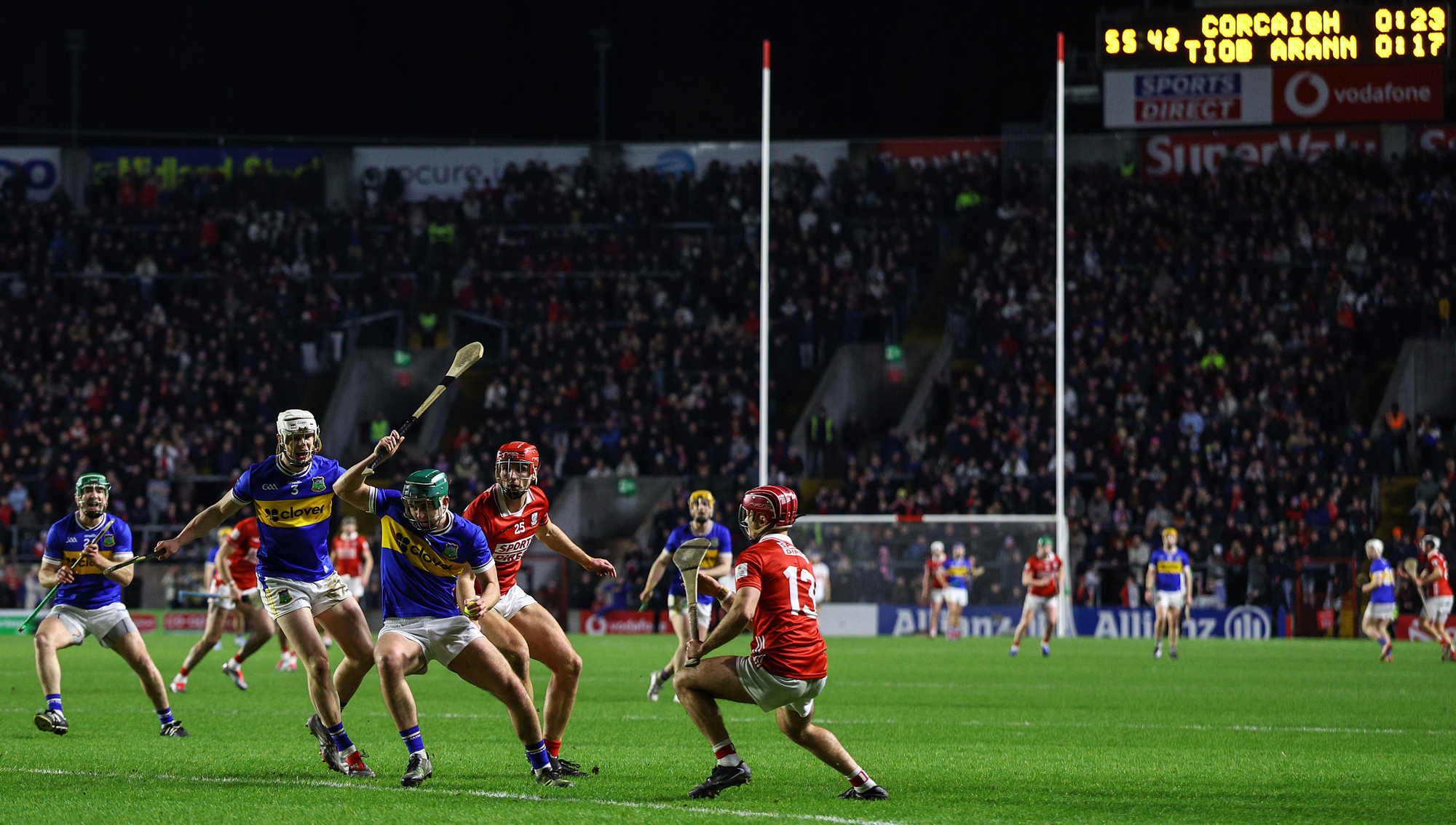
A crowd of just over 14,000 for the Offaly game in Páirc Uí Chaoimh on March 21 will be enough to see the Cork hurlers break their home attendances record for the second successive year. Pic: ©INPHO/Ben Brady
For all we know, John Cleary could be a whizz in the kitchen but he’s no Delia Smith.
When he called on Cork people to get behind the team to face Meath in Páirc Uí Rinn this Sunday, it’s because we asked him if he hoped there would be a good crowd. There was no “where are you?”
Anyone with an affiliation to Cork football is used to the love being shown elsewhere.
Nevertheless, they are another Cork winning side who can fill the vacuum for a county whose hurlers will have gone six weeks without a home game by the time they play Offaly on March 21. Those with withdrawal symptoms could do worse than wander down Boreenmanna Road on Sunday.
Read More
The Cork folk that travelled to Tullamore may have been humble in numbers but they were heard in the equally modest crowd of 1,260. A shout of “Rebels, Rebels” pierced the low murmur as they went 12 points ahead in the second half.
The home crowd were quiet and in his match programme notes Offaly chairman Tom Parlon noted the amount of fixtures that are coming the way of the dual county.
“It is very difficult for supporters to attend games every week, for financial and practical reasons, and this will become even more pertinent soon when minor and U20 matches get underway.
“However, I must encourage Offaly fans to please continue to row in behind our teams, whenever possible. It means a lot to the players who are putting in a massive effort behind the scenes.”
With the greatest of respect to Parlon, a rallying call from a county chairman doesn’t have the same effect as it does from David Clifford or Liam Cahill as was the case for All-Ireland champions Kerry and Tipperary last year.
Parlon clearly appreciates that the fixtures schedule is forcing supporters to be more discerning in their game-going. None of Offaly’s three football and hurling league fixtures are double-headers either.
At a time when the GAA is reporting incredible gate receipts of €45.7m, up €6.6m from 2024, why do counties feel compelled to try and round up the troops?
It’s not a button Pat Ryan, Ben O’Connor or Darragh Fitzgibbon have had or will have to press but it is becoming more common elsewhere. Only the week before last, Kilkenny captain TJ Reid took a leaf out of Clifford and Cahill’s books: “This year we need the Kilkenny fans to really get behind us. I know everyone's talking about a little bit of negativity and a bit of impatience at the moment, so we need our supporters out in droves this year to drive us on.”
Absence of the Liam MacCarthy Cup has made the heart grow fonder in Cork but not in Kilkenny. There is a listlessness in the Leinster SHC. In 2018 and ’19, the average attendance for round robin games in Nowlan Park was around the 12,500 mark. Across 2024 and ’25, it had diminished to 8,627.
The decline isn’t as obvious in the league, but it exists. In 2018, Kilkenny’s average home crowd was 8,932 whereas last year, despite the visits of Limerick and Tipperary, it was 7,179.
Sunday’s derby with Waterford should attract a decent crowd and the following weekend’s visit of Cork could draw over 10,000, although the visiting support may challenge the home following for supremacy.
The two-down, two-up jeopardy attached to the National Hurling League undoubtedly contributed to the 43% growth in attendances last season, but Cork were the main reason for the jump.
Over 108,848 came to their three round fixtures and Division 1 final in SuperValu Uí Chaoimh. Including their away fixtures in Wexford, Thurles and Ennis, the seven games involving Cork represented approximately half of the total attendance for the league last year (271,229).
When we asked GAA director of finance Ger Mulryan about Cork’s contribution to the league gate receipts at last Wednesday’s financial report launch, he also referred to their pulling power in the championship. “I think probably if Cork played anyone in the semi-final, it would have been a sellout,” he said.
Just as their rivals Limerick and the Dublin and Mayo footballers before them, Cork are the GAA’s cash cows. When the GAA suffered a €3.6m drop in SFC gate receipts in 2018, Mayo’s failure to make the All-Ireland SFC’s Super 8 was cited as a reason.
Were Cork not to reach the last four, it would have a detrimental effect on the GAA’s coffers. Winning an All-Ireland might be the quickest way of paying off Cork’s stadium debts, as the county board’s chief executive Kevin O’Donovan has said, and the association are invested in the county’s pursuit of it.
A crowd of just over 14,000 for the Offaly game in Páirc Uí Chaoimh on March 21 will be enough to see the Cork hurlers break their home attendances record for the second successive year. What the footballers wouldn’t give for half that number in Páirc Uí Rinn this Sunday.
john.fogarty@examiner.ie
It’s fair to say Mickey Harte has mellowed towards Gaelic football’s new rules but the 50-metre advancement bugs him as it does others.
Speaking to this newspaper after Sunday’s defeat to Cork, the Offaly co-manager’s major gripe with it was the lack of consistency in its application. He took issue with how Offaly weren’t allowed to play quickly after winning frees.
“The one that was very strict at the start when the new rules came in was if anybody interfered in any shape or form when a player was fouled and wanted to go ahead, it was immediately 50m. Which I don't agree with, in fact, because I think the 50m is too arbitrary. The 50 can become 70 in certain cases.
“But there was no sign of it today at all. Interference wasn't an issue. You always had to take the free where it was. If you're going to have the rules in, you must apply them consistently. Even though I don't like it, if it's in, we need to deal with it properly.
“But apart from that, they definitely have helped the game. They've made it more of a free-scoring spectacle. I think the country at large will be happy with them.”
Fógra – Thanks to Tom Hunt for alerting us to the passing of Waterford goalkeeper and former journalist Gerry McCarthy in Dublin last week. McCarthy manned the nets in The Déise’s famous 1957 Munster semi-final victory over a Mick O’Connell and Mick O’Dwyer-blessed Kerry side in Waterford city. It remains Waterford’s last and second ever senior football championship win over The Kingdom.
May we also extend our condolences to former GAA correspondent Jim O’Sullivan and his family on the passing of his wife Josephine. May they both rest in peace.
Just nine seconds into Saturday’s Division 2 game in Croke Park, football referee Brendan Griffin with the assistance of linesman Martin McNally showed exactly what hurling is missing.
Temporarily dismissing two players from each of the Louth and Meath teams for contributing to a melee, the nonsense was ended there and then. Four yellow cards were later shown in the first half but any post-Leinster final resentment had dissipated.
Imagine how much the Cork-Tipperary game would have benefitted last Saturday week if rather than being red carded Shane Barrett and Jason Forde were sent to the sin bin for 10 minutes.
Not only would both men have avoided facing suspensions, in Barrett’s case a two-match ban, and the trouble of trying to overturn the decisions, they would have returned to the field and the game mightn’t have fallen as flat as it did.
In their report 11 years ago, the Hurling 2020 Committee proposed that a player who picks up a second yellow card be replaced. It was a flawed recommendation from a body that otherwise did good work for the game, but expanding the black card to incidents like melees could be a means of protecting the integrity of a game.
Hurling may think it’s largely above such flashpoints. It most certainly isn’t and the sooner the rule applies to both codes, the better.
A collection of the latest sports news, reports and analysis from Cork.