Christy O'Connor: Hurling's black card anomaly doesn't make any sense
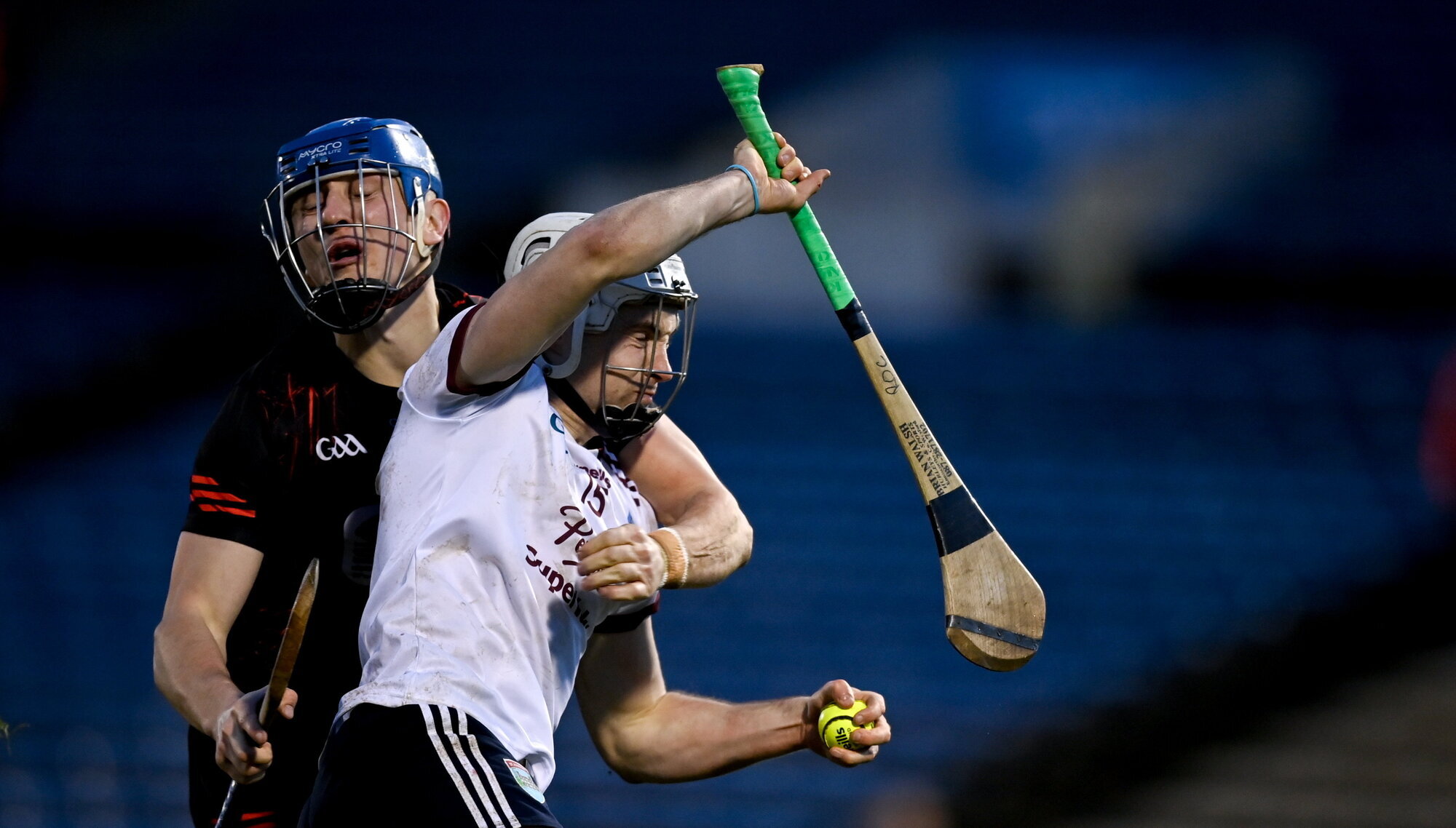
Paddy Leavey foul on Rory O'Connor during the All-Ireland semi-final between Ballygunner and St Martin's would have been a black card in inter-county but that rules does not apply in the club game. Pic: Tyler Miller/Sportsfile

In the 33rd minute of the All-Ireland semi-final Thurles yesterday, Rory O’Connor secured possession on the edge of the D and took off towards goal. The St Martin’s forward got past Ballygunner's Ian Kenny and Philip Mahony but just as he was about to enter the large parallelogram inside the 13m line, O’Connor was pulled down around the neck by Paddy Leavey.
If Leavey was in a Waterford jersey, it would have been a penalty but the Ballygunner midfielder knew it couldn’t because the black card is still not in club hurling.
It's not the first time that the Gunners have shown that street-smarts in this campaign. In their Munster semi-final win against Sarsfields in November, Ballygunner goalkeeper Stephen O’Keeffe committed a stonewall black-card offence when pulling back Barry O’Flynn just as he was about to strike the ball to the net. O’Keeffe took a harmless yellow card and Sars only ended with a point from a free.
At the outset of this year, the black card/sin-bin rule (for the cynical behaviour category) was first introduced at minor, U20 and Junior inter-county levels. A black card for Clare’s Jamie Moylan in the Munster U20 final in May was critical to the outcome of that game as Darragh McCarthy buried the penalty and Tipp outscored Clare by 2-3 to 0-0 during that 10-minute numerical advantage.
With black cards so rare in the inter-county game though, the GAA are reluctant to introduce them for club games. Yet the Leavey incident again underlined the continuing anomaly around the black card ruling, especially for big provincial and All-Ireland club games.
Just before half-time, Peter Hogan took off on a solo in the Ballygunner attacking half of the field but ran into a St Martin’s wall and was driven back by a shoulder from Philip Dempsey. After Dempsey struck the ball down field to Michael Coleman, St Martin’s worked the ball back up the field again when their attacking avenue down the central channel was blocked off. And on the process went.
Jake Firman thought about a shot before offloading the sliotar to Joe Barrett, who, in turn passed the ball across to Diarmuid O’Leary. The St Martin’s defender composed himself before slipping the ball back to Barrett who steadied himself and drove the ball over the bar from the half-way line.
The roof nearly lifted off the Ryan Stand with the noise from the St Martin’s supporters. It was an outstanding score but it also encapsulated how St Martin’s had got a grip on Ballygunner’s throat and how they were squeezing their windpipe in such a forceful and calculated manner.
Hogan had been isolated by not having enough support runners around him. St Martin’s were swallowing up individual Ballygunner attackers in packs but they were punishing Ballygunner too by how well they were spreading the play across the pitch, and in how they were using goalkeeper Callum Quirke as an out-ball option.
Ballygunner were struggling to break down St Martin’s defensive structure. Their conversion rate was just 40% in that opening half, but much of St Martin’s solidity hinged on the control they had on their own puckout, and of how it enabled them to patiently build the play and work the ball around Philip Mahony; St Martin’s hit just one long ball down on Mahony in the first half.
After the break though, Ballygunner changed their approach on the St Martin’s puckout, showing a high press and baiting Quirke to go long but their forwards ran back the field faster as soon as he did. When Quirke went to go to his half-back line midway through the half, he was picked off by Dessie Hutchinson, who landed the ball back over the bar.
After conceding no scores off their own puckout in the first half, St Martin’s shipped 0-4 off their restart after the break. But the panic that set in with St Martin’s defenders pushing higher up the field to try and win more breaks knocked them out of shape and left them much more exposed on the counter attack.
Ballygunner went to town in that chaos; they sourced 0-8 off turnovers in the second half. Their conversion rate also improved to 65% after the interval, with the Gunners converting nine of their last 12 shots. Hutchinson delivered another outstanding display over the 60 minutes, nailing 0-6 from 10 shots from play and also having an assist.
Ballygunner never panicked and just eventually wore St Martin’s down. The Wexford side’s efficiency levels and decision making cracked. In the second half, St Martin’s lorried five long balls down on Philip Mahony, which he ate up.
As soon as that happens against Ballygunner, the game is always up.
Long before the Loughrea and Slaughtneil players arrived in Parnell Park yesterday, they knew how soft the pitch would be and how much the ground battle would set the terms and conditions of the afternoon. Winning ruck ball was going to be a war. And Slaughtneil’s greater physicality and power was clearly an advantage on that frontline.
Ruck ball though, is as much as about attitude, application and raw desire than anything else, and Loughrea showed from the first whistle that they were primed for the trenches. In the first seven minutes alone, they won the ruck-ball battle 5-0. That set the tone for the afternoon. By the end of the match, Loughrea had dominated the ruck-ball stat 17-7.
Loughrea went into this match as the better team, with the more talented forwards, but so much of the pre-match analysis was predicated on Slaughtneil’s capacity to physically dominate teams and secure enough possession – especially on such a poor surface. Loughrea don’t have the same physical profile – or experience on this stage – but winning successive Galway titles in probably the most attritional championship in the country had battle-hardened Loughrea for the war. And they won it hands down.
Slaughtneil were on the back-foot all afternoon. Their efficiency kept them in the game in the first half when Loughrea could have been out of sight. When it looked like Slaugthneil were finally getting to grips with Loughrea’s intensity and the pace of their hurling in the second quarter, the Galway champions burned them off in the third quarter.
And once more space opened up in the fourth quarter and Loughrea began to spray the ball around more, they buried the Ulster champions beneath an avalanche of scores Loughrea had been wasteful from low-percentage shooting in the first half but they were more direct and precise and they delivered the ball much faster into their full-forward line. And it began to stick. Nobody showcased that more than Anthony Burns - he only scored one point in that second half but Burns had four assists.
Slaughtneil set up with Cormac O’Doherty as a sweeper, a role he has played numerous times this year, but Loughrea posed a completely different threat with the quality of their angled deliveries, and how well they were able to play around Doherty.
They did pick up three yellow cards in that opening half but Loughrea were dominating the physical battle. Even their younger and smaller players were doing more than just surviving; Cullen Killeen, who is still under 19, was outstanding and a deserved recipient of the TG4 man-of-the-match. Kieran Hanrahan wasn’t far behind Killeen.
Loughrea sourced 1-11 from turnovers but they strangled Slaughtneil on their own puckout in the fourth quarter; five of Loughrea’s last ten scores came from the Slaughtneil restart.
By that stage, Loughrea were winning every battle. The war had firmly been won.