John Fallon: Anatomy of Ireland's World Cup dream being crushed
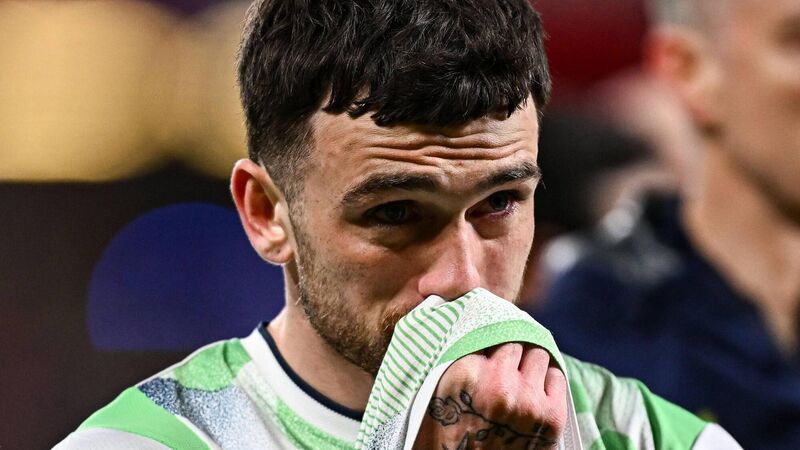
Troy Parrott of Republic of Ireland after the FIFA World Cup 2026 European Qualifiers play-off semi-final. Pic: Seb Daly/Sportsfile

If time is supposed to be a healer, don’t expect Ireland's agony arc to taper off come June.
Either side of the bank holiday weekend, they’ll be providing opposition to Qatar and co-hosts Canada as warm-up acts for the World Cup.
The sense of envy, and regret, will only deepen when the tournament billed as the greatest show on earth tumbles into our eyeline.
Guadalajara on June 11, Atlanta a week later and finally the famous Azteca Stadium on June 25.
South Korea, South Africa and another co-host Mexico seemed to be a favourable group too.

Preferable to England’s of Croatia, Ghana and Panama. Ditto Scotland’s containing Brazil, Morocco and Haiti.
What will gnaw away at Ireland’s players when watching from afar while on holiday is sure to be the control they held of their destiny.
Not just singular moments either. Two goals ahead away to Czechia after 23 minutes. Still one goal in the lead with four minutes left.
Then, as the first taker, holding a 3-2 advantage in the shootout after six spot-kicks.
Of course, there was still last night’s playoff final against Denmark to navigate to end a 24-year wait but the momentum from four straight competitive wins in front of a home crowd would have bred justifiable optimism.
There’s no guarantee of Ireland engineering a more manageable path in four years’ time.
Formats have yet to be finalised, yet on the basis of this playoff schedule, Ireland need a top-two finish in their group to avoid being bottom seeds.
Those were assigned to the four qualifiers through the Nations League backdoor, a route available to Ireland if they produce their best performance in the eight-year history of the competition this Autumn.
Inhabiting either the first or second place in the table across 12 groups entitles those top 24 status in Europe.
That Ireland currently sit in 29th place demonstrates the ground they’ve to make up over the Euro 2028 cycle to replicate success which spiked on the run-in of the series.
There’s been a morbid atmosphere engulfing the camp since Prague pain ruined the weekend but there’s nothing to be learnt by ignoring what caused the elation to plummet into deflation.
Turning points have been highlighted within the postmortem but there were a plethora of incidents that could, and in many cases should, have seen Ireland progress by the end of 90 minutes or the shootout.
If this team, harnessed by a generation of mid-twentysomethings such as Caoimhín Kelleher, Nathan Collins, Troy Parrott, Jayson Molumby and Adam Idah, truly is to peak over the next couple of tournaments, better they study the moments which cost them a World Cup decider shot.
Six days later the rawness remains but so does the reality of where it went wrong.
It started to go right for Ireland from before kick-off when the prime threat Heimir Hallgrímsson had identified, Tomás Soucek, was dropped for the first time in nine years.
New Czechia boss Miroslav Koubek was an international novice and didn’t waste time in proving it.
Here we distil the series of misfortunate events at the Fortuna Arena, any one of which might have led to a showdown on home soil last night.
Captain Nathan Collins, up from the back, latches onto Parrott’s knockdown from the first of Jake O’Brien’s long-throw ins. A slight deflection off defender Robert Hranac angles the ball onto the crossbar.
From the resultant Finn Azaz corner, Collins again gets a sight at goal, clearer and closer this time.
His timing to rise above Tomas Holes six yards out is perfect, unlike his execution. He inexplicably glances the header wide, rolling his eyes to heaven during his retreat into position.
A goal ahead through Parrott’s penalty, he’s left alone inside the box when the Czechia defence are dissected from another O’Brien throw. A better squared pass from Chiedozie Ogbene would have allowed the marksman to pull the trigger.
Precisely 120 seconds after Ireland’s second came via Matěj Kovář’s own-goal, Ireland are defending Czechia’s first corner.
They do so admirably until Ryan Manning chose to grab Ladislav Krejčí’s shirt when no danger existed.
Having failed to win the initial header against the Wolves man, all he required was shadowing him out as the loose ball fizzed towards the endline.
Goalless in his 33 internationals, Molumby was inches from a goal similar to the late Alan McLoughlin’s in Belfast 33 years ago, both in execution and significance.
The midfielder had time to pick his spot when Czechia half-cleared Azaz’s corner. A dipping volley with the outside of his boot from 20 yards beat the goalkeeper but not the post. Ogbene couldn’t gobble up the spinning rebound.
No fault of any Irish players but Kovář channelled his predecessor Petr Čech by producing the save of the night.
Parrott’s header from O’Brien’s throw and Dara O’Shea’s flick-on carried the power, spin and accuracy to force a fingertip around the post.
Several chances to clear the danger were missed before substitute Adam Karabec earned a fortunate free-kick near the corner flag.
Sandwiched between fellow subs Robbie Brady and Alan Browne, the Lyon winger fooled Glenn Nyberg’s assistant into flagging by throwing himself into Browne as if shot by a sniper.
Collective culpability applies for allowing the equaliser.
On review, Ireland looked equipped to deal with the cross by Michal Sadílek; Ogbene, Browne and Séamus Coleman all touch-tight in marking.
Collins is side-on anticipating the run of fellow beanpole Soucek but Krejčí is left alone on the penalty spot.
As the free is lofted in, he wanders into the corridor between O’Shea and Parrott, launching himself into the air with his back to goal.
Might Kelleher have charged to the front post to punch clear?
He takes two steps along his goal-line but is blinded by the congested six-yard box, ending up in his net as the ball strikes the back of the captain’s head. Preventable.
One clearance and those four minutes would have swiftly dissolved. Unusually, there was only another four of stoppage time.
As a siren sounded in the background, Kelleher got his hand to the first attempt by Krejčí. Statistically, Azaz walked up to make it 4-2 with a 78% chance of winning the shootout.
His was saved and, in contrast to Schick, who waited for Kelleher to dive in converting the next to level, Browne kept his head down when Kovář dived to his right.
Events, events, as one famous former UK Prime Minister once said.
There’ll be a long time to bemoan them.
Uefa’s new system for the U19 makes the clunky Nations League seem straightforward but the upshot of Ireland’s three first round games in Glasgow is them progressing to the second round later this year.
The introduction of a third round to the qualification meant this is effectively an U18 age-group, leaning heavily on the U17 squad that reached the knockout stages of the World Cup last November.
Draws in their opening pair of matches against Poland (1-1) and mini-group hosts Scotland (3-3) left the side under the new management of John Cotter with all to play for against Italy.
Despite losing 2-1 to the Azzurri, with Kian McMahon-Brown halving the arrears for the Irish, Poland’s 3-0 loss to Scotland kept them in third place by virtue of goal difference.
That was sufficient for advancing to the second round in the Autumn, with the aim to hurdle a third to be among the eight nations at next year’s finals.
Newcastle United’s Rory Finneran and newly-enlisted Chris Atherton from Chelsea both started for the Irish, as did Ramon Martos (Almeria) and Grady McDonnell (Club Brugge), but the composition of the team will evolve over this extended period of time.
Only seven teams joining the hosts is a daunting task. The last Irish team to reach the finals, seven years ago in Armenia, were decimated by withdrawals by their clubs but Andrew Omobamidele, Mark McGuinness and Festy Ebosele graduated to win senior caps.
Read More