Kieran Shannon: If Ireland continue to treat penalties as a lottery they'll never hit jackpot
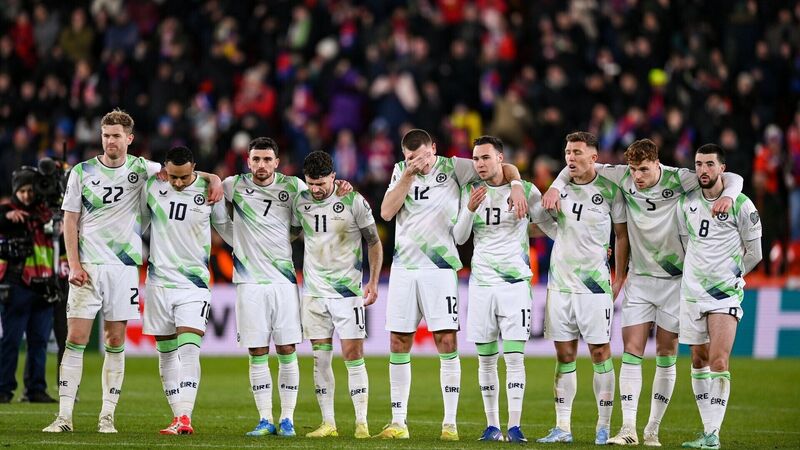
Republic of Ireland players react during the penalty shoot-out. Pic: Stephen McCarthy/Sportsfile

WE’RE the new England.
For decades our nearest and dearest considered penalty shootouts a lottery, something that came down to an individual’s temperament and technique rather than a collective activity or responsibility, and invariably a cruel – even unfair – way to decide a contest and end the journey of a group of players who had been so gallant and defiant and heroic in the preceding 120 minutes.
And so they had to endure the torment of Turin only a week after we had experienced the euphoria of Genoa.
And then Wembley ’96 and St-Etienne in ’98 and Lisbon 2004 and Gelsenkirchen in 2006 and Kyiv 2014, just like we’d suffer Suwon and Bratislava and now Prague, until they came to a realisation, a bit like the ensemble cast of Magnolia in a surreal musical sequence: No, it’s not going to stop, ’Til you wise up.
For the outcome to change, their narrative and preparation had to change. Maybe penalties weren’t a lottery.
We don’t seem to have quite reached that point. In recent days, Keith Treacy, one of the finest football pundits in the country, summed up decades of conventional football thinking by remarking on Off The Ball, “You can practise them [penalties] if you want, I honestly don’t think it’s going to make too much of a difference. I mean, me standing in Abbotstown rifling balls into the top corner with no pressure on me is not going to replicate taking one in Prague in front of 20,000 and a ticket to the World Cup [is on the line].”
Stuey Byrne, the former League of Ireland veteran, rowed in behind Treacy, underlining just what a culturally-ingrained belief it is in Irish football.
Read More
“You can’t train for that situation. You could go through the whole week taking penalties every day, walking 50 yards, putting them in the top corner, and do it again and do it again. But when it comes to that scenario, environment, cauldron, you can’t replicate it.”
Heimir Hallgrimsson would have a similar outlook, or at least he had prior to last Thursday night; who knows, but maybe at the closure meeting he and his staff held with his players last Friday the failure to adequately prepare for penalty shootouts was amongst the items that “cost us”.
Heading into the game against Czechia though he declared Ireland would not practise penalties in advance.
“I am not so sure that training penalties would be such an asset,” he told reporters last week. “Especially when you look at the short time we have. Other things are more important.”
To be fair to Hallgrimsson, and indeed Byrne, Ireland had at least talked about the possibility of penalties, as the former Shels man would have noted. He and his staff had formed a list of penalty-takers, “from one to 23” and were open to “tweaking one or two”, depending on circumstances.
Twenty-four years on from Saipan and Suwon, we’d at least made some progress. If you remember back then Mick McCarthy had remarked, “Practising penalties is garbage. You stand up and take them if you fancy it on the night.”
Sure isn’t that how we won in Genoa?
Paul McGrath didn’t fancy it while Andy Townsend and Tony Cascarino did after sharing a quip and a dare. Hallgrimsson at least wanted to know days in advance who fancied taking one or not.
But as for practising them? Whatever about being garbage, they weren’t vital. Not as a collective exercise anyway.
At the start of the campaign, Hallgrimsson noted that his team hadn’t been adequately resourced to employ the services of a sport psychologist.
After the manner in which the team salvaged and turned around their campaign though, such an issue disappeared from the agenda. In a way Hallgrimsson, like a Mourinho or even a Micko as we’d routinely hear about the Waterville maestro, was a psychologist.
Brendan O’Brien, in these pages, adeptly observed, “His Scandinavian zen is so strong, it deflects or disarms anything vaguely suggestive of alarm.”
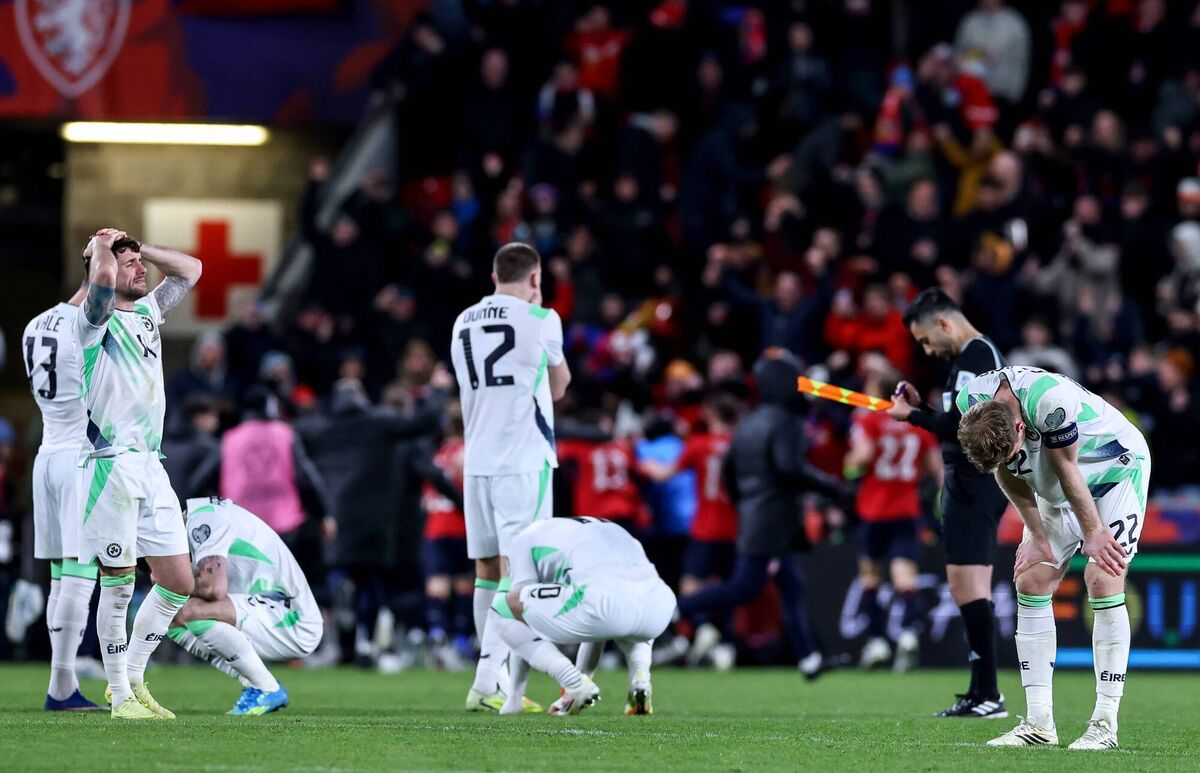
And that serenity had rubbed off and empowered his players.
Sadly, Hallgrimsson and his charges would have been better served if they had been familiar with the work and words and wisdom of another Scandinavian sport psychologist.
For over 20 years, Geir Jordet has specialised in the psychology of football and most particularly the science of penalty shootouts.
Last year he published a book on the subject, fittingly entitled ‘Pressure: Lessons from the psychology of the penalty shootout.’ In his book, and in various interviews he gave to promote it, he dismissed much of the myths that used to abound in conventional football circles, including those perpetuated by the likes of Treacy and Byrne.
“The pressure of taking a penalty in [or to qualify for] a major tournament is huge. Actively taking control with preparation, individualising pre-shot protocols, and systems for social support will never guarantee a positive result, but it WILL increase the probability of winning.
“Can you replicate the pressure of a penalty shootout? Well the answer is you can’t replicate it 100%. So those who say you can’t are right in that sense. But where they will be wrong is if they conclude that just because you can’t replicate it we shouldn’t train for it.
“If you can replicate some of it, if you can simulate a part of it, as multiple studies have shown, and you can train with mild anxiety, then you will prepare yourself more effectively for performing under high anxiety.
“So you don’t have to replicate it 100%. If you have a little bit of simulation training, then that’s enough for you to feel [mild anxiety], and that’s enough for you to train your protocols and routines, and that’s enough to give you a sense of what’s happening and will help you when you get there.”
England came to this realisation a decade ago, shaped by, as well as shaping, Jordet’s work. Informed by the Norwegian’s findings, a Chris Markham made contact with Gareth Southgate in advance of the 2018 World Cup and duly collaborated to inform a 12-step intervention.
First, narrative – change it from penalties being a lottery to something controllable.
Second, dosage – spend the right amount of time – not too much, but definitely not too little – on presenting data to staff and especially players.
Third, break the shootout into functional phases: the break after extra-time, the walk, the penalty spot and plan each phase.
Fourth, give players a process that helps them to have a sense of control.
Fifth, analyse each player’s strength, weaknesses and preferences.
Sixth, have a meeting about the group’s mindset towards penalties to illustrate and reinforce that it is preparing better than opponents for shootouts.
They went into further detail, most vital being to tailor training and simulate the situation, from how you’d walk to the centre circle and get the ball from your own goalkeeper, to how long you should wait until the referee’s whistle before stepping forward to take the penalty.
It was clear in the unfortunate but obvious case of Alan Browne that Ireland did not follow many of the above steps. Was Hallgrimsson even aware that he had missed in Bratislava? Or convinced that his process was now rigorous it could withstand the shadow and memory of that miss?
England as a football nation have subsequently enjoyed significantly more success in penalty shootouts than they did prior to Markham’s intervention.
In contrast, the football writer Mark McCadden has pointed out in recent days that Ireland have won only three of the 11 significant penalty shootouts they have been involved in across the various age-groups. In that time, we’ve conceded 48 penalties while converting only 38.
Unless you’re the Armagh footballers, it is understandable for teams in high-scoring sports like football and hurling not to dedicate much training time to penalty shootouts.
But in a low-scoring one like international football, it is mandatory.
There was at least a one-in-four chance that Prague would go to penalties, or that over the course of two playoff games, a 50% chance that we would be involved in at least one shootout.
How long, how long must we sing this song?
Time for a different one. Aimee instead of Bono. It’s not going to stop, ’til we wise up.