John Fallon: Average age of women’s team is 29 — but is there any appetite for change?
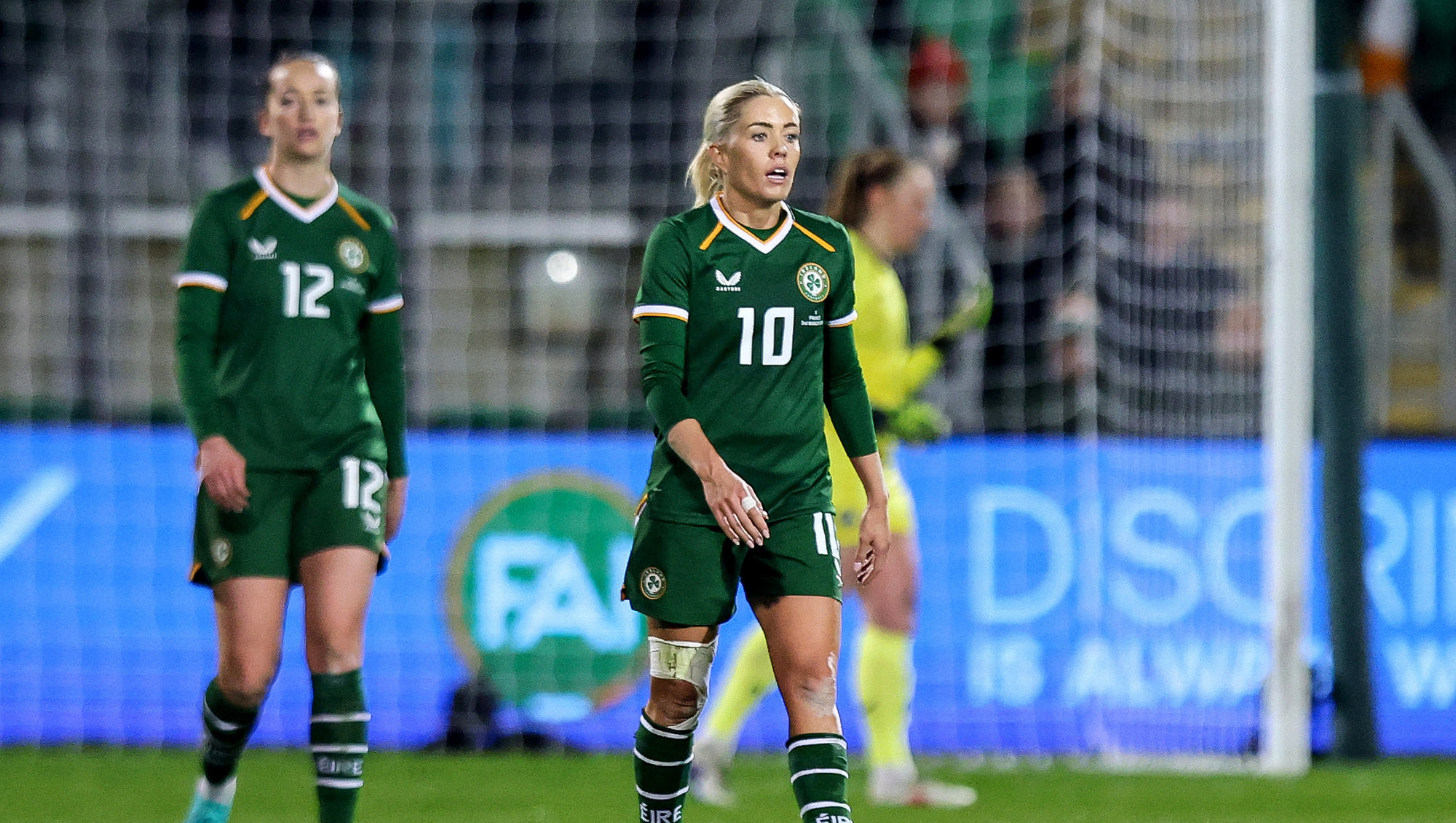
Ireland’s Denise O'Sullivan dejected after conceding against France. Pic: Ryan Byrne/Inpho

SEEING as the FAI are heralding a better future, you’d wonder if the fact that there are just three Irish-born players in the women’s national team is pause for thought. Ditto with the average age.
By the time the association’s latest strategy document matures in 2029, it will be the European Championships again, and likely a swansong for most of Carla Ward’s current team.
They spent last week competing against two of Europe’s established powerhouses, France and the Netherlands, losing 2-1 in both games. How negotiable their path to next year’s World Cup will be through the play-offs was always going to be determined by the results of the April double-header against Poland.
Four points now seem essential for Ireland next month to seal third in the table and a playoff semi-final against a League C opponent rather than B.
If the last team to reach the World Cup in 2023 were at their peak — including now-retired Niamh Fahey, Louise Quinn, and Diane Caldwell — the same can be said of the current bunch. Katie McCabe will be heading for 32 when the Brazil-hosted showpiece comes around in the summer of 2027. Denise O’Sullivan will be into her 33rd year.
Fellow 32-year-old Lucy Quinn, replacing the injured Cork woman for the Dutch test on Saturday, brought the number of starters beyond the 30 mark to seven. The average age was 29.
With 35-year-old Ruesha Littlejohn likely to feature against the Poles once she regains game-time at Crystal Palace, the trend is apparent. Ireland have an ageing team, and Ward has no appetite to change that.
It’s not her job to prioritise youth, but the clock is ticking. Since the World Cup in Australia, as few as five debuts have been handed out by Ward and her predecessor, Eileen Gleeson.
Anna Patten and Caitlin Hayes quickly developed into regulars, eventually followed by Emily Murphy. Australian-born striker Healy hasn’t been seen since a cameo in a friendly against USA, while third-choice goalkeeper Sophie Whitehouse has one cap to her name, also a friendly.
What all five have in common is that none came through the Irish system. The last domestic graduate was Erin McLaughin in 2023.
Ward hasn’t disguised her liking for the granny rule, recently admitting she expected more second- or third-generation recruits to have enlisted since she took the helm in early 2025.
There doesn’t seem to be any public clamour for a bright young thing to be capped. US-born Kelly Brady was the star of last season’s domestic league, but only got called up after moving to Crystal Palace. That she remains at club level behind Abbie Larkin, a super sub for Ireland, justifies her exclusion.
Brady should eventually benefit from exposure and force her way into the team, but the shortage of ready-made replacements is self-evident.
It’s almost two years since the U19s qualified for the Euros, but none of that generation were in the mix for involvement in the senior’s opening qualifiers.
A roadblock in the UK system, where the English Women’s Super League continues to attract the best and most expensive talent in the world, is a factor, but so too are internal considerations.
The failure to develop a professional home-based league since its inception in 2011 conspires against the standard being considered worthy of international elevation.
Moreover, the absence of a development squad to bridge that gap between U19 and senior is unquestionably in the FAI’s charge.
Scotland, for instance, commenced their U23 squad in 2008. All they were doing was keeping pace with the likes of Sweden, Spain, France, England, and the Netherlands. That creates twin pluses of players feeling relevant and the windows being utilised by staff to assess the capacity of gems first-hand.
For all their talk of embracing this necessity, it now transpires that the FAI are awaiting Uefa to initiate a platform for the lost generation.
“Look, it is in the strategy, even if it may not jump out at you,” chief executive David Courell said. “It’s in there in the formal words of ‘we commit to aligning to Uefa best practice in the women’s pathway’. They have made it clear in their women’s strategy that they will be introducing a new tier of competition for women’s international set-up.
“My understanding is that it is likely to be at U21 level as opposed to what we’ve seen in other countries that are U23. So we are making a commitment that we will be one of the first federations to sign up to that once it comes to light. So we’re just waiting for Uefa to kind of signpost when that will be.”
As always with the FAI, money talks. “It’s an element of, firstly, wanting to do it right,” Courell continued. “In the sense of if there’s going to be a change in that focus from U23 to U21, then we’d like to get in on the ground floor, if that makes sense.
“That’s as opposed to working towards something for six, nine, 12, 18 months, and then pivoting.
“And then obviously, we need to weigh up all the different investment needs across the women’s game, but also the breadth of the
association. So that’s a variable.”
So there. Variables rule while grim guarantees come sharply into focus.
E: john.fallon@examiner.ie
IT could be easy to forget that the FAI is subject to a discrimination claim that could act as precedent for the global women’s game.
Former Ireland women’s boss Gleeson is taking legal action against the FAI claiming she and her team were treated unfairly by the association because of their gender.
That is certainly groundbreaking but what makes the case bizarre is that Gleeson continues to work for the association.
Ten months of idleness followed her dismissal as manager in December until she was announced into a newly created post as head of football strategic insights and planning.
Damming claims about the FAI’s treatment of the women’s teams, its players and staff were contained within Gleeson’s testimony in her case under Employment Equality Acts 1998 to 2015.
It prompted her employers to refute the details and vow to “preparing a very robust defence, to be be submitted in the coming weeks.” This promise, made by chief executive David Courell, was made last September.
Six months later and nothing of the sort has occurred.
“No - we still have not,” he said yesterday in response to a query from the
“These things take time. I don’t even know the legal language for it but there is a bit of back and forth between both sides. To be clear, we have not formally lodged any defence.
“Eileen is continuing to work away within the organisation and she's building out her scope within that research and insights piece.”
Another lingering case is about who knew what and when internally before the Girls in Green documentary, exposing historical abuse of women’s footballers, was aired in 2024. That’s not gone away.
Ireland – as with the other three nations in their playoff pathway D – have been ordered by Fifa to prepare for the World Cup and a training base has been assigned.
Should the Irish overcome Czechia on Thursday fortnight and then either Denmark or North Macedonia five days later, Mansfield in Texas will be where they operate from around the three groups games.
Mansfield Stadium was only last week designated as an approved stadium by Fifa. The €75m arena is still under construction but organisers insist it will be ready for the team’s arrival.
That’s likely to be on Sunday, June 7, the day after they provide friendly opposition to co-hosts Canada in Vancouver.
Ireland’s first game at the tournament, were they to end a 24-year wait, will be against South Korea in Zapopan, Guadalajara. South Africa comes second in Atlanta on June 18 before co-hosts Mexico at Estadio Azteca, Mexico City six days later.
Fort Worth-Dallas is the central region for the base, with their luxurious five-star Sheraton Hotel digs located a 20 minute coach drive from the grass pitch.