Christy O'Connor: Mayo’s orange crush a reward for shift in focus
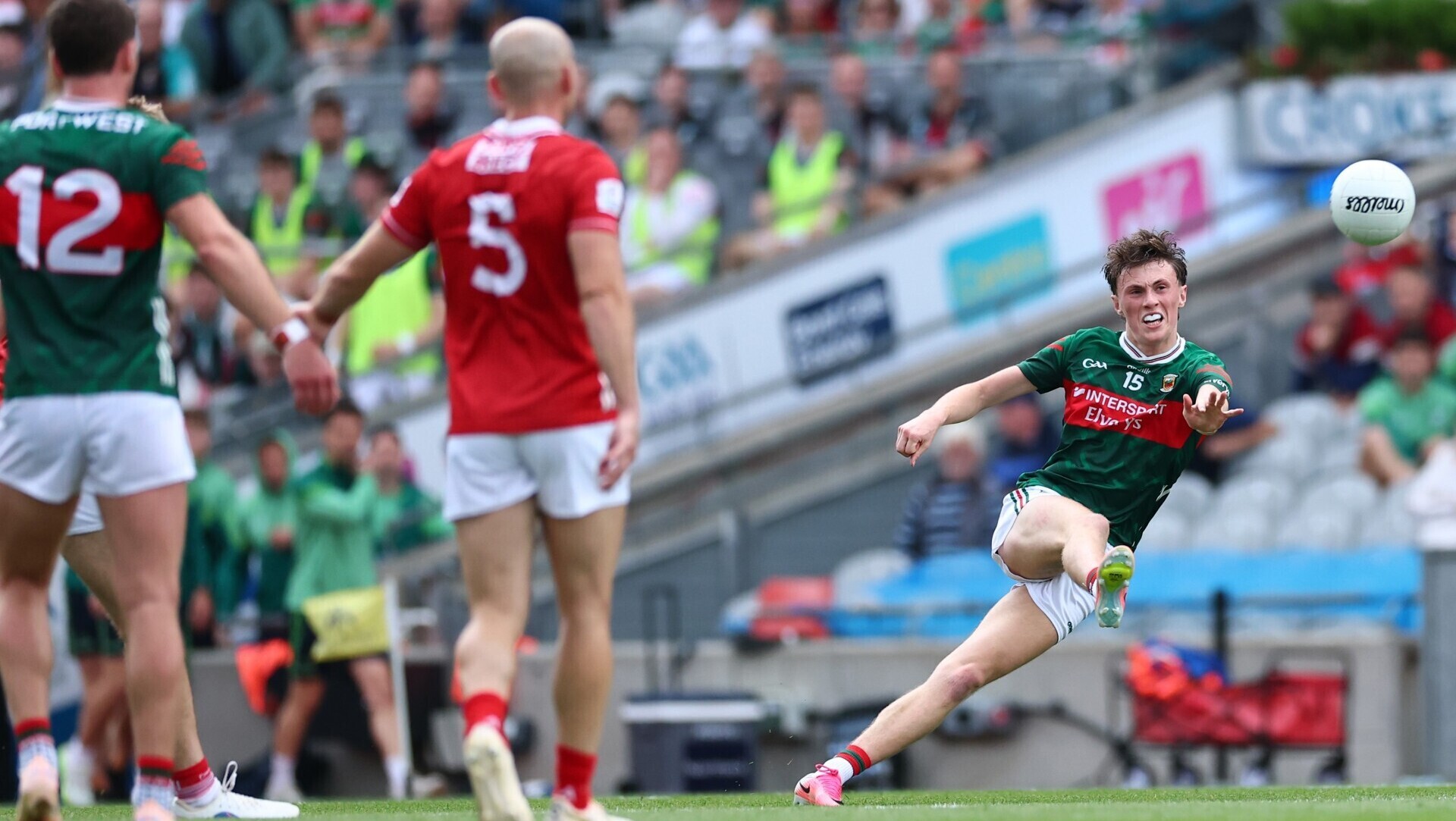
Mayo’s Kobe McDonald kicks a two-pointer against Cork. Pic: ©INPHO/James Crombie

Big margins. Huge gains. In last year’s entire championship, Mayo only scored three two-pointers. As Monaghan forwards coach during the same period, Andy Moran was instrumental in the Ulster side being the highest two-point scoring team in the country in 2025.
Monaghan had the weapons that Mayo didn’t possess, but Moran upgraded that arsenal over the winter when recalling Robbie Hennelly, Cillian O’Connor, Michael Plunkett and James Carr.
All four are good long-range kickers, but Moran had plans for other players to step up as long range shooters. “It’s for us to make sure that the right level of confidence is there to take them on,” said Moran back in January.
It was obvious from the outset of the season that the environment was being created. Jack Carney didn’t even attempt a two-pointer in 2025 but his brilliant orange on Saturday pushed Mayo five points ahead of Cork at a critical stage of the second half. It was Mayo’s fifth two-pointer of the match. It was Carney’s sixth orange flag of the championship.
Read More
Nobody has personified Mayo’s willingness to shoot now from distance more than Carney. Extremely cautious around shooting under the previous management, Carney missed a two-point attempt before he scored on Saturday. He was off-cue with two long-range shots against Meath before raising an orange flag.
Mayo have taken plenty of flak for numerous aspects of their play this season but the way in which their long-range shooting game has improved is testament to the coaching under Moran and his management. Especially in how the arsenal has increased.
Hennelly was dropped after the Roscommon game, while O’Connor and Carr picked up injuries and Plunkett has been in and out of the squad. But Mayo have compensated for that perceived deficit in long-range shooters by engineering more weapons.
During the league, Mayo had the joint-highest total of two-pointers in Division 1 with 25, despite playing one less game than Kerry. Yet David Clifford raised nine of those 25 orange flags while Mayo had a far greater spread of long-range shooters across their team during the spring, with 11 in total.
Saturday took Mayo’s championship total of orange flags to 25. Across league and championship, 13 different players have raised at least one; Carney, Hennelly, Plunkett, O’Connor, Ryan O’Donoghue, Cian McHale, David McBrien, Conor Loftus, Kobe McDonald, Paul Towey, Darragh Beirne, Jordan Flynn, Fergal Boland.
Since the end of January, Mayo have now raised 50 orange flags. Huge margins. Massive gains.
After Kerry went ahead by 1-14 to 0-13 in the 45th minute on Saturday, the Kerry crowd finally began to feel comfortable about themselves as chants of ‘Kerry, Kerry, Kerry’ began to ring around Croke Park. At last, Jack O’Connor’s side appeared set to stride away from Tyrone.
And then Mattie Donnelly kicked a point off the resultant kickout. And then the decibel levels rose another few levels when Darren McCurry was introduced as a substitute. The message was loud and clear – Tyrone were going nowhere.
Bang. Bang. David Clifford landed a two-pointer. McCurry matched that off the kickout with an orange flag. That pattern had been set in the first half where magic was consistently matched by even more magic. After Clifford’s sensational first-half goal, Ethan Jordan responded with a superb two-pointer. When Dylan Geaney landed a brilliant point shortly afterwards, Kieran McGeary responded with another two-pointer.
The big problem for Tyrone though, remained Kerry’s kickout. Overall, O’Connor’s side won 26 of their 31 restarts. They are extremely creative on mid-range and long-range kickouts, securing 11 of Shane Murphy’s restarts that travelled beyond their own 65-metre line. In total, Kerry scored a sensational 2-20 off their own restart.
The only way Tyrone could have survived, and prospered, under those conditions was to be ultra-efficient with whatever possession they did have, especially on their own kickout. They had come under pressure on Niall Morgan’s restarts in the first half but Tyrone had also kicked seven wides and dropped one short in that period.
After the break though, Tyrone were outstanding with how they managed their possession; from 18 attacks, they got off 17 shots and scored 0-15. Of that total in that half, Tyrone sourced 0-9 from their own restart, and 0-2 off Murphy’s kickouts. In that second 35 minutes, Tyrone only turned over the ball once.
The problem for Tyrone was that Kerry matched that efficiency throughout the second half. They only turned over the ball twice. Kerry had 28 attacks in the second half but they came back outside the 45 metre-line on ten occasions before going back in to penetrate even more. And of those 18 Kerry attacks, Kerry got off 15 shots, scoring 1-14, with 1-12 sourced from Murphy’s restarts.
Bang. Bang. Yet when it becomes a shootout, Kerry are always the last team standing.
For those of a certain vintage, it was the line of the weekend. After John Ross O’Reilly landed the winning score for Limerick in Saturday’s All-Ireland minor final, Naoise Waldron surely borrowed, and engineered, a remark that echoed the old prime time US soap Opera ‘Dallas’. “Shoot JR,” said Waldron. “Shoot.”
It may be hard to believe now but trying to discover who actually shot JR Ewing was once almost the most discussed topic across the world where that soap opera was aired. JR was the show’s main character but Waldron surely had JR’s son – John Ross – in mind when connecting a memory from ‘Dallas’ to John Ross O’Reilly’s epic score in the Gaelic Grounds.
Limerick’s win secured their first All-Ireland minor title since 1984 but the victory was also another massive statement for Munster hurling. All five of the counties that compete in the Munster minor championship have now won an All-Ireland in the last six years.
That achievement is only really appreciated by contextualising it with historical data; there was only one previous time when all five Munster counties won an All-Ireland minor title across a set period – and that extended across three decades, ranging from 1984-2013.
In that time, Clare won a first ever All-Ireland minor title (1997) while Waterford ended a 65-wait without a title in 2013. Limerick may have dominated the senior landscape across the last decade but the terrain looks even more fertile than ever now that their minors have ended a 42-year hiatus.
Saturday was another example of how Munster’s raging blue tide is threatening to swamp the rest of the hurling landscape. After last year’s Clare-Waterford final, Saturday was the second all-Munster final in succession. In the last two seasons, three of the four All-Ireland semi-finalists were Munster teams.
Similar to Munster now, Leinster did win six All-Ireland minor titles in succession between 1986-91. But all of those titles were won by Offaly and Kilkenny, while Munster hurling wasn’t as far behind the eastern province as Leinster lies behind its southern counterpart now; Munster counties won four senior and three U21 All-Irelands during that same six-year period between 1986-’91.
With Munster teams having won the last eight senior All-Irelands, and with sides from the southern province having won 13 of the last 15 All-Ireland U20/21 titles, Saturday was another example (worrying, in a wider context) of how hurling’s landscape is being engulfed by a raging blue Munster tide.