Éamonn Fitzmaurice: Has the red card become too penal in football's new age?
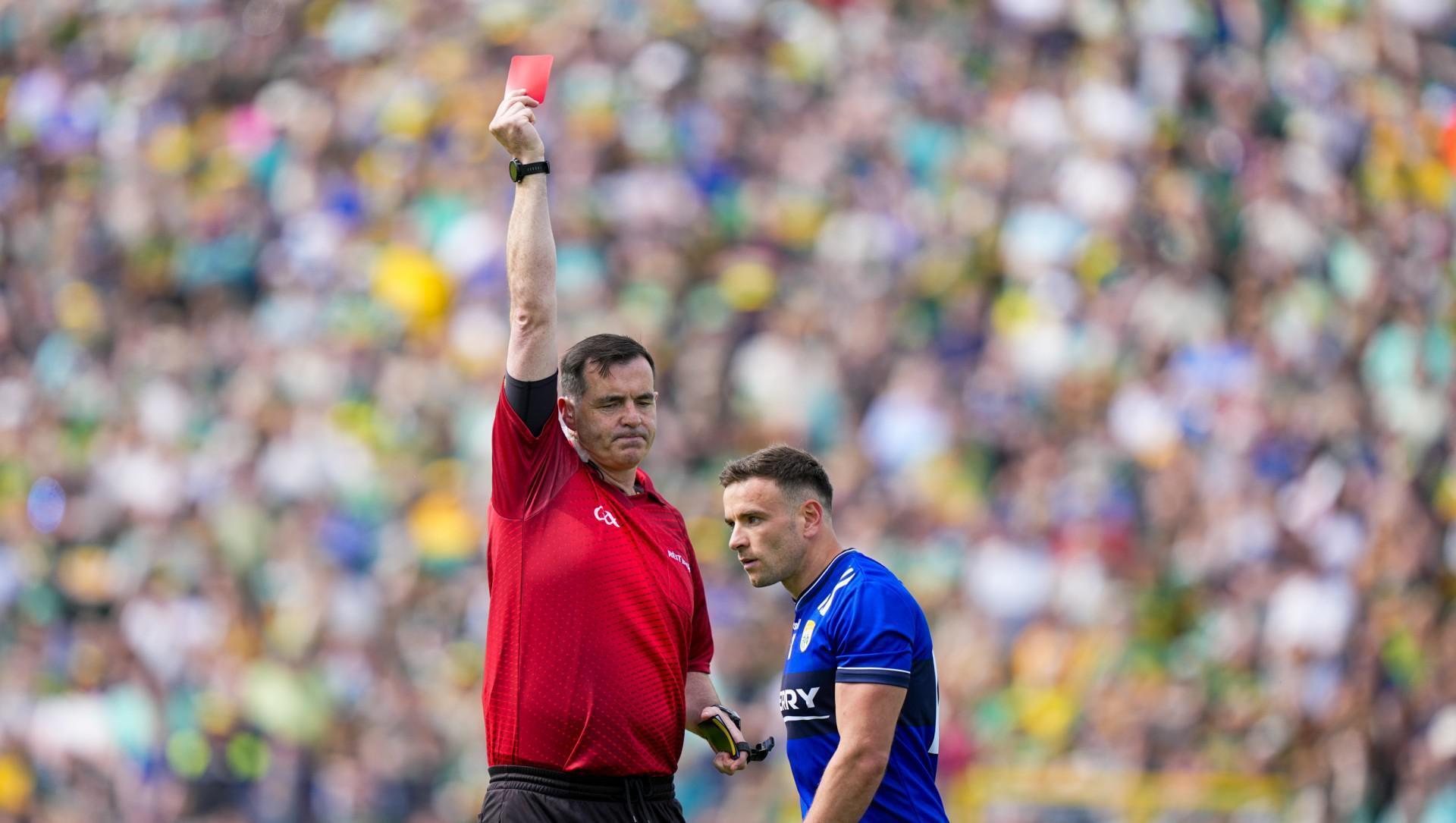
SEEING RED: Micheál Burns is shown a red card by referee Seán Hurson in Kerry’s All-Ireland SFC defeat to Donegal last month. Pic: ©INPHO/James Lawlor.
Eight of the dozen big championship matches this weekend, between Sam Maguire and Tailteann Cup, are do-or-die. That brings that fabulous edge unique to knockout football.
While there is a sense that it is still early in proceedings, it is hard to have any sympathy for the teams eliminated this weekend who will be losing a third game in a row. The exceptions are provincial champions, Kerry and Roscommon, who if beaten will fall to their second consecutive defeat.
The public imagination has captured by the quality of the football, the new championship format and the fact that there is a healthy group of contenders jostling for positions. This is reflected in the fact that four of the weekend's championship outings are sold out. Fasten your seatbelts and enjoy the action as in three short weekends we will be down to the last four.
In most instances Saturday and Sunday, the favourites should prevail but as we have learned throughout this season there will a twist or three across the weekend. Identifying where exactly that will happen is no easy task but here are a few talking points that should be relevant.
Read More
Westmeath have been the feel good story of the championship so far. Their brand of football coupled with the unexpected (at least externally) success has been superb to witness. The entire county is surfing the waves of enthusiasm created by their exciting team. Central to all of that is Mark McHugh. His positive energy is clear on the sideline, and in the way he speaks before and after matches. There is a refreshing air of a good madness about him. A disciple of Jim McGuinness, he borrowed from his playbook by running the daylights out of his players in Castlepollard Woods on the Cavan border last winter to bring their fitness levels to an elite level, but equally to build their mental reserves to provide them with the fortitude for when the going gets tough.
Three consecutive injury time victories later, the value of that can be seen in terms of both their fitness and resilience reserves. Those reservoirs will be well tested in Salthill Saturday evening. However, he has also proven himself to be extremely shrewd tactically. They can go quick and slow. They have a huge spread of scorers, usually in double digits in every game. They are good on their own kickout. They have an organised unpredictability about them, facilitated by hybrid players that can contribute at both ends of the pitch.
McHugh is getting the best out of nearly all of his players, the true measure of a manager doing a good job. To underline McHugh’s tactical acumen, watch out for the excellent Matthew Whittaker’s positioning for the throw-in at the start of matches. It is a lovely innovation that I haven’t seen any other team do. He positions himself as a second centre back in the middle of the defence leaving the wing-forward he's marking free. He is ready to drive forward straight away should Westmeath win the throw-in. Get it right and they at least will get a shot at the posts and possibly more. What about if they lose it? Isn’t his man wide open? Cleverly the player, usually Brian Cooney or Tadhg Baker situated on the sideline as the second midfielder always makes for Whittaker’s man, as a safety measure in that scenario. It is a clever set-play designed to lead to a goal.
Donegal brilliantly picked Kerry apart in Killarney with their numerical advantage in the second half three weeks ago. This was particularly evident in attack, when they set up slow attacks to pull the home defence apart and open up facile scoring opportunities. It was death by a thousand cuts and excellently played by the Ulster men. It is something I have written about previously here and would have been critical of teams not maximising their advantage previously.
However, it begs the question has the red card become too penal? Initially when the new rules were proposed a team reduced to 14 men were permitted to adjust the numbers required to be kept up and back. For example, in that aforementioned game Kerry could have kept two rather than three forwards up when defending, thus making it an 11 v 11 when Donegal were attacking.
Similarly when Kerry were attacking they could have kept three, rather than four back and again attacked with 11. It was felt at the time that the team with the extra man wasn’t gaining a sufficient advantage. This was especially evident in a league match between Kerry and Tyrone in Pomeroy, that I attended in February 2025. Both Joe O’Connor and David Clifford were black carded for a period in the second half. Kerry continued to attack and defend with 11. At one stage as Tyrone attacked they had to keep three backs in place, as required by the rule, but they were left marking one Kerry forward. The home side were chasing the game and it made for a farcical scene. Subsequently the rule was adjusted to its current iteration.
A further option the FRC discussed at the time was to allow the team reduced to 14 men to decide which end of the pitch they would like to be disadvantaged at. Again, revisiting the Battle of Killarney to illustrate this, once Micheál Burns got his marching orders Kerry could have decided to reduce the number they attacked with it, as in they would keep two rather than three up at all times, but would have to maintain the four back. Thus, they could defend with the normal 11 but could only attack with 10.
It was felt at the time that it might be too confusing, especially at club level. But now that the rules have bedded in, it might be worth exploring again. Yes, a red card has to be penal, but not to the point of discommoding a team from competing, and effectively deciding a contest.
One of the (admittedly few) disappointments I have with the new rules is that teams still are not accepting the invitation (rather than a compulsion) to kick as much as I would have anticipated. Kick passing was marginally up in this year's league but hand passing also increased, meaning the hand pass to kick pass ratio has crept slightly again. I’m optimistic by nature and I still expect to see more kicking as its value is appreciated again. While some teams prefer to go through the hands almost exclusively there are plenty of opportunities in the new game to kick, as recently illustrated.
An obvious and effective one is to move from a turnover in defence to attack as quickly as possible, by foot. I have always felt that by kicking from the full back line it sets the chain reaction in motion that leads to majors. Consecutive kicks increases that probability. The receiver’s movement and positioning is as important as the kicker in this context. Developing that understanding, timing and chemistry can be the most difficult part of the jigsaw to solve. The most enjoyable example so far this summer has been the Bobby McCaul goal against Mayo last day out.
Rory Beggan’s arrowed 60 metre pass, followed by Stephen Mooney’s floated delivery and McCaul's catch and finish was breathtaking, in accuracy, quality and simplicity. Kobe McDonald also got an excellent point from a similar pattern in the first half of the same match. Jack Livingstone made one of his many fine saves and Mayo looked to counter immediately. Sam Callinan kicked to Ryan O’Donoghue wide on the halfway line, who immediately turned and kicked inside to Darragh Beirne. He got his head up to add another popped kick inside to Kobe who had made a great run from the opposite side to receive and score. With Damian Comer coming back towards full fitness, Galway will use him in these type of direct situations as well. Paul Conroy in particular has a telepathic understanding with him and actively seeks him out.
A different situation that offers the opportunity to go fast is to win a kickout and go vertical. Jack Carney did exactly this in that game in Clones where he fielded a Jack Livingstone restart, immediately turned and looked to kick inside to Ryan O’Donoghue. It eventually finished with another Kobe point. Similarly, in Croke Park having received a Niall McDonnell kickout, Daire Nally kicked over the midfield maelstrom to release James Maguire who got in on the Dublin goal and finished. Accurate kicking on fast attacks leads to goals.
Additionally, teams can make major gains by kicking more in the established 11 v 11 attacks, and bit by bit we are seeing more of this. When Galway played Kildare in the last round they showed they are willing to switch play from one side to the other quickly with accurate kicks to set up space at the opposite side. Shane Walsh kicked a nice two pointer on the back of this type of setup in the second half. Westmeath are also good at this where they like to switch from the left side of their attack, which they load up, to the other side to get a shot off.
In the first half of the Kerry Donegal match in Killarney, Kerry kicked well in the final third against the Donegal set defence. Donegal can leave the corners free as the opposition attack, to defend centrally. For one of Dylan Geaney’s points he stayed wide in the corner. Diarmuid O’Connor found him with an accurate 30 metre kick pass, allowing Dylan dance inside before the Donegal defence could shift numbers to him. Similarly, Seán O’Brien was an excellent target for kicked balls centrally inside. He set up Tadhg Morley for his goal chance that ended in a point and also had a wide himself.
Rather than using those inside men as mere decoys in set attacks they can become realistic target for kicks, and move from a plant to a threat, thus altering the defending teams approach. Kick from outside the 45 metre line and they will can gain an offensive mark, worst case scenario. There is a variety of ways for teams to exploit the opposition with positive kicking. A willingness to play with courage, adventure and the prerequisite accuracy will reward.
Hopefully we will see more of it in the coming weeks - starting this weekend.