Irish Examiner view: Urgent need to fix flaws in endometriosis scheme
The stark testimony shared by those demonstrating in Dublin this week has brought home the human cost of not addressing this problem adequately
Irish Examiner view: Urgent need to fix flaws in endometriosis scheme

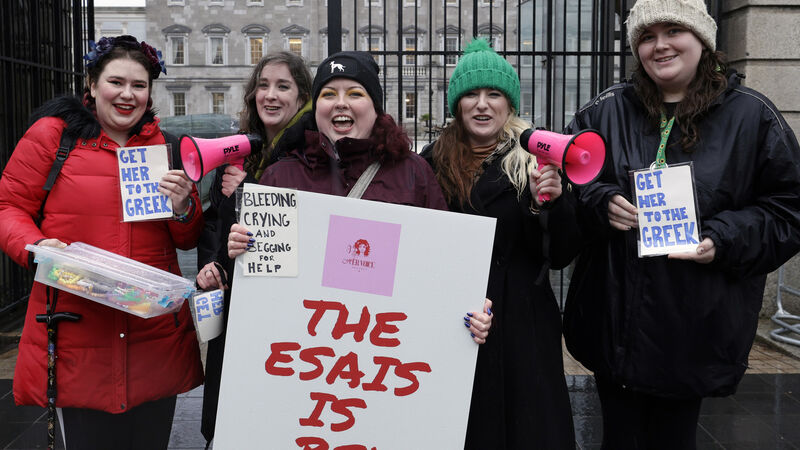
Her Voice Project hold protest at Dáil looking for better endometriosis healthcare. Picture: Conor Ó Mearáin / Collins

Women demonstrated outside Leinster House this week to draw attention to the ongoing challenges they face securing treatment for endometriosis treatment, a long-running — and long-neglected — issue.

The history of women’s healthcare in this country is not an edifying one, to put it mildly, and this latest chapter shows appalling gaps in care which should be addressed as a matter of urgency, or which should not have arisen in the first place.

For instance, a new scheme was launched in Ireland last October which offered upfront payments for endometriosis surgery abroad, which could be seen as a step forward.

However, because some foreign clinics are not on the approved list, Irish women’s options were immediately limited. A Greek clinic used by Irish women, for instance, is not on the list, therefore Irish patients attending must pay for the cost and be reimbursed later.

Other complications arise if an Irish patient does not have a consultant to sign off on her treatment, as GP referrals are not accepted under the new scheme.

The obvious question to ask is why the Irish health system does not have the required expertise to help women suffering from endometriosis, and to be fair, steps are being taken to address this.

The health minister pointed out this week that a new colorectal surgeon has been hired for Cork University Maternity Hospital, while Irish doctors are also attending specialised training courses across Europe to improve their skills in this area.

However, the stark testimony shared by those demonstrating in Dublin this week brought home the human cost of not addressing this problem adequately.

One of the women at the demonstration at Leinster House, organised by the Her Voice Project advocacy group, said she was sharing her story so that others would not have to undergo a hysterectomy at the age of 33 because no one had listened to them.

There are many worthy causes which have a claim on the attention of the Government, but the flaws in this treatment scheme should be addressed as a matter of urgency.

Staggering lack of oversight in St James's Hospital

Another scandal emerged in the health service this week when news broke of troubling payments in the biggest hospital in the country.

St James’s Hospital in Dublin has already apologised for paying out almost €1.4m for a variety of services to a radiology company which is not only based on its own campus but features 18 directors who are already members of the hospital’s staff. The Public Accounts Committee was told that there had been no public tender process for the services.

For anyone with even half an eye on the news the staggering lack of oversight involved here will hardly come as a surprise.

It is no shock either to learn that some of those involved in this private company somehow omitted to make declarations of interest, even though that does not make this situation any less distasteful. How highly qualified medical professionals somehow did not see fit to share this information with the hospital is extraordinary.

As a comparison, readers can consider the current focus on another example of State spending, one which coincided almost exactly with the revelations about the St James’s Hospital spending.

This week, the Oireachtas committee on education and youth discussed the hot school meal programme. This initiative has been available to all primary schools since September of last year, with around 3,700 schools and organisations eligible to access the scheme.

The children’s charity Barnardos told the committee bluntly that not all of the 35,000-plus children it supports would receive a hot meal without the programme, and asked that it be extended to secondary schools as well.

Interestingly, one issue some school principals have with the scheme is the procurement process, which is so stringent that it takes up a significant amount of time each week in the absence of specific staffing, expertise, and resources.

Readers need only compare the lack of oversight of a private company’s lucrative relationship with St James’s Hospital with the more rigorous governance requirements of a
programme aimed at helping the most vulnerable.

If that company donated its profits to the hot school meal programme, it would be a welcome gesture.

Oscars could go green this year

It was a good day for the Irish when this year’s Oscar nominations were announced yesterday.

As expected, Jessie Buckley was nominated in the best actress category for Hamnet. The competition this year is keen but Killarney native Buckley will be seen as the favourite given her victory at the recent Golden Globes.

Paul Mescal, her Hamnet co-star, was not nominated, but two-time visual effects Oscar winner Richard Baneham from Dublin is up for a third award for his work on Avatar: Fire and Ash.

John Kelly’s The Retirement Plan is nominated in the best animated short film category, while Irish production company Element Pictures received four nominations for Bugonia, its latest collaboration with filmmaker Yorgos Lanthimos.

Element Pictures previously enjoyed Oscar success with Lanthimos’s Poor Things and The Favourite.

The vampire hit Sinners was nominated for best original score, which also features a strong Irish presence. The stirring performance of Rocky Road to Dublin in the film was arranged by Baile Mhúirne native Iarla Ó Lionáird, who also contributed the sean-nós vocals to the film’s opening sequence.

Will we see a Cork-Kerry double at the Oscar ceremony to be held a little over 24 hours before St Patrick’s Day?

More in this section